


Hybrid Inverter Factory | Manufacturer, Production & Quality Guide

Hybrid Inverter Factory: How Quality Manufacturing Shapes Solar Energy Systems
- The selection of the appropriate inverter manufacturer may have a long-term impact on the performance, reliability, and flexibility of a solar project. A modern hybrid inverter factory does much more than assemble electrical components. It integrates product engineering, power electronics, battery integration, software, testing, and quality control to develop equipment capable of controlling solar generation and energy storage.
- With the increasing demand for renewable energy equipment, the buyers are starting to pay more attention to the product label. They would like to know how an inverter is constructed, how it is tested, and whether the manufacturer can support various residential and commercial applications.
What Does a Hybrid Inverter Factory Do?
A hybrid inverter factory plans and builds power conversion devices capable of interconnecting solar panels, batteries, electrical loads, and, in some models, the utility grid. A common hybrid solar inverter can have multiple functions in a single unit:
• Transform DC solar energy to AC power.
• Control photovoltaic input using MPPT.
• Charge connected batteries
• Release stored energy where needed.
• Liaise with grid electricity.
• Backup loads in compatible systems.
• Monitor operating conditions
• Protect connected equipment
This renders a hybrid inverter more adaptable than a simple photovoltaic inverter that is only intended to be connected to the grid and used to generate solar power. An efficient hybrid inverter manufacturer thus requires skills in both battery energy management and solar power conversion.
Hybrid Inverter Production Process
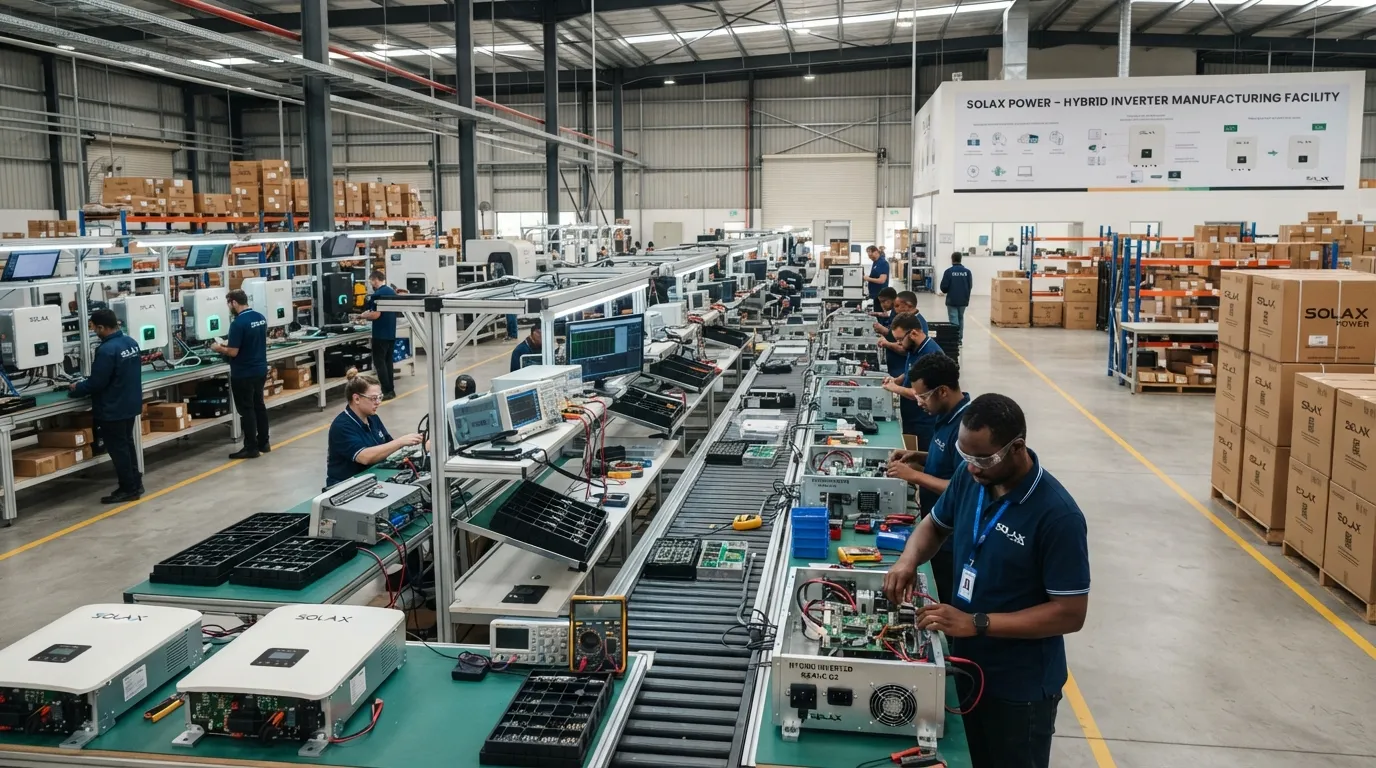
Several steps are involved in the production of the hybrid inverter. The stages may influence the performance and service life of the final product. It usually involves:
1. Circuit design and product engineering.
2. Sourcing and inspection of components.
3. PCB assembly
4. Power module installation
5. Inverter assembly
6. Software and firmware setup.
7. Electrical safety testing
8. Performance testing
9. Load and thermal testing.
10. Last inspection and packaging.
Each stage should have specific procedures to be followed in a professional inverter assembly factory, not just checking the final product. This method assists in detecting manufacturing issues earlier when they can be corrected easily.
JSD Solar Strategy of Solar Inverter
- According to JSD Solar, it was founded in 2005, and it is based in Shenzhen, China. According to the company, it is engaged in the design, development, production, and sale of solar inverters and lithium batteries. Its website records yearly inverter production of 150,000 units, items utilized in over 150 nations and areas, and 15 percent of yearly sales invested in research and development.
- The company also defines itself as a solar power system provider that serves residential, industrial, and commercial purposes. Its product line consists of solar inverters, lithium batteries, residential solar systems, portable power stations, and commercial solar solutions. This wider product ecosystem may apply to projects that may need more than a single inverter.
Importance of MPPT in Hybrid Inverters
Maximum power point tracking, also known as MPPT, is one of the most significant technical characteristics of a modern hybrid inverter. The amount of voltage and current generated by solar panels varies with sunlight, temperature, and operating conditions. An MPPT solar inverter is a device that continuously changes the electrical operating point of the PV array in order to extract the available power. Buyers need to look at the specifications when comparing models:
• Maximum DC input power
• Maximum PV voltage
• MPPT voltage range
• Maximum DC input current
• Number of MPPT trackers
• Battery voltage range
• Maximum charging current
• Maximum discharge current
These numbers will dictate the compatibility of a specific inverter with the intended solar array and battery system.
JSD Solar Hybrid Inverter Technology
The JSD Solar website features a 10kW hybrid solar inverter with split-phase output as one of its inverter models. The company explains that its smart inverter products are developed to meet residential and commercial solar system installations, and that the conversion is high-efficiency and that there are alternatives that fit various environmental conditions.
- The company also features a wider variety of inverter products, such as 3kW and 12kW split-phase inverters, and a 30kW/40kW/50kW three-phase hybrid inverter to support larger commercial solar energy systems.
- This range enables system designers to take into account the various inverter power classes instead of trying to make all applications fit in a single standard configuration.
Thermal Control and Inverter Stability
- One of the significant factors in power electronics is heat. When electricity is processed by an inverter, a part of it is heat. Increased loads may cause thermal stress, particularly in hot climates.
- A proper thermal design is thus required in a good inverter manufacturing facility. This can include heat sinks, cooling fans, thermal sensors, enclosure design, and software-controlled protection, depending on the product.
- The environment in which they operate is also important. Poor ventilation, dust, humidity, and high ambient temperatures can influence equipment performance.
This is the reason why the enclosure protection and installation requirements must be taken into account with the electrical specifications.
OEM and ODM Production of Solar Companies
Not all customers desire an average off-the-shelf inverter. Solar distributors and system companies might require tailor-made products, branding, communication protocols, or special electrical configurations. It is here that an inverter OEM factory or inverter ODM factory can add value. OEM and ODM arrangements may be used to support such requirements as:
• Private-label branding
• Customized product appearance
• Specific power ratings
• Communication requirements
• Battery compatibility
• Regional electrical configurations
• Software adjustments
• Packaging customization
Buyers need to consider production capacity, engineering resources, quality systems, certifications, testing capabilities, and after-sales support before choosing an OEM partner.
Conclusion
Many contemporary solar and storage systems rely on a reliable inverter. Beyond that inverter is another vital manufacturing process that incorporates engineering, component selection, assembly, testing, and quality management.
JSD Solar, a hybrid inverter factory, integrates solar inverter and lithium battery production with residential, commercial, and industrial energy solutions. The company also encourages distributor and installer alliances via our site.
Share on Social:


