


Solar System Manufacturer | Complete Solar Energy Solutions

How to Choose the Right Partner for Complete Solar Solutions
When you need more than a couple of photovoltaic panels, the choice of a manufacturer of solar systems is a significant matter. A complete solar system can consist of PV modules, inverters, batteries, charge controllers, mounting systems, cables, monitoring systems, and protection devices. When these components are designed to be compatible, the entire system becomes simpler to plan, install, monitor, and expand.
- To the homeowner, installer, distributor, and business, the correct manufacturer must provide more than just competitive prices. Experience in manufacturing, product testing, engineering assistance, system compatibility, and production capacity are all important.
- JSD Solar positions itself as a provider of a complete solution in solar energy, including residential solar, solar inverters, lithium batteries, portable power stations, and commercial solar solutions.
What Does a Solar System Manufacturer Offer?
A contemporary manufacturer of solar power systems can provide single parts or a full package of renewable energy. The precise portfolio differs by companies, and thus it is convenient to ensure that the manufacturer is capable of supporting the entire project and not just a single aspect of it. A more diversified product range can be:
• Monocrystalline solar panels
• Solar inverters
• Hybrid solar inverters
• Grid-tied inverters
• Off-grid solar inverters
• Lithium solar batteries
• LiFePO4 battery storage
• Solar charge controllers
• Solar mounting systems
• PV cables and electrical equipment.
• Solar monitoring systems
The products that JSD Solar offers on its site include residential solar solutions, solar inverters, lithium batteries, portable power stations, and commercial solar. This combined solution could prove helpful since the solar system components must be electrically and operationally compatible.
Importance of Manufacturing Quality in Solar Projects
Solar equipment is used outdoors over years. Panels are exposed to sunlight, heat, rain, humidity, dust, and varying temperatures. During normal operation, inverters and batteries are also subject to electrical and thermal loads. The manufacture of solar equipment and quality control are considerations. The stages of a professional solar system manufacturing operation are usually:
1. Design and engineering of products.
2. Inspection and sourcing of components.
3. Electronic assembly or solar panel assembly.
4. Electrical and functional testing.
5. Quality inspection
6. Performance verification
7. Packaging and shipment
In the case of photovoltaic modules, the solar panel assembly process can include interconnection of cells, lamination, framing, junction-box assembly, and electrical testing. The production of inverters involves another process that entails the use of electronic parts, power circuits, firmware, cooling, enclosure assembly and safety testing.
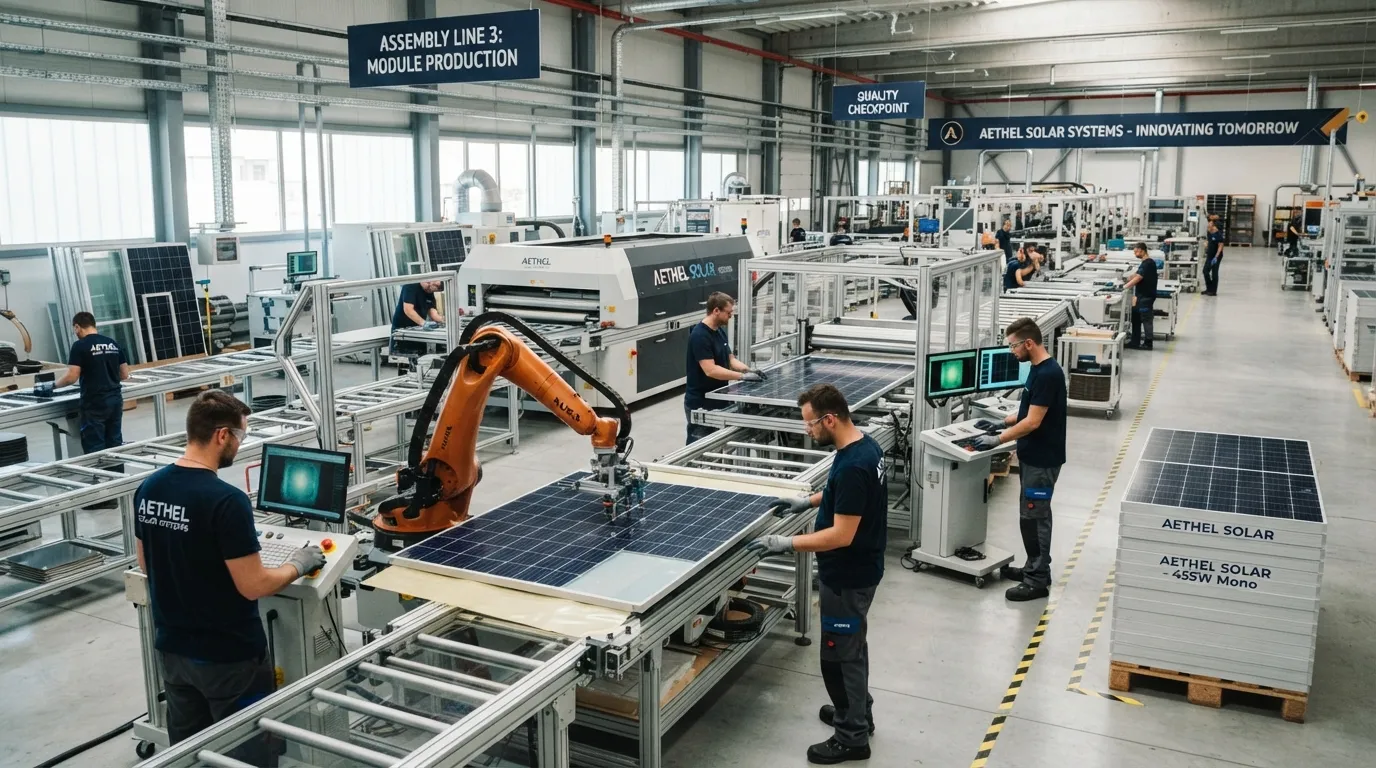
Interior of a Modern Solar Production Facility
An efficient solar manufacturing plant must possess well-structured production and appropriate testing measures. Capacity to produce is also significant when a buyer requires hundreds or thousands of systems as opposed to one residential package. A bigger solar production plant can incorporate special spaces to:
• Solar module production
• Solar panel assembly
• Solar module assembly
• Inverter assembly
• Battery pack assembly
• Electrical testing
• Aging and reliability tests of products.
• Final quality control
• Packaging and logistics
JSD Solar claims that its inverter output is 150,000 units annually and that its products have been used in over 150 countries and regions. It further asserts that 15 percent of its sales are used in research and innovation in technology. These numbers aid in explaining the magnitude of the manufacturing and product-development activities reported by the company.
Real 10kW Hybrid System: JSD Solar Product
The Complete 10kW Hybrid Solar Energy System by JSD Solar is meant to serve villas, farms, and large homes. The product page explains that it is a hybrid system that integrates photovoltaic generation, battery storage, and power conversion, and grid interaction and backup capabilities.
The package listed includes:
• Load power of 10kW.
• 12 × 580W monocrystalline solar panels
• 48V 200Ah lithium battery
• 120V/240V split-phase inverter
• MPPT controller
• Roof or ground mount.
• PV cables
• Power distribution boxes
According to the product page, the battery has a 6,000-cycle rating at 80% depth of discharge. It also outlines a scalable system design whereby extra capacity can be taken into account as the requirements evolve. The mentioned output options are 120/ 240 V split phase, 208 V to use in two or three-phase, and 230 V single phase with 50/ 60Hz frequency options.
The package thus serves as a good illustration of how a manufacturer can bundle a number of solar system components to form a single coordinated solution.
What to Look at Before Selecting a Manufacturer?
A low cost of purchase may appear attractive, but solar equipment is a long-term investment. See past the first quotation.
Product Range
Confirm that the manufacturer has the equipment that your project actually requires, such as panels, inverters, batteries, and other electrical equipment.
Technical Capability
Check specifications, system compatibility, inverter ratings, battery properties, monitoring features, and configurations.
Manufacturing and Testing
Inquire about the production line of solar panels, the process of inverter assembly, battery production, quality control, and product testing.
Production Capacity
To distributors and installers, ensure that the manufacturer is able to sustain supply as the project volumes rise.
Technical Support
During deployment, engineering advice, product documentation, installation details, troubleshooting, and after-sales support can be of significant help.
JSD Solar as a Full Solar Manufacturing Partner
- According to JSD Solar, it concentrates on solar home storage and industrial and commercial energy storage systems and combines the R&D, production, and sales of solar inverters and lithium batteries.
- The company also boasts of 100,000 cases of solar home system applications and outlines its products as used in over 150 countries and regions.
- Combining residential systems, inverters, lithium batteries, portable power stations, and commercial solutions can simplify the process of sourcing a system to buyers seeking a solar system provider.
Conclusion
The best solar projects start with the appropriate foundation. The energy is produced by panels, converted and controlled by inverters, stored in batteries, and monitored to provide users with insight into the performance of all the components. JSD Solar provides various solar power equipment and integrated energy solutions for various applications. When you are about to decide on a new project, check its product range and order a configuration that suits your needs in terms of power, storage capacity, and the conditions of installation.
Share on Social:


