

Commercial Solar Equipment Supplier | Complete Guide

Choosing the Right Partner for Business Energy Projects
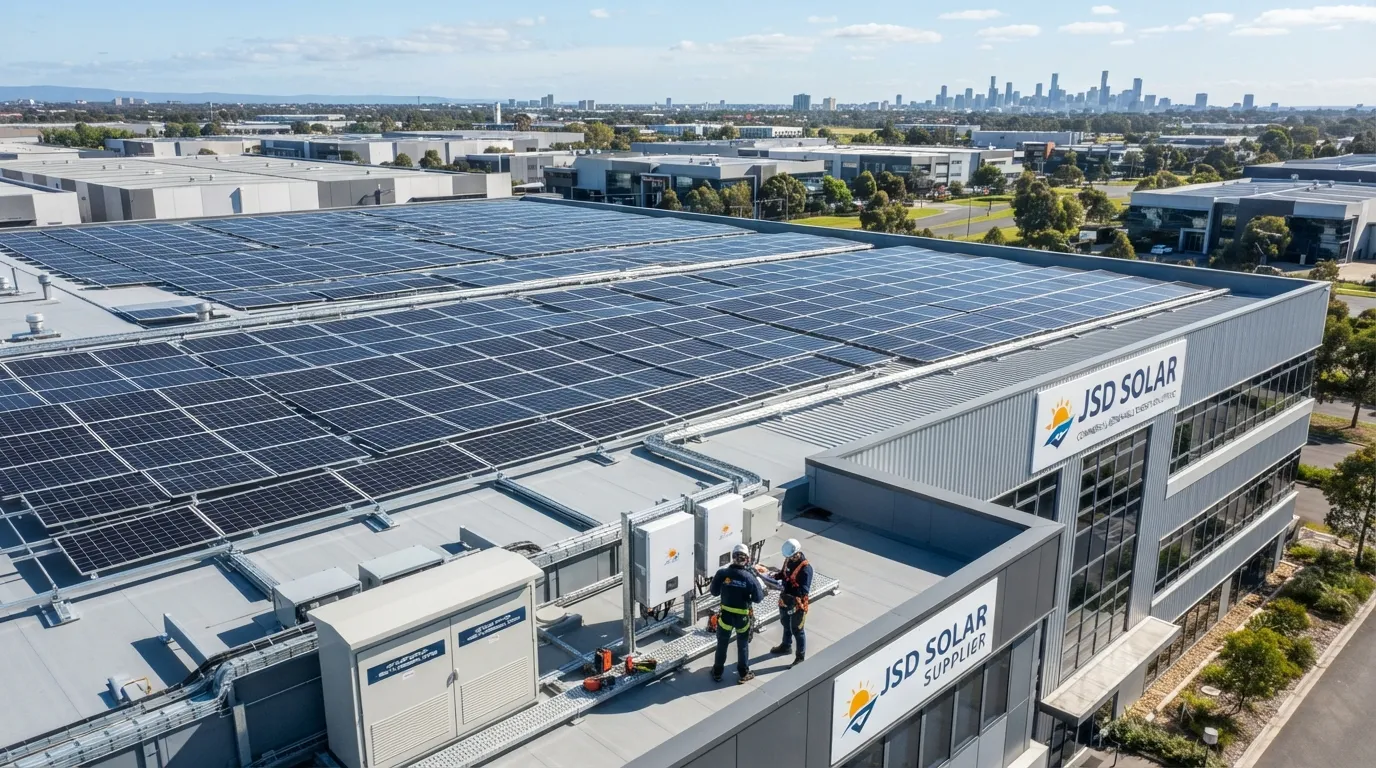
The success of a commercial solar project is as good as the equipment. Solar panels can harness the sun, yet the entire system requires dependable inverters, battery storage, protective devices, mounting systems, cables, and smart controls. This is why the selection of the appropriate commercial solar equipment supplier should be given a second thought.
- In the case of factories, warehouses, offices, farms, retail buildings, and large facilities, solar equipment should be compatible with actual electrical loads and operating conditions. An excellent supplier is not one who sells individual products but one who knows how to size a system, convert power, store energy, and be safe and perform well over time.
- JSD Solar, a commercial solar equipment supplier, is a one-stop provider of solar energy solutions, which sells residential and commercial solar products, inverters, lithium batteries, and energy storage solutions.
The Reasons Why Commercial Solar Equipment Should Be Carefully Selected
A commercial solar energy system is not like a small residential system. Commercial systems tend to be heavily loaded, three-phase electric, have larger PV arrays, and have more demanding operating hours. As an example, a warehouse can have significant daytime loads of lighting, HVAC, refrigeration, machinery, or automation devices. A factory can also have spurts of high demand that will need keen power management. This is where distributed energy generation comes in handy. A business does not have to completely depend on electricity sold by the utility grid and can produce some of its own electricity locally.
A properly designed system can support:
• Solar self-consumption
• Less grid electricity consumption.
• Better energy management
• Backup power
• Commercial battery storage
• Increased use of renewable energy.
• Better management of surplus solar energy.
The financial and technical advantages will be determined by the electricity tariffs, load profiles, solar availability, regulations, and system design.
Technical Specifications Matter
A commercial supplier of solar equipment ought to supply detailed technical specifications rather than just headline power ratings. Notable parameters of inverters are:
• Maximum DC input power.
• Maximum PV voltage
• Maximum PV input current.
• MPPT voltage range
• AC output power
• Nominal output voltage
• System voltage
• Inverter efficiency
• Number of MPPT trackers
• Operating temperature
• Protection functions
Maximum power point tracking, or MPPT, assists the inverter to regulate the PV array around its optimum power point as the sun and module conditions vary. When carrying out a commercial project, the interaction between PV input voltage, string setup, inverter power rating and AC output capacity should be verified thoroughly prior to installation.
Commercial Storage System of JSD Solar
The three-phase commercial energy storage system listed by JSD Solar is a hybrid inverter with lithium-ion battery storage and smart energy management. The product page outlines the configurations of Deye SUN-30K, SUN-40K, and SUN-50K hybrid inverters.
- The system is intended to be used in commercial and industrial applications and is capable of coordinating photovoltaic generation, batteries, the utility grid, and loads connected to it. The product information also mentions that the system can be used to support diesel generator connection as well as rapid switching of various energy sources.
- The 50kW model has a maximum DC input power of 65kW and maximum active power in AC output of 55kW. The 30kW model has a 39kW maximum DC input power and 33kW maximum AC output active power.
- These statistics demonstrate the importance of technical matching. A commercial system is not merely a bundle of products. PV voltage, current, battery voltage, inverter capacity, and load requirements should be compatible.
Smart Monitoring Assists Businesses
With a commercial solar system, energy management is a lot easier when it has monitoring. A solar monitoring system can give data regarding:
• PV generation
• Battery charging
• Battery discharge
• Grid import
• Grid export
• Load consumption
• System status
• Fault conditions
This information can then be used by an energy management system to regulate the flow of electricity in the installation. The commercial storage product of JSD Solar explains intelligent monitoring and energy control, as well as the communication between the inverter and battery management system via RS485 and CAN interfaces.
What to Look at Before Selecting a Supplier
Price is important, but it should not be the only deciding factor when selecting a commercial solar distributor or equipment supplier.
Consider the following areas:
1. Product Compatibility
Make sure that panels, inverters, batteries, and protection equipment are compatible.
2. Technical Documentation
Request datasheets, electrical specifications, installation manuals, and communication information.
3. Product Testing
Ensure that equipment undergoes proper quality and performance tests.
4. Project Experience
A supplier who has experience in commercial and industrial projects might be more knowledgeable about larger electrical systems.
5. After-Sales Support
Technical support, troubleshooting, spares, and warranty support are of concern throughout the life of the installation.
6. Scalability
Select equipment to facilitate future expansion where feasible.
Why JSD Solar Can Be Taken into Consideration in Commercial Projects
- According to JSD Solar, a commercial solar equipment supplier, it is involved in the integration of R&D, production, and sales of solar inverters and lithium batteries, as well as providing industrial and commercial energy storage solutions. On its site, it offers commercial solar, residential systems, solar inverters, lithium batteries, and portable power stations.
- The company records a yearly inverter production of 150,000 units, over 100,000 cases of solar home system applications, and product applications in 150+ countries and regions. It further adds that 15 percent of the yearly sales are invested in technological research and innovation.
This expanded product range can simplify the process of finding a single supplier of generation, conversion, and storage equipment for businesses seeking a commercial solar solutions provider.
Conclusion
When generation, storage, conversion, and monitoring are integrated into a single system, solar gains more power. The appropriate equipment partner can assist companies to go beyond merely generating renewable electricity to smarter management of energy. JSD Solar integrates solar inverters, lithium battery storage, and commercial energy storage to meet the needs of various projects. Call JSD Solar and talk to them about the capacity, PV system, battery storage, and electrical system you need in your next business venture.
Share on Social:


- NEXT: Solar System Manufacturer | Complete Solar Energy Solutions
- NEXT: Null
In This Article
-
1
Choosing the Right Partner for Business Energy Projects
- 1.1 The Reasons Why Commercial Solar Equipment Should Be Carefully Selected
- 2 Conclusion
