


Custom off-Grid Solar System | Design & Energy Solutions

Custom Off-Grid Solar System: Design a Smarter Energy Solution for Your Needs
All properties do not consume energy equally. A small cabin might require several lights, a refrigerator, and communication devices. A big house can have pumps, air conditioning, cooking devices, and other loads. The demand profile of a remote business can be completely different.
- This is why a tailor-made custom off-grid solar system may be more reasonable than a pre-assembled one. The system can be designed based on your real electricity usage, where you are, how much sunlight is available, how much backup you need, and how much you may need in the future, rather than selecting equipment and then adjusting your lifestyle to it.
- An effective off-grid system consists of photovoltaic solar panels, battery storage, an off-grid inverter, and an appropriate solar charge controller. Collectively, these elements form a self-sustaining energy system that does not have to be connected to the utility grid.
Why is an Off-Grid Solar System Custom?
A custom off-grid solar system is designed to meet the electrical needs of the site and is customized. The design usually begins with a load test and not a product catalogue. The system designer or installer takes into account:
• Peak electrical demand
• Turning on of current of motors and pumps.
• Roof or ground area available.
• Local solar radiation
• Peak sun hours
• Required backup duration
• Battery chemistry and capacity
• Inverter power rating
• Future electricity demand
This is what is referred to as off-grid solar system design. It assists in identifying the extent of solar generation and storage that is really needed. To illustrate, a property that uses 8 kWh/day will have very different needs compared to one that uses 25 kWh. An electric water pump site also requires an inverter capable of temporary surge loads.
The Size of the Battery Determines the Duration of Power
Half of the equation is solar generation. Storage defines the amount of energy that is left behind after the sun sets or when there is cloud cover. To illustrate, when a house requires 10 kWh of usable energy and the battery is modeled with an 80% depth of discharge, the nominal capacity should be bigger than 10 kWh. Lithium iron phosphate batteries are commonly used in modern systems due to the good cycle-life properties and stability of LiFePO4 technology when well controlled. Critical battery specifications are:
• Battery voltage
• Battery capacity
• Usable battery capacity
• Depth of discharge
• Battery discharge rate
• Battery cycle life
• Battery efficiency
• Round-trip efficiency
In modular systems, a solar battery bank can also be increased in case the energy needs grow in the future.
Charge Controllers: MPPT and PWM
The solar charge controller controls the energy flowing out of the PV array to the battery. There are two common technologies:
- MPPT charge controller: Utilizes maximum power point tracking to vary the operating point of the solar array and harvest the available power effectively in varying conditions.
- PWM solar charge controller: This operates by pulse-width modulation and is typically less complex, but the operating characteristics are different from an MPPT design.
In larger or more performance-oriented installations, an MPPT solar charge controller may be a good choice, as it can operate with higher voltages of PV arrays and offers greater flexibility in system design.
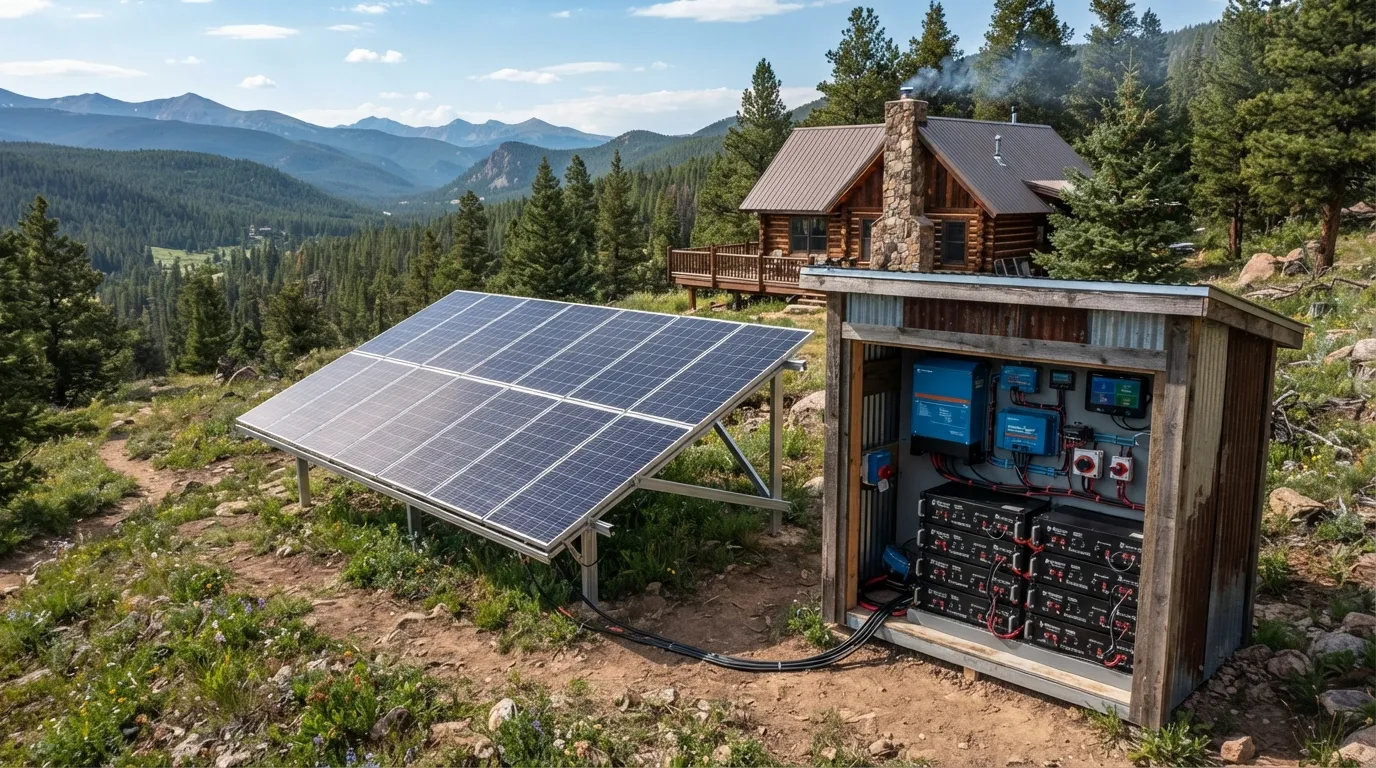
6kW Residential Case of JSD Solar
The 6kW Solar Package for Residence by JSD Solar is a convenient example of an integrated residential system. It is an off-grid solar power system with battery storage, which is described on the product page as a combination of photovoltaic generation, lithium battery storage, and hybrid power conversion.
- The following setup consists of eight 580W solar panels, two 120 V/240 V split-phase solar inverters, and a 48 V/51.2 V 200Ah LiFePO4 battery with a 6,000-cycle rating. Electrical distribution equipment and PV cables are also included in the package listed on the page.
- The product specification provides a maximum load power of 6kW, 110 V/220 V output, 50Hz/60Hz frequency, and about 23 kWh of power production at four peak sun hours. The manufacturer also mentions that the package can be increased based on the real needs.
The fact that it is expandable is helpful when it comes to custom projects since the energy requirements may vary once installed.
Designing for Remote and Future Requirements
A remote custom off-grid solar system must be planned more carefully than a simple grid-connected system since there is no utility to back up on.
- A site-specific design ought to take into account seasonal weather, long cloudy seasons, transportation constraints, and accessibility for maintenance and replacement needs.
- It can also make sense to have a scalable or modular system. You can start with a residential off-grid solar system and then increase battery capacity or add more solar panels as the energy consumption grows. This strategy will allow energy autonomy and keep the system flexible.
Reasons Why JSD Solar Can Be Considered to Do Custom Projects
- According to JSD Solar, it is a one-stop provider of solar energy solutions, and its products include residential solar solutions, solar inverters, lithium batteries, portable power stations, and commercial solar products. According to its webpage, the company was founded in 2005 and has 20 years of experience in the solar energy sector.
- The company also records an annual production of 150,000 inverters, over 100,000 cases of solar home system applications, and products used in over 150 countries and regions.
In case of a custom project, technical requirements must still be aligned to the load profile of the site, local electrical requirements, and climate and installation conditions.
Conclusion
The largest custom off-grid solar system is not always the best. It is the one that suits the property, carries the real-world loads, stores sufficient energy, and leaves reasonable room for tomorrow. JSD Solar will assist you in discovering solar panels, battery storage, inverters, and full system setups to use in residential and other off-grid systems. Begin with your daily power consumption and the backup capacity needed, and create the system around these figures.
Share on Social:


