


Solar Street Light vs Traditional Street Light


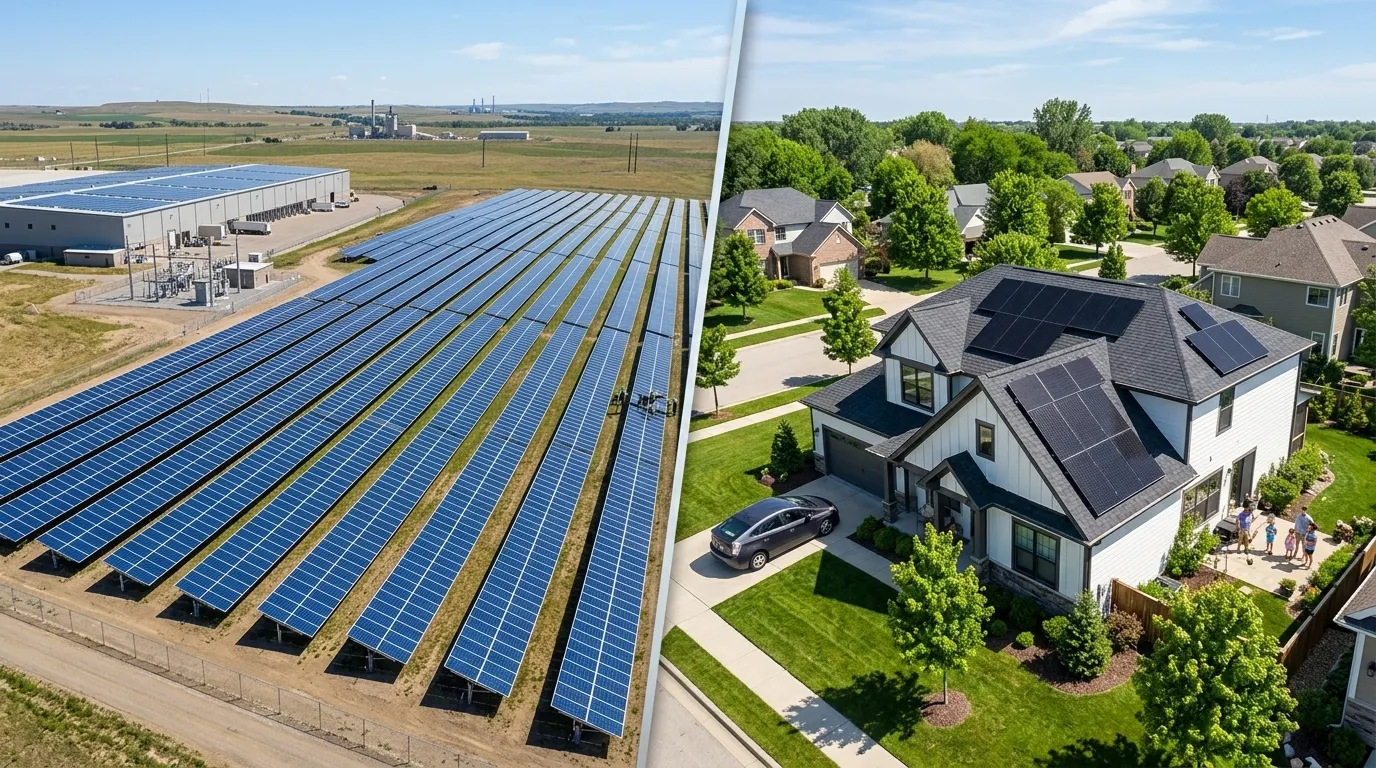
Street lighting is an important component of road safety, public spaces, residential communities, parking facilities, industrial parks, and commercial areas. Most of the roads in the past have been powered by the old electricity system and are grid connected. But solar street lights are getting more and more popular as they are powered by renewable energy and can work without electricity.
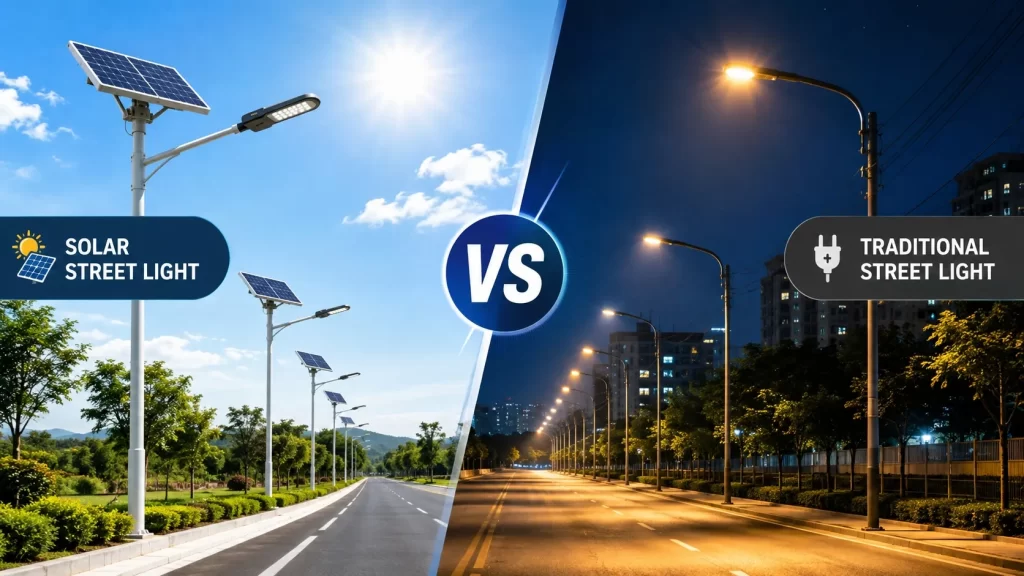
So, which one is better – Solar street lights or traditional street lights?
The solution will vary based on project goals, long-term goals, maintenance considerations, infrastructure and energy costs, and installation location. This guide is a comparison of both systems for businesses, municipalities, contractors and property builders to make an informed choice.
What Is a Solar Street Light?
A Solar Street Light is a lighting solution that uses solar power for outdoor lighting. A standard system consists of a solar panel, an LED lamp, a rechargeable battery, a solar controller and a lighting pole.
Solar panel generates electricity from sunlight and stores energy in battery during the day. The LED light turns on automatically by the stored electricity at night.
Solar street lights are not normally connected to the electrical grid, making them especially well suited for remote roads, rural areas, parks, construction sites, campuses, and areas where it is difficult or expensive to install the electrical grid.
What Is a Traditional Street Light?
Street lights are the conventional type that are plugged into a power grid. A basic system typically is composed of an LED light or other fixture or light source, pole, electrical wiring, control gear, and a grid power source.
LED street lights are more energy efficient than traditional lighting solutions, but they require grid electricity to function.
Traditional systems are generally found in urban roads and highways, commercial areas, residential streets, and regions with existing electrical facilities.
Solar Street Light vs Traditional Street Light: Key Differences
1. Energy Source
The main difference is the source of the energy.
Solar street light is a renewable lighting solution, which is powered by the energy of sun light. They don't use electricity from the grid when installed.
Street lights are traditionally electric, connected to the power grid. They are thus directly impacted by the pricing of electricity and local energy policies.
Solar street lighting is an obvious choice for projects seeking to liberate themselves from the reliance on traditional electric power.
2. Installation Cost
Solar street lights can be more expensive upfront as they may be equipped with a solar panel, battery, solar controller, and special lighting system.
However, installation may be easier as there are no need for extensive grid connections and underground electrical cables in most cases.
Traditional street lighting can be cheaper in terms of street lighting fixtures, but can be more expensive in terms of installation, which may involve trenching, wiring, transformers, distribution equipment, and electrical connections. These infrastructure costs can quickly add up and make up a large percentage of the project installation costs for large or distant projects.
So, the most cost-effective solution is not strictly a matter of the cost of the equipment but depends on the project site.
3. Operating Costs
The solar street light reduces its own electricity consumption, hence a major reduction in electricity costs.
Street lights are on nightly and use electricity throughout their service life, meaning that they are a source of energy costs.
Municipalities and businesses with hundreds or thousands of street lights can see a substantial impact on their long-term operating costs with energy reductions.
This makes solar street lights a good choice for long-term energy saving projects.
4. Maintenance Requirements
Lighting systems need maintenance, but it is different for both systems.
Street light inspection and replacement of lamp, driver, cable, switch and other electrical parts are the major tasks that are done in a traditional street light system.
Solar street lights include more components such as solar panels, batteries etc. If dust, pollution or heavy environmental exposure causes a degradation of the solar panels efficiency, periodic cleaning might be necessary. Batteries are also not permanent and will require replacement at some time.
But, in the modern era, the integrated solar street lights can simplify the installation and maintenance of the lights by combining multiple components in a compact system.
5. Reliability During Power Outages
One of the major merits of solar street lights is that they are not connected to the electricity grid.
When a traditional street light (grid connected) goes down, the light may become useless until power is restored.
In the event of power outages, a well-designed solar street light can keep lighting the area thanks to the fact that the energy produced during the day is stored in its battery.
This is especially useful in the rural and off-grid areas.
6. Environmental Impact
The operational carbon footprint of solar street lights is typically lower compared to those that continuously consume electricity from the grid, since they rely on the sun's power for their operation.
The traditional street light system can cause a higher environmental impact, depending on local electricity generation.
High efficiency LED lighting can help to make both systems more environmentally friendly. But solar street lights utilize LED technology as well as renewable energy generation, making them an appealing option for sustainable infrastructure ventures.
Solar Street Light vs Traditional Street Light: Comparison Table
| Feature | Solar Street Light | Traditional Street Light |
|---|---|---|
| Energy source | Solar energy | Grid electricity |
| Grid connection | Usually not required | Required |
| Electricity cost | Very low after installation | Continuous |
| Installation | Relatively simple | Requires electrical infrastructure |
| Remote locations | Excellent | More difficult |
| Power outage performance | Can continue operating | Usually stops |
| Maintenance | Battery, panel, LED, controller | Electrical system, LED, wiring |
| Environmental impact | Lower operational impact | Depends on electricity source |
| Initial investment | Often higher | Often lower |
| Long-term savings | High potential | Depends on electricity costs |
Advantages of Solar Street Lights
Solar street lights offer several benefits for modern infrastructure projects:
Energy independence: Solar panels generate electricity locally, reducing dependence on grid power.
Lower electricity bills: Once installed, solar energy can provide free power during the system's operating life.
Easy installation: Many systems do not require extensive underground cabling.
Remote-area compatibility: Solar street lights can be installed in locations without reliable grid access.
Automatic operation: Integrated controllers can turn lights on and off according to programmed schedules or light conditions.
Sustainable infrastructure: Solar power and LED technology support energy-efficient development.
Advantages of Traditional Street Lights
Traditional street lighting also has important advantages.
First, grid electricity can provide consistent power regardless of daily sunlight conditions. This can be valuable in areas with limited solar resources or extended periods of cloudy weather.
Second, traditional systems can support very high lighting loads and large-scale urban lighting networks.
Third, existing electrical infrastructure can make grid-connected lighting cost-effective in densely developed areas where wiring and power distribution are already available.
Which Is Better: Solar or Traditional Street Lighting?
There is no universal answer.
Solar street lights are generally better for remote locations, rural roads, parking areas, parks, campuses, construction sites, and projects where reducing electricity consumption is a priority.
Traditional street lights may be more practical in dense urban areas with existing electrical infrastructure and reliable grid power.
For a new project, decision-makers should consider the total cost of ownership rather than focusing only on the initial purchase price. This includes equipment, installation, electricity, maintenance, battery replacement, infrastructure, and expected service life.
How to Choose the Right Solar Street Light
If you choose solar lighting, several technical factors should be evaluated.
Solar Panel Capacity
The solar panel must generate enough energy to recharge the battery based on local sunlight conditions and expected lighting hours.
Battery Capacity
Battery capacity should be sized based on the lighting load and number of days of backup required. High energy storage capacity may be needed for areas where cloudy days are common.
LED Efficiency
Solar system can be more efficient with the use of high efficiency LED fixtures which can deliver more light per watt.
Lighting Requirements
When choosing a solar street light, the width of the street, the distance between poles, the height of the pole, traffic conditions and the required illumination levels should all be taken into consideration.
Weather Resistance
The design of the lighting equipment used outdoors must be able to endure the impact of the weather, such as rain, dust, temperature change and so on. For long-term reliability, it is essential to have a protection rating that is suitable.
Final Verdict
In solar street lights vs traditional street lights comparison, solar strength provides extensive benefits in terms of independence from energy sources, cost-effectiveness, installation versatility and sustainability. In the places where the grid exists and power is readily available, traditional street lights are still a viable option.
The ideal system for an organization planning to build new infrastructure isn't the cheapest system to buy. Rather, look at the overall picture of costs, local climate, installation conditions, energy costs, maintenance needs and lighting performance.
Due to the improvements in renewable energy technology and LED efficiency, solar street lights are becoming more and more appealing for modern, energy-efficient street lighting applications.
Share on Social:


In This Article
- 1 What Is a Solar Street Light?
- 2 What Is a Traditional Street Light?
- 3 Solar Street Light vs Traditional Street Light: Key Differences
- 4 Solar Street Light vs Traditional Street Light: Comparison Table
- 5 Advantages of Solar Street Lights
- 6 Advantages of Traditional Street Lights
- 7 Which Is Better: Solar or Traditional Street Lighting?
- 8 How to Choose the Right Solar Street Light
- 9 Final Verdict
