


Solar Street Light vs LED Street Light: Key Differences

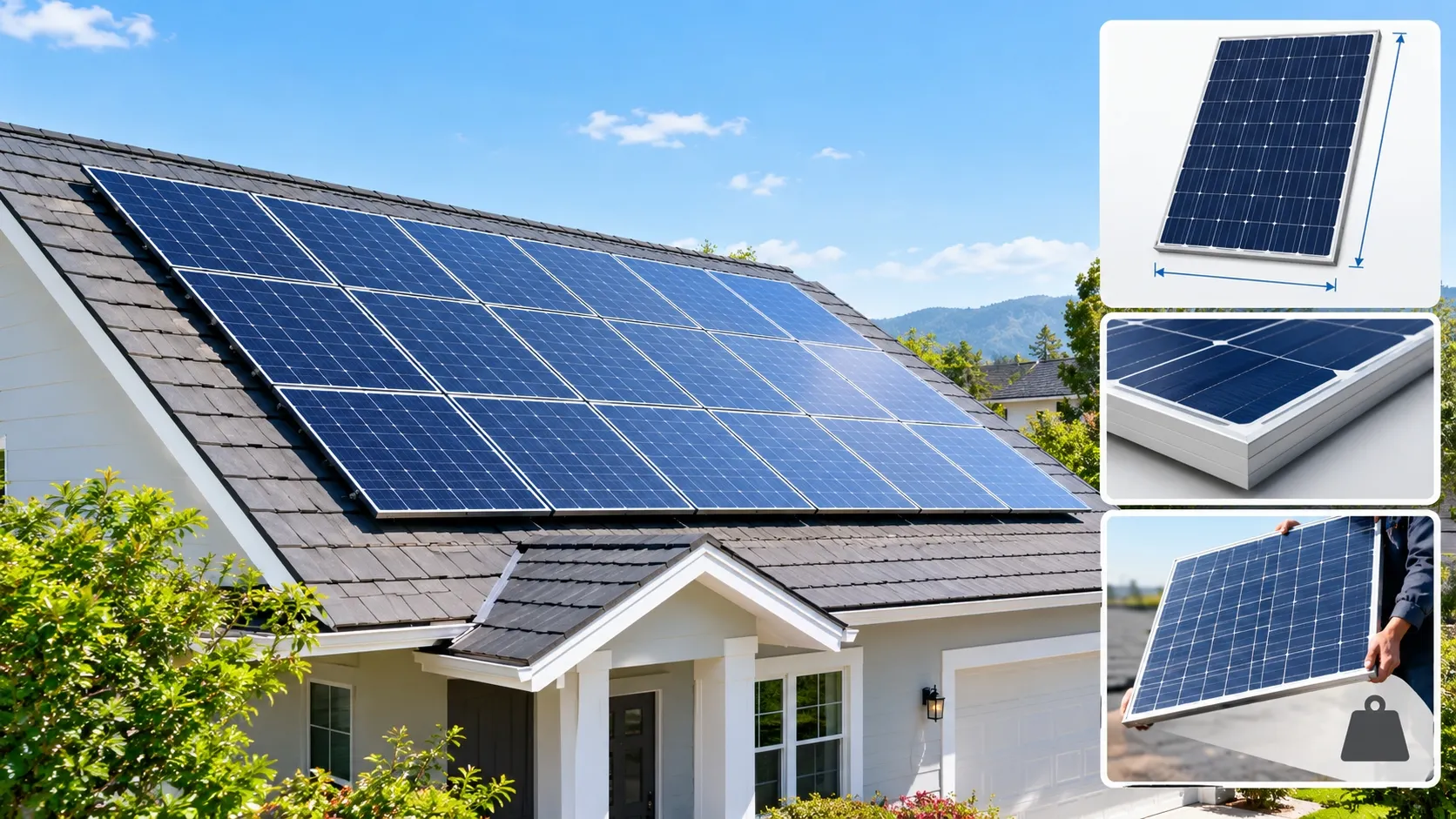
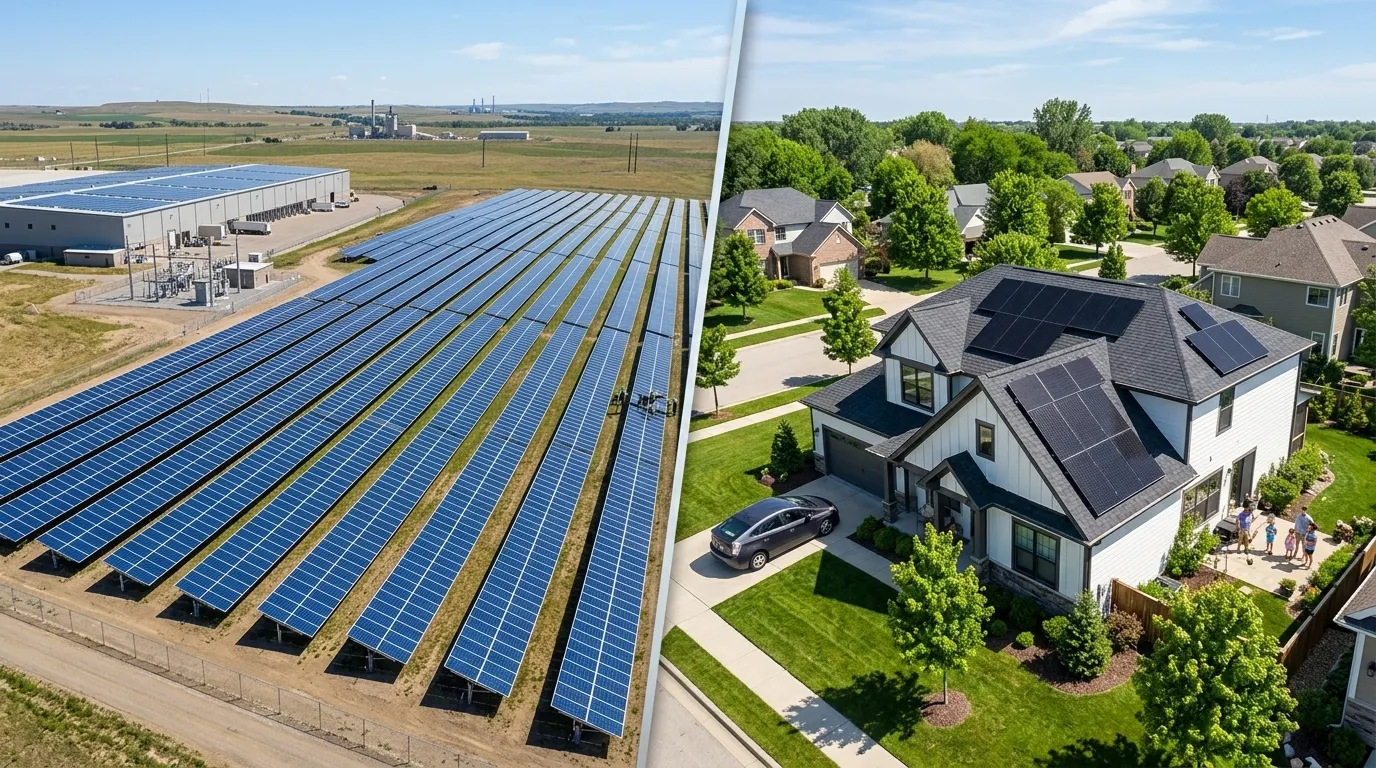
With the goal of finding efficient and sustainable lighting solutions for cities, businesses, and communities, solar street lights and LED street lights have emerged as two popular options for outdoor lighting. While they both employ LED technology for energy efficiency, their power sources, installation specifications, operating costs, and uses are very different.
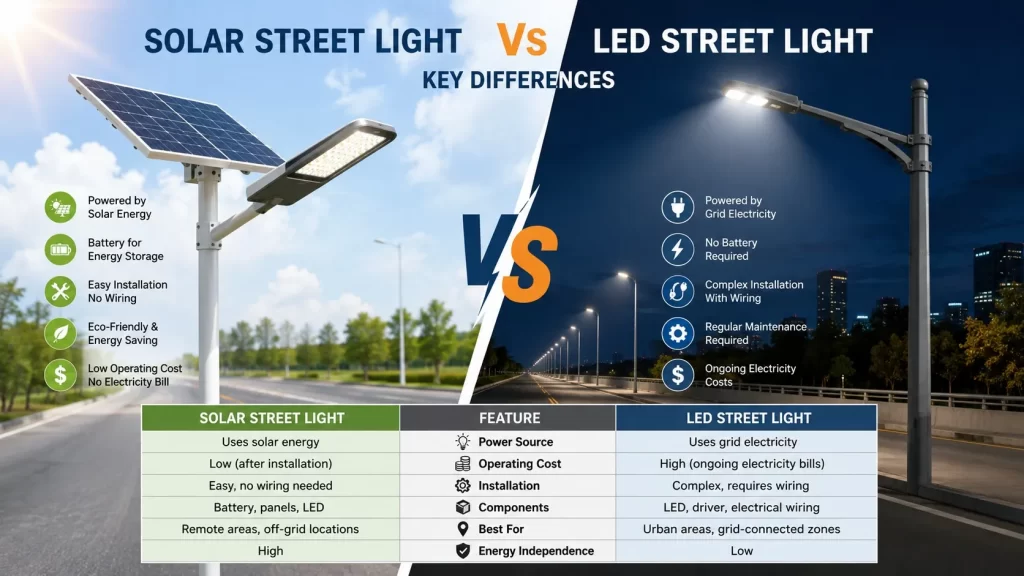
So, what is difference between solar street lights and LED street lights? The main difference between solar and LED street lights is that the former uses solar panels and batteries to create and store electricity, while the latter uses electricity from the public power grid.
This guide explains how solar street lights are different from LED street lights, to guide municipalities, contractors, property developers and commercial buyers toward the right choice.
What Is a Solar Street Light?
Solar street light is an outdoor lighting equipment powered by sunlight. The typical system consists of a solar panel, an LED lamp, a rechargeable battery, a controller, a pole and mounting hardware.
The solar panel, during the day, will turn sunlight into electricity and charge the battery. The stored energy will automatically turn on an LED light at night.
Unlike traditional electrical street lights, Solar street lights can run without electrical connections and are especially relevant in remote areas, developing communities, parking areas, roads, parks, and in areas where the deployment of electrical power lines is costly.
What Is an LED Street Light?
An LED street light is typically a street lighting fixture that is connected to the electrical grid and utilizes LED lights as its light source. The fixture is not a source of electricity, but it takes in electricity from the power grid.
The LED street light has a long life, low operating cost, high energy efficiency, good lighting quality, and low maintenance requirements, which has been widely used.
They do require electricity to operate, though, which usually means that they require an electrical cable, poles, distribution equipment, and a qualified electrician to install them.
Solar Street Light vs LED Street Light: Key Differences
The biggest differences can be summarized across several important factors.
| Feature | Solar Street Light | Conventional LED Street Light |
|---|---|---|
| Power source | Solar energy | Electrical grid |
| Battery | Usually required | Usually not required |
| Solar panel | Required | Not required |
| Grid connection | Usually unnecessary | Required |
| Installation | More flexible | Requires electrical infrastructure |
| Operating electricity cost | Very low after installation | Ongoing electricity cost |
| Maintenance | Battery and panel maintenance | Mainly fixture and electrical maintenance |
| Remote locations | Excellent | More difficult |
| Initial cost | Usually higher | Usually lower |
| Energy independence | High | Low |
| Environmental impact | Lower operational emissions | Depends on electricity source |
1. Power Source
The most fundamental difference is the power source.
Street Lighting Solar – a renewable energy source. During the day, solar panels absorb sunlight and store energy in batteries to power their operation at night. This enhances the ability of the lighting system to be independent from the utility grid.
However, the LED street lights are typically connected to the electric grid. LEDs use less power than other lighting systems, but the system relies on external power infrastructure.
Solar Street Lighting can save the cost of installing power lines to the project sites that are far from the electrical network.
2. Installation Requirements
There are also significant differences in installation.
The installation of a grid-connected LED street light can involve the use of underground cables, electrical conduits, transformers, distribution boxes, and other infrastructure. This infrastructure can be quite expensive and time-consuming on large-road projects.
Often, solar street lights can be deployed more easily, avoiding the need for power cables between each light pole. After the pole, solar panel, battery and LED fixture installation and configuration, the system can run without the need for electricity from the grid.
This makes solar lighting appealing for parking areas, new developments, construction sites, remote roads and rural areas.
3. Initial Investment
The initial cost of solar street lights may be higher due to the extra components included in a unit, which typically consist of a solar panel, a lithium battery, a solar controller, and a dedicated mounting structure.
Typically, a standard LED street light will contain only a LED fixture and an electrical connection and be simpler.
But just comparing the equipment buy price is not necessarily indicative. Trenching, cable installation, connection fees to the grid, electricity price, maintenance and service life should also be included in a complete project assessment.
In some projects, the cost of initial investment in solar lighting may be counterbalanced by the reduction in operating costs.
4. Operating Costs
Solar street lights come with several of the major pros, with one of them being operating cost.
Once installed, solar street lights harness the energy from the sun, eliminating the typical monthly electric bill for lighting energy. This can be helpful for municipalities or businesses with hundreds or thousands of street lights.
Even though the LED lights are grid-connected, they need to be powered throughout their lifespan. But the technology of LED is very efficient, which means that electricity use can be significantly reduced, compared to the previous lighting technology.
Which one is best will depend on the local costs of electricity, sunlight availability, system size and project requirements.
5. Battery and Energy Storage
The battery is an integral component of a solar street light system.
The battery is used to store energy collected during daylight hours and provide energy at night. Lithium-based batteries are often employed in modern systems due to their ability to provide high energy density, long cycle life, and compact designs.
Batteries, however, are also one of the parts that will need to be replaced throughout the life of the entire system.
Typical street lights use LED (light emitting diode) lamps and are directly connected to the electricity power grid, so they typically do not require an energy storage battery.
Thus, battery capacity, expected cycle life, operating temperature range, charging efficiency and availability of replacement batteries should be taken into account when comparing systems.
6. Performance During Bad Weather
Solar street light performance can be influenced by weather conditions.
Clouds or rain on a few days can reduce the generation of solar energy, and thus decrease the amount of energy available for lighting during the night. An adequate system should consider the local solar radiation, battery size, lighting power and number of days of backup required.
Weather has less impact on grid-connected LED street lights, as they are continually powered by electricity.
For those areas that are subject to long spells of little sunlight, a hybrid solar system or purpose-sized battery might be the answer.
7. Maintenance Requirements
Both systems need maintenance but the work involved is different.
The solar panels, batteries, LED fixtures, controllers and street lights need to be inspected and cleaned, the batteries monitored, the LED fixtures maintained, the controllers checked, and battery replacements may be required occasionally with solar street lights.
The number of components of LED street lights is less, which means they may have simpler maintenance requirements. The LED fixture, wiring, poles, electrical connections and control systems are the main areas of inspection by technicians.
LED street lights do, however, come with higher infrastructure costs for ongoing operation as the electrical network would need to remain in place.
8. Environmental Benefits
It's undeniable that solar street lights are better for the use of renewable energy. They produce electricity using sunlight, and can help to decrease reliance on fossil fuel grid electricity.
LED technology also offers environmental advantages as LEDs consume a lot less energy than many other lighting technologies and can last for a long period of time.
Furthermore, solar LED street lights can be a viable solution for green infrastructure initiatives for organizations with sustainability objectives in mind, offering a fusion of renewable energy and effective LED lighting.
9. Smart Lighting and Control
Smart controls can be used in modern solar and LED street lights.
They can have features such as motion sensors, dimming, remote monitoring, automated brightness regulation, timers, and/or centralized management platforms.
Smart controls are an option for solar street lights that can be used to save the energy stored in the batteries. For instance, a light could turn off during low traffic times, and turn bright if the light is being activated by movement.
Other features of a grid connected LED system include intelligent controls, and the fact that it has a continuous supply of grid power.
Which Is Better: Solar Street Light or LED Street Light?
There is no universal winner because the best solution depends on the project.
Choose solar street lights when:
- Grid electricity is unavailable or expensive to extend
- The project is located in a remote area
- Reducing electricity bills is a priority
- Renewable energy is an important project goal
- Independent lighting is required
- Flexible installation is needed
Choose grid-connected LED street lights when:
- Reliable grid electricity is readily available
- Consistent power is the highest priority
- The project has demanding nighttime lighting requirements
- Initial equipment cost needs to be minimized
- Existing electrical infrastructure can be reused
A hybrid is also an option for large commercial or municipal projects. The solar road lights can be used where the grid is not available, and the LED lights can be used in areas with good power facilities.
Final Thoughts
A comparison of solar street lights and LED street lights is really a comparison of two methods of providing lighting outdoors.
Solar street lights are composed of solar panels, batteries, LED lamps and intelligent control systems to form an independent light source that requires little electricity for operation. They are particularly well suited for remote roads, rural communities, parking lots, parks, and areas that may be hard or expensive to connect to a grid.
Unlike solar-powered lights, grid connected LED street lights do not require batteries or solar panels to convert energy into light, they are a stable and continuous power source because they depend on the grid. They are still a great option for urban roads and highways, commercial developments and areas with stable grid access.
Customers should consider solar radiation, illumination needs, battery size, installation budget, cost of electricity, maintenance needs, weather factors and projected lifespan of the system before selecting a system.
The crux of the issue is not which technology is better, solar or LED, but rather what is the right choice. In fact, many of the modern solar street lights are already LED lights. The really important question is whether you need energy independence and renewable energy or access to the existing grid.
Share on Social:


In This Article
- 1 What Is a Solar Street Light?
- 2 What Is an LED Street Light?
- 3 Solar Street Light vs LED Street Light: Key Differences
- 4 1. Power Source
- 5 2. Installation Requirements
- 6 3. Initial Investment
- 7 4. Operating Costs
- 8 5. Battery and Energy Storage
- 9 6. Performance During Bad Weather
- 10 7. Maintenance Requirements
- 11 8. Environmental Benefits
- 12 9. Smart Lighting and Control
- 13 Which Is Better: Solar Street Light or LED Street Light?
- 14 Final Thoughts
