


Solar Battery vs Portable Power Station: What's the Difference?
Two popular types of backup power solutions for home, camping, RV and emergency use are solar batteries and portable power stations. Both can store electricity and serve as backups power supplies, but they are used for different purposes.
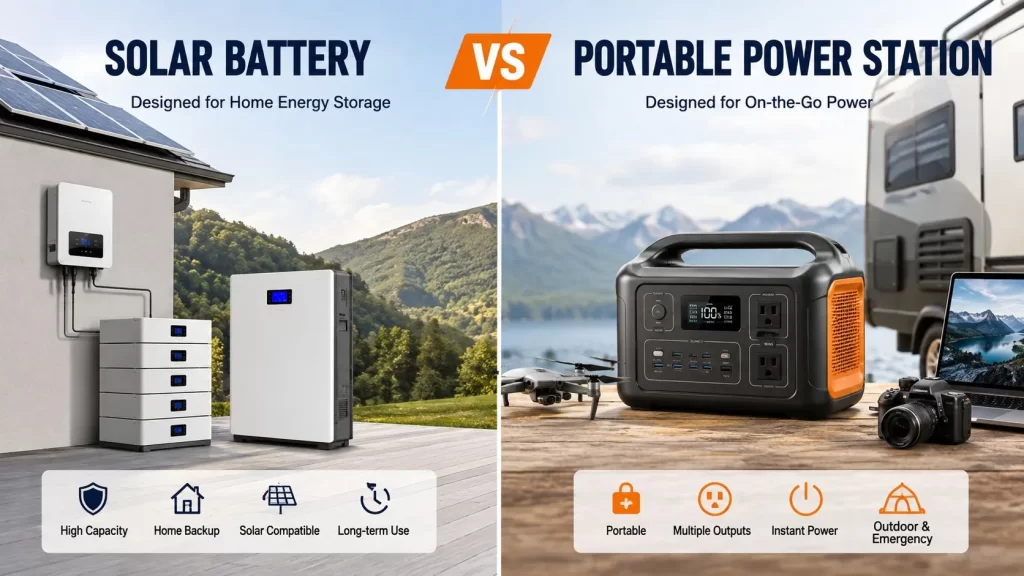
So, what's the difference between a solar battery and a portable power station? To put it simply, solar batteries are built to store solar energy for a solar power generation system, whereas portable power stations is an all-in-one, moveable energy providing solution that integrates a solar battery, inverter and charging system.
Knowing the differences can get you to select the right battery backup solution in accordance with your energy needs.
What Is a Solar Battery?
Solar battery: It is an energy storage device used to store electricity from solar panels. Solar battery (SSB) serves as an electricity storage system, allowing you to store surplus energy for later use instead of using it immediately.
During the day, for instance, a solar panel can generate more electricity than might be required by a dwelling. The surplus energy can be stored in the battery. The electricity stored may be available at night and during a power outage to operate household appliances and electrical systems.
Some typical solar battery technologies are:
- Lithium iron phosphate (LiFePO4)
- Lithium-ion batteries
- Lead-acid batteries
More and more, solar energy systems are being installed at homes utilizing LiFePO4 batteries which are characterized by long cycles, excellent thermal stability, and reliable performance.
Solar batteries are usually part of a solar energy system, which can also consist of the solar panels, an inverter, a battery management system (BMS), and other electrical components.
What Is a Portable Power Station?
Portable power stations are small, rechargeable battery stations that deliver power when and where it is needed.
Typically, a portable power station combines multiple elements into a single system, such as:
- Rechargeable battery
- Inverter
- Battery management system
- AC outlets
- DC outputs
- USB ports
- Charging controller
Many portable power stations can be charged using solar panels, AC outlets, or a vehicle, making them flexible for outdoor and emergency applications.
Portable power stations are commonly used for camping, RV trips, road trips, outdoor work, photography, tailgating, and emergency backup power.
Solar Battery vs Portable Power Station: Key Differences
The biggest difference between these two products is their intended use and system design.
| Feature | Solar Battery | Portable Power Station |
|---|---|---|
| Primary purpose | Home energy storage | Portable electricity |
| Portability | Usually stationary | Highly portable |
| Solar charging | Yes, with compatible system | Usually supported |
| Inverter | Often separate | Usually built-in |
| AC outlets | Depends on system | Usually included |
| Installation | Often requires installation | Plug-and-play |
| Capacity | Small to very large | Small to medium/large |
| Best for | Homes and solar systems | Camping, RVs, emergencies |
| Expansion | Often expandable | Depends on model |
| Grid integration | Common | Limited |
The best option is either a permanent energy storage system or a portable energy source, depending on the type of use you plan to make of it.
1. Installation and Setup
The ease of setup is one of the major benefits of a portable power station.
The majority of portable power stations have an instant-on feature, which means they are ready to use upon receiving a charge. The devices can be plugged straight into the built-in outlets, with no need for additional electrical gear or an inverter.
Solar batteries are not these types. Residential solar batteries usually have to be designed into a solar system. Professional installation might be necessary depending on the system designed.
As such, if the convenience and simplicity of setup are paramount, a portable power station is typically the easier solution.
2. Portability
One of the biggest pros of portable power stations is its portability, as the name would suggest.
Can be transported to campsite or job site, RV, outdoor events, etc. in a compact model. The larger models may have wheels and handles to make it easier to move around with.
On the other hand, solar batteries are typically used for stationary use. They should be permanently hooked up to the house's electrical and solar installations.
For electricity in various locations, a portable power station is often the preferred option.
3. Energy Capacity
Residential and commercial applications can benefit from much greater storage capacity using solar batteries.
A home energy storage system can be made up of several battery modules, which means you can store a lot of solar energy in your home.
Portable power stations generally come in smaller sizes, but there are high-capacity versions as well. They are not designed to run specific appliances and devices for long periods of time or to power an entire house.
A solar battery system is typically better for whole home storage.
4. Solar Charging
Both solutions can be used with solar power – but they are different.
Solar battery is specially created to store power produced by a solar photovoltaic system. All the solar panels, inverter, battery and home electrical system are a single package.
Portable power stations are also chargeable using compatible solar panels. That's why they're great for camping off the grid and emergencies.
For instance, portable power stations can be linked with foldable or stiff solar panels when it is the day and then powered to charge phones, computers, lights, refrigerators and more.
5. Backup Power During Outages
Solar batteries and portable power stations are both options for powering during a blackout.
Their abilities are, however, different.
With a properly installed solar power battery system in your home, it is possible to have automatic backup to selected circuits, or to a significant portion of the home, depending on the system. It is particularly effective for homeowners who are looking for long-term backup power.
A portable power station can provide power to important devices without having to install them. It can be handy for short-term crisis situations, such as when you require to power communication devices, lights, medical devices, small appliances, or other vital electronics.
6. Cost and Long-Term Value
Initial cost is often more manageable with a portable power station as it is an integrated product and does not always require professional installation.
The total cost of a home solar battery system could be more expensive due to the battery, inverter, electrical equipment, installation, etc.
But, if a homeowner already has solar panels and is seeking to enhance his or her energy independence, solar batteries can offer more value.
Purchase price should not be the only criterion for the best option; instead the total system cost, usable capacity, battery life, efficiency, installation requirements and expected usage should be taken into consideration.
Which One Should You Choose?
Choose a solar battery if you:
- Own or plan to install solar panels
- Want long-term home energy storage
- Need higher storage capacity
- Want to increase solar self-consumption
- Need a more permanent backup power solution
- Want to reduce dependence on the electrical grid
Choose a portable power station if you:
- Need electricity while traveling
- Go camping or hiking
- Own an RV
- Need backup power for essential electronics
- Want a plug-and-play solution
- Need a power source that can be moved between locations
In some situations, it may be advantageous to use both. A solar battery system for your home can offer end-to-end electricity storage, and a portable power pack can offer electricity flexibility when you're away from home.
Solar Battery or Portable Power Station: Which Is Better?
There is no overall winner as these products address different issues.
A solar battery is ideal for long-term residential energy storage and solar use, while a portable power station is suited for mobility, convenience, and temporary backup power.
If you are focused on generating power and utilising it at night or when the power grid is down, then a solar battery system is probably the better option. A portable power station is more convenient if you need portable electricity for camping, traveling, outdoor activities or emergencies.
When shopping, take note of battery chemistry, capacity, continuous and peak output, charging rate, solar rate, cycle life, warranty, safety and expandability.
Final Thoughts
The key difference between a solar battery and a portable power station is the distinction in terms of purpose, portability, capacity, and system integration.
The solar batteries are intended to be integrated into a greater solar energy system, and are perfect to be used in homes and extended energy storage. Portable power stations integrate battery storage and power conversion in a handy mobile package, which are perfect for outdoor use and emergency power.
A solar battery can play a crucial role in a residential solar power system, offering homeowners increased energy independence. A portable power station is a handy solution for travelers, campers, RV owners and those seeking a flexible backup power source.
So, the right energy storage option will vary based on the area you need power in, the quantity of electricity you require, and if portability or long-term energy storage is the main objective.
Share on Social:


In This Article
- 1 What Is a Solar Battery?
- 2 What Is a Portable Power Station?
- 3 Solar Battery vs Portable Power Station: Key Differences
- 4 1. Installation and Setup
- 5 2. Portability
- 6 3. Energy Capacity
- 7 4. Solar Charging
- 8 5. Backup Power During Outages
- 9 6. Cost and Long-Term Value
- 10 Which One Should You Choose?
- 11 Solar Battery or Portable Power Station: Which Is Better?
- 12 Final Thoughts
