


Lithium Battery vs AGM Battery: Which Is Better?


The performance, reliability, and overall costs of an energy storage system can be influenced by the selection of the battery technology. The two common types of batteries are Lithium and AGM (Absorbent Glass Mat) batteries. They are both used in RVs, boats, backup power systems, solar energy storage, telecommunications and many other applications.
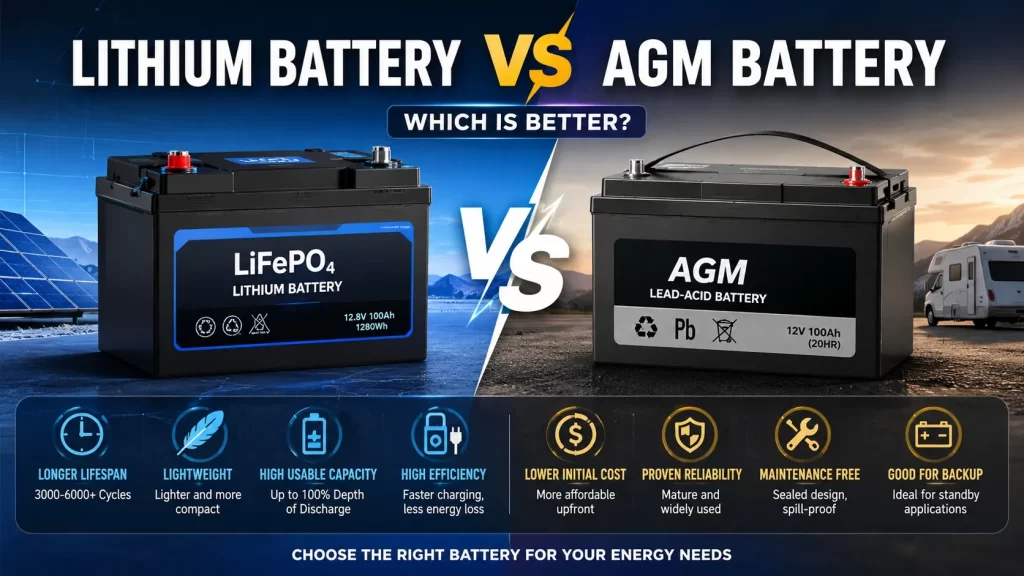
However, lithium or AGM, which is the better?
It will depend on your application, budget, energy needs, installation and expected battery life. Lithium batteries provide many benefits in many applications where long term performance, lightweight and high useful capacity are important. However, for users seeking to purchase a lower initial cost and an easy-to-use, reliable battery system, AGM batteries are an appealing option.
What Is a Lithium Battery?
A lithium battery is a battery made of lithium-based cells. However, in today's energy storage solutions, lithium iron phosphate (LiFePO4) is a lot more popular for its superb cycle life, thermal stability, and safety.
Lithium batteries are standard in batteries such as:
- Solar energy storage systems
- RV and marine power systems
- Portable power stations
- Electric vehicles
- Backup power systems
- Off-grid energy systems
- Telecommunications
One important benefit of Lithium Technology is that it possesses a high energy density. Lithium battery can store a lot of energy in a relatively small and light package.
What Is an AGM Battery?
Absorbent Glass Mat or AGM batteries are one type of sealed lead-acid battery. Fiberglass mats absorb the electrolyte in between the plates, preventing any spills and resulting in a mostly maintenance-free battery.
AGM batteries are typically found in:
- UPS systems
- Emergency backup power
- Automotive applications
- RVs and boats
- Security systems
- Telecommunications
- Small solar systems
AGM batteries have been used for decades and are known for their reliability, relatively low purchase price, and simple installation.
Lithium Battery vs AGM Battery: Key Differences
The biggest differences between lithium and AGM batteries involve usable capacity, lifespan, weight, charging efficiency, maintenance, and cost.
| Feature | Lithium Battery | AGM Battery |
|---|---|---|
| Energy Density | High | Lower |
| Weight | Lightweight | Heavy |
| Usable Capacity | Typically higher | Typically lower |
| Cycle Life | Much longer | Shorter |
| Charging Efficiency | Very high | Lower |
| Maintenance | Low | Low |
| Upfront Cost | Higher | Lower |
| Long-Term Cost | Often lower | Can be higher |
| Deep Discharge | Better suited | Can reduce lifespan |
| Battery Management | Usually requires BMS | Generally simpler |
1. Lifespan and Cycle Life
When it comes to lithium vs AGM, battery lifespan is one of the most significant criteria.
A quality LiFePO4 Lithium battery can perform thousands of cycles of charge/discharge if it is maintained in good health. The number of cycles an AGM battery can achieve is typically much fewer than deep-discharge batteries, especially those that are discharged repeatedly.
This property is particularly appealing for solar storage, RVs, marine systems, and other applications that require frequent cycling.
With an expected daily use life for many years, lithium technology may offer better value for the long-term.
2. Usable Battery Capacity
Lithium batteries tend to yield more usable energy for the same nominal battery capacity.
Repeated deep discharging of an AGM battery, for instance, might reduce the battery life. This means that users may have to reserve a greater percentage of the battery's capacity.
It is possible to achieve a much higher percentage of the rated capacity in lithium batteries without the degradation that can be seen in deep cycling lead acid batteries.
Lithium can then offer more practical capacity, in applications where available energy is important.
3. Weight and Size
Another significant benefit of lithium batteries is their weight.
For similar usable energy, a lithium battery can be substantially lighter than an AGM battery. This is especially crucial for RVs, boats, portable energy systems and mobile equipment where each kg counts.
The ease of installation and the cost savings of transportation can also be achieved with a lighter battery.
Lithium is generally the preferred material if you need a high energy density but don't require much weight.
4. Charging Efficiency
Lithium batteries are more efficient when it comes to charging than AGM batteries.
More of the electric power delivered to a lithium battery can be stored. The charging losses are higher and the charging time is longer for AGM batteries, particularly at the end of the charge.
This variation can be significant in solar power systems. The more efficient a charger is, the more energy a solar panel produces can be stored and used.
This can boost the overall efficiency of the system for off-grid applications.
5. Maintenance Requirements
Both types of Lithium and AGM batteries require relatively little maintenance than flooded lead acid batteries.
AGM batteries are sealed and generally do not need to be maintained regularly with respect to electrolyte level. Lithium batteries are also low maintenance.
Usually, however, a Battery Management System (BMS) is included in lithium batteries. The BMS can be used to monitor voltage, temperature, current and other operating conditions, and it can also provide important protection functions.
This increases the complexity of the system, but also allows for advanced battery monitoring and protection.
6. Upfront Cost vs Long-Term Value
The problem with lithium batteries is that they're more expensive to buy than other types.
When it comes to battery prices, an AGM battery can be quite a bit cheaper than other batteries that have the same nominal voltage and capacity.
But it is not enough to just get the purchase price information.
Typical lithium batteries provide:
- Longer service life
- More usable capacity
- Higher charging efficiency
- Lower weight
- Better performance during frequent cycling
Therefore, lithium can have a lower cost per cycle or lower total cost of ownership over the lifetime of the system.
AGM may still be more economical for applications with low cycling frequency or limited budgets.
7. Performance in Different Applications
The best battery depends heavily on how you plan to use it.
Solar Energy Storage
For daily solar charging and discharging, lithium batteries are generally the better option because of their longer cycle life, high efficiency, and greater usable capacity.
RV and Marine Applications
Lithium batteries are increasingly popular in RVs and boats because they reduce weight while providing more usable energy.
AGM remains a good option for users who prioritize lower upfront costs or have relatively simple power requirements.
Backup Power
For occasional backup applications, AGM batteries can be an economical choice. If the system requires frequent cycling or long-term operation, lithium may provide better overall value.
Portable Power Systems
Lithium batteries are usually the preferred solution because their high energy density allows manufacturers to create compact and lightweight power systems.
Lithium vs AGM: Which Battery Should You Choose?
There is no single answer for every application.
Choose a lithium battery if you prioritize:
- Long service life
- Frequent charging and discharging
- Lightweight design
- High usable capacity
- High charging efficiency
- Solar and off-grid applications
- Lower long-term operating costs
Choose an AGM battery if you prioritize:
- Lower initial purchase price
- Simple installation
- Occasional backup power
- Established lead-acid technology
- Applications where weight is not a major concern
When considering long-term investments in solar, RV, marine and portable applications, it's important to understand that LiFePO4 lithium batteries frequently make more sense. But for many traditional backup and low cycle applications, AGM batteries continue to be a viable, low-cost option.
Frequently Asked Questions
Is lithium better than AGM?
In most applications with high number of cycles, long life, low weight and high usable capacity, lithium batteries appear to be superior. AGM batteries may be a better choice when cost of the initial battery is the main concern.
How long do lithium batteries last compared with AGM?
Lithium batteries typically have much higher number of charge and discharged cycles than AGM batteries. The actual life of the battery will vary depending on the battery chemistry, depth of discharge, temperature, charging practices and operating conditions.
Are lithium batteries worth the extra cost?
They can be. Lithium batteries typically cost more initially, but can be more cost effective throughout their lifespan due to their longer life, higher capacity, lightweight, and high efficiency.
Can I replace an AGM battery with a lithium battery?
Many applications, yes, but the charging system must meet the lithium battery's needs. Before making the replacement, the voltage, the settings of the charger, the battery management system, the temperature limits and the system specifications should be checked.
Conclusion
Battery types are not a one size fits all proposition—Lithium battery is not necessarily the superior choice to AGM battery, and vice versa. For many low cycle applications, AGM batteries provide affordable, proven technology and reliable performance. Lithium batteries offer increased energy density, cycle life, lower weight, and usable capacity.
Lithium batteries can be more suitable for applications such as RVs, marine storage, portable power stations, and other situations where performance and long-term value are essential. AGM batteries can be a good value for temporary power or economical projects.
The best option will vary based on your energy needs, how often you ride, budget, space constraints, weight considerations and anticipated lifespan.
Share on Social:


In This Article
- 1 What Is a Lithium Battery?
- 2 What Is an AGM Battery?
- 3 Lithium Battery vs AGM Battery: Key Differences
- 4 1. Lifespan and Cycle Life
- 5 2. Usable Battery Capacity
- 6 3. Weight and Size
- 7 4. Charging Efficiency
- 8 5. Maintenance Requirements
- 9 6. Upfront Cost vs Long-Term Value
- 10 7. Performance in Different Applications
- 11 Lithium vs AGM: Which Battery Should You Choose?
- 12 Frequently Asked Questions
- 13 Conclusion
