


Inverter Power Solar MPPT Design Guide for Dual MPPT Systems


For an Inverter Power Solar system, PV capacity alone does not determine energy yield. Two arrays rated at the same kWp can behave very differently because module temperature, roof orientation, shading, string voltage and operating current continuously shift the maximum power point.

This is why MPPT architecture should be treated as an electrical design decision rather than a feature-list item.
The JSDSolar J6KHB 48V 6kW hybrid storage inverter uses two independent MPP trackers with one PV string per tracker. Its technical data specifies 7,800W maximum recommended DC power, 500V maximum DC voltage, 18A input current per MPPT and 25A maximum short-circuit current per tracker.
Why Two PV Arrays Need Independent MPPT Control
A solar module does not operate at a fixed voltage. Its I-V and P-V curves change with irradiance and cell temperature.
Consider an Inverter Power Solar installation with:
• One east-facing array;
• One west-facing array;
• Partial morning shading on one roof;
• Different module temperatures during the day.
Connecting these electrically different arrays to one tracker forces them toward a shared operating condition. Neither array may remain at its individual maximum power point.
Dual MPPT separates this behavior.
| PV Layout | One MPPT | Dual MPPT |
| Same orientation, uniform sunlight | Usually acceptable | Limited additional gain |
| East + west roof | Higher mismatch potential | Each array tracks independently |
| One shaded array | Shading can affect common operating point | Shaded array remains electrically separate |
| Different string conditions | Harder to optimize | Greater design flexibility |
Dual MPPT therefore does not automatically "increase generation." It reduces mismatch losses when the two PV groups require different electrical operating points.
MPPT Range, Startup Voltage and Full-Load Voltage Are Different Limits
A professional Inverter Power Solar design must distinguish several voltage values.
For the J6KHB, JSDSolar lists:
| Parameter | J6KHB |
| Maximum DC voltage | 500V |
| Nominal DC operating voltage | 360V |
| MPPT voltage range | 70–480V |
| MPPT range at full load | 220–500V |
| Start input voltage | 125V |
| Number of MPPTs | 2 |
Cold-Weather Voc Determines Maximum String Length
Series modules increase voltage. The design check is not simply:
Module Voc × module quantity < 500V
Voc rises as module temperature falls. The correct engineering check should use the manufacturer's Voc temperature coefficient and the site's minimum design temperature.
A practical rule is:
N × Voc at minimum temperature < inverter maximum DC voltage
Operating too close to 500V at STC can leave insufficient cold-weather voltage margin.
Hot-Weather Vmp Determines Whether the String Remains Useful
High module temperature normally reduces Vmp.
A string may therefore satisfy the cold Voc limit but still operate too close to the lower MPPT boundary during hot conditions.
For high-output operation, the 220V full-load MPPT lower limit is particularly important. A short string operating well below this region may remain detectable by the MPPT but may not support full inverter output under the same conditions.
High-Current Solar Modules Change the MPPT Design
Modern high-wattage modules increasingly make current compatibility as important as voltage compatibility.
Each J6KHB tracker is specified for:
• 18A maximum PV input current
• 25A maximum short-circuit current
• One string per MPPT
This means an installer should compare:
Module Imp → MPPT operating-current limit
and
Module Isc → short-circuit-current limit
A panel cannot be judged compatible simply because it is described as a "550W" or "600W" module.
For every Inverter Power Solar project, JSDSolar recommends evaluating at least:
• Voc;
• Vmp;
• Isc;
• Imp;
• Voc temperature coefficient;
• Module quantity per string.
This is also why "dual MPPT" should not be confused with "multiple parallel strings." The J6KHB configuration is 2 MPPT × 1 string per MPPT, so parallel-array design assumptions used for other inverter architectures should not be applied automatically.
Why a 6kW Inverter Can Use 7.8kW of PV
The J6KHB combines 6,000VA nominal AC output with 7,800W recommended maximum PV input, giving a nominal DC/AC ratio of approximately:
7,800 ÷ 6,000 = 1.30
That does not mean the inverter continuously delivers 7.8kW AC.
PV oversizing can improve useful generation when modules are below STC output because of:
• Morning and afternoon irradiance;
• Cloud cover;
• High module temperature;
• Seasonal solar angles;
• Normal module and wiring losses.
However, during high irradiance, the Inverter Power Solar system may reach its conversion or energy-absorption limits.
| Design Factor | Lower DC/AC Ratio | Approx. 1.30 DC/AC Ratio |
| Low-light energy availability | Lower | Higher |
| Peak clipping possibility | Lower | Higher |
| PV utilization window | Shorter | Potentially longer |
| Battery/load absorption requirement | Lower | More important |
PV oversizing should therefore be evaluated from annual energy behavior, not only peak panel wattage.
MPPT Harvest Must Match the 48V Battery and Load
Good MPPT performance is only one part of an Inverter Power Solar energy balance.
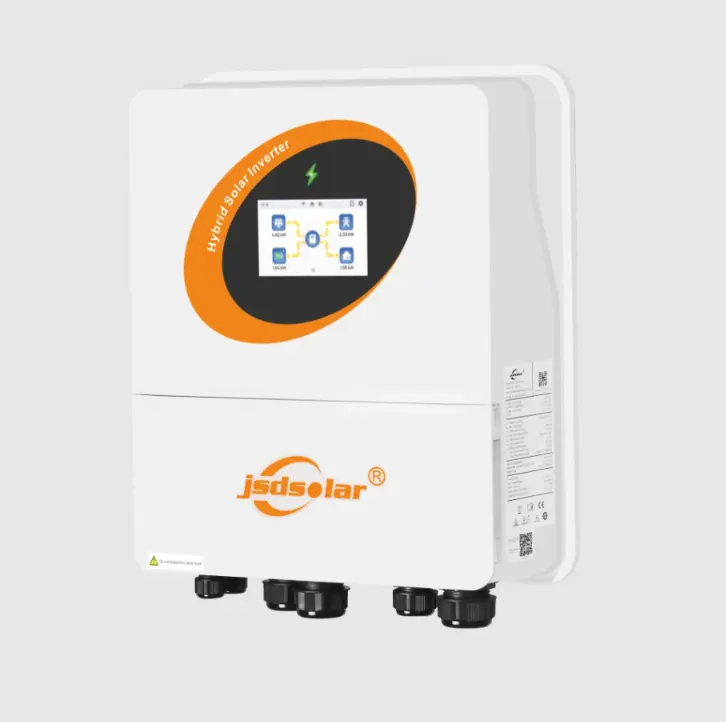
The J6KHB is designed around a recommended 48V battery platform, supports lithium and lead-acid batteries and integrates CAN, RS485, WiFi, LAN and DRM communication. Its technical data also lists 6,000VA EPS power with switching below 20ms.
The complete power path is:
PV array → MPPT → DC bus → battery / inverter → AC load
If the battery is nearly full while AC demand is low, there may be nowhere for all available PV power to go. In that condition, the control system may curtail PV production even though irradiance remains high.
Therefore, increasing PV capacity without considering:
• Battery usable capacity;
• Charge-current limits;
• Daytime load;
• Evening consumption;
• Backup reserve;
can result in lower-than-expected utilization.
Installation Details That Protect MPPT Performance
Correct commissioning is essential for maintaining the expected Inverter Power Solar output.
Installers should verify:
Keep Different Roof Conditions on Separate Trackers
East/west orientations or independently shaded arrays should generally use different MPPT channels.
Avoid Mixed Modules Within One String
Modules in series share string current. Significant differences in current rating, ageing or shading can increase mismatch loss.
Control DC-Side Losses
Check:
• Cable cross-section;
• Connector rating;
• DC voltage drop;
• Polarity;
• Insulation resistance;
• Terminal torque;
• Actual operating Vmp after startup.
Monitoring should then be used to compare MPPT1 and MPPT2 voltage, current and daily energy. A persistent difference should be investigated rather than automatically attributed to weather.
Do Not Confuse MPPT Efficiency With Inverter Efficiency
JSDSolar specifies:
• MPPT efficiency: 99.9%
• Euro efficiency: 97%
• Maximum efficiency: 97.6%
• Maximum battery charge/discharge efficiency: 95%
These values describe different conversion stages.
A 99.9% MPPT efficiency means the controller can closely track available PV power under defined test conditions. It does not mean 99.9% of panel energy reaches the AC load.
This distinction matters when comparing Inverter Power Solar products from different suppliers.
Final Technical Check Before Purchasing
Before selecting an inverter, request or calculate:
• PV data: Voc, Vmp, Isc, Imp and temperature coefficients.
• Site data: Minimum temperature, maximum module temperature, orientation and shading.
• String design: Modules in series, operating voltage and current.
• Storage data: Battery voltage, capacity and charge/discharge limits.
• Load data: Peak kW, daily kWh and EPS-critical loads.
• Compliance data: Certificates and test reports applicable to the actual model and destination market.
For projects requiring a 48V, 6kW Inverter Power Solar architecture, the JSDSolar J6KHB combines dual MPPT control, up to 7,800W recommended PV input, storage integration and EPS backup in one platform. Rather than selecting the inverter from nominal wattage alone, installers and distributors can review the JSDSolar J6KHB technical specifications and match the PV string, battery and load profile before finalizing the system.
FAQs
Q1. What type of Inverter Power Solar system does JSDSolar offer?
JSDSolar provides hybrid and off-grid solar inverter solutions designed to integrate PV generation, battery storage, AC loads and backup power. Its J6KHB is a 48V 6kW hybrid storage inverter designed for residential and distributed energy applications.
Q2. Does the JSDSolar J6KHB use dual MPPT?
Yes. The J6KHB uses two independent MPPT trackers, with one PV string connected to each tracker. This architecture is useful when two PV arrays have different orientations, irradiance levels or shading conditions.
Q3. What is the recommended maximum PV input for the JSDSolar J6KHB?
The J6KHB technical specifications list a maximum recommended DC input power of 7,800W with 6,000VA nominal AC output. This gives an approximate DC/AC ratio of 1.30.
Q4. What PV voltage range should installers consider?
The J6KHB technical data lists a 70–480V MPPT operating range, 125V startup voltage and 500V maximum DC input voltage. Installers should calculate both cold-weather Voc and hot-weather Vmp before determining string length.
Q5. What is the maximum PV current per MPPT?
Each MPPT is specified for up to 18A maximum operating input current and 25A maximum short-circuit current. Module Imp and Isc should therefore be checked before selecting high-current PV modules.


In This Article
- 1 Why Two PV Arrays Need Independent MPPT Control
- 2 MPPT Range, Startup Voltage and Full-Load Voltage Are Different Limits
- 3 Cold-Weather Voc Determines Maximum String Length
- 4 Hot-Weather Vmp Determines Whether the String Remains Useful
- 5 High-Current Solar Modules Change the MPPT Design
- 6 Why a 6kW Inverter Can Use 7.8kW of PV
- 7 MPPT Harvest Must Match the 48V Battery and Load
- 8 Installation Details That Protect MPPT Performance
- 9 Do Not Confuse MPPT Efficiency With Inverter Efficiency
