


Best Portable Power Stations Manufacturer

Portable power stations are a great backup power and outdoor recreation solution, emergency power, remote work solution and mobile solution. With the demand for a reliable power source continually growing, it's a priority for distributors, retailers, OEM buyers and commercial customers to select the best portable power station manufacturer.
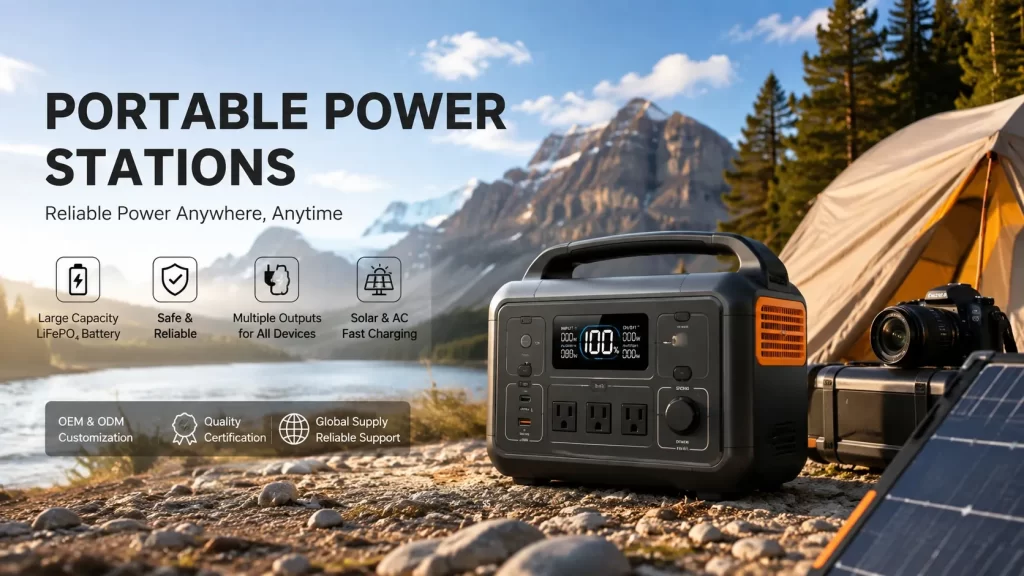
More than a high-capacity battery should be offered by a professional manufacturer. Factors such as product safety, battery technology, power output, charging efficiency, durability, customization, certifications, and after-sales support all contribute to the long-term value of portable power station.
What Is a Portable Power Station?
A portable power station is a battery-powered energy storage device that can be used to generate power without a plug. The portable power stations normally function with lower noise and with no direct exhaust gases during operation when compared to conventional generators.
Modern models can supply power to a variety of devices such as smartphones, laptops, lights, routers, cameras, refrigerators, medical equipment and selected power tools. They can have AC outlets, USB-A ports, USB-C ports, DC outputs, and car charging ports, depending on the capacity and design.
Portable power stations deliver flexible power in situations where grid electricity isn't available or reliable for consumers and businesses.
Why Choose a Professional Portable Power Stations Manufacturer?
Manufacturer has an obvious impact on quality, reliability and safety of products. A professional supplier will have a proven track record and experience in the field of battery management systems, power electronics, thermal management, enclosure design, and quality control.
1. Advanced Battery Technology
Battery performance is one of the most crucial criteria to consider when checking out portable power station manufacturer. Because of their high energy density and relatively small size, lithium-ion batteries are broadly used.
Another lithium battery technology that is gaining traction is lithium iron phosphate (LiFePO4) technology for its durability and thermal resistance properties. The suitable battery technology should be chosen by the manufacturer and integrated for the intended application, capacity, operating environment and target market.
2. Reliable Battery Management Systems
A battery management system or BMS can aid in monitoring important battery parameters like voltage, temperature, charging status and current.
The BMS can offer several protection layers to prevent overcharging, over-discharging, overcurrent, overheating, and short circuit. When choosing an extended manufacturing partner, battery management is an important factor to take into account.
3. Multiple Power Output Options
Various power connections are required for various users. A good portable power station can incorporate a number of output technologies to help power a variety of electronic devices.
Common interfaces include:
- AC outlets for household and professional equipment
- USB-C ports for modern laptops and mobile devices
- USB-A ports for smaller electronics
- DC outputs for compatible equipment
- 12V car-style outlets
- Wireless charging on selected models
Manufacturers that offer flexible platform designs can better serve different market segments.
Key Features to Look for in a Portable Power Station
When comparing manufacturers, buyers should evaluate more than battery capacity.
Capacity and Output Power
Capacity is generally expressed in watt-hours (Wh), while output power is measured in watts (W). Capacity indicates approximately how much energy the battery stores, while output power determines what type of equipment the unit can operate.
For example, a compact model may be suitable for phones, cameras, and laptops, while higher-capacity systems may be designed for refrigerators, communication equipment, or emergency backup applications.
The best manufacturer should provide multiple capacity and power configurations to meet different customer requirements.
Fast Charging
Charging speed is another important product feature. Depending on the design, portable power stations can be charged through AC power, solar panels, vehicle charging systems, or combinations of these methods.
Solar charging is particularly useful for camping, outdoor work, emergency preparedness, and off-grid applications. Manufacturers with strong engineering capabilities can optimize charging systems to improve efficiency while maintaining battery protection.
Safety and Certifications
Safety should be a top priority when purchasing portable energy storage equipment. Buyers should ask manufacturers about applicable product testing, battery safety measures, transportation requirements, and market-specific certifications.
For international distribution, certification requirements may vary by country and application. Working with an experienced manufacturer can help buyers understand which compliance documentation is necessary for their target market.
OEM and ODM Customization
For distributors and brands, customization can be a major advantage when choosing a portable power stations manufacturer.
OEM services may allow customers to apply their own branding, packaging, labels, and product configurations. ODM services can go further by supporting customized product design, appearance, capacity, interfaces, software functions, or other specifications.
A manufacturer offering flexible OEM and ODM capabilities can help businesses create differentiated products instead of competing solely on price.
Quality Control Matters
Portable power stations combine batteries, electronic components, charging systems, inverters, cooling structures, and protective circuits. Quality control must therefore cover the entire production process.
A reliable manufacturer should have procedures for incoming component inspection, battery testing, assembly inspection, electrical testing, aging tests, safety verification, and final product inspection.
Consistent quality control helps reduce product failures, returns, warranty costs, and customer complaints.
Applications of Portable Power Stations
Portable power stations serve a broad range of markets.
Outdoor recreation: Camping, hiking, RV travel, fishing, and outdoor events can benefit from portable electricity.
Emergency backup: Portable power stations can provide temporary electricity for communication equipment, lighting, networking devices, and essential electronics during power interruptions.
Remote work: Laptops, monitors, routers, and other office equipment can be powered in locations without convenient access to electricity.
Professional applications: Photographers, videographers, construction teams, technicians, and field workers can use portable power for equipment in remote environments.
Renewable energy: Solar-compatible power stations can be integrated into portable energy systems, offering a flexible approach to off-grid electricity.
How to Select the Best Manufacturer
Before placing an order, B2B buyers should evaluate several factors:
- Product range: Does the manufacturer offer suitable capacities and output configurations?
- Battery technology: What battery cells and management systems are used?
- Safety: Are appropriate testing and certifications available?
- Manufacturing capability: Can the supplier support stable production volumes?
- OEM/ODM services: Can the product be customized for your brand?
- Quality control: What testing procedures are used before shipment?
- Lead times: Can the manufacturer maintain reliable delivery schedules?
- After-sales support: Does the supplier provide technical and warranty assistance?
- Experience: Does the manufacturer understand international markets and customer requirements?
- Total cost: Does the product provide competitive value rather than simply the lowest purchase price?
Why Manufacturer Experience Matters
Portable energy storage is a rapidly developing industry. Battery chemistry, inverter technology, charging solutions, smart control and energy management systems continue to evolve.
A knowledgeable manufacturer will be more likely to have a chain of supply, engineering capabilities, testing, and manufacturing. This can assist businesses minimize development risk and deliver reliable products quicker.
Whole-salers and private-label manufacturers could also benefit from a long-term manufacturing relationship, which can lead to greater consistency in product quality and more streamlined communication.
Conclusion
When selecting the best portable power stations manufacturer, one should take into account the battery technology, power capacity, safety measures, charging speed, battery quality control, customization options, certifications, and production capacity.
The right supplier should be able to offer reliable products for various applications and meet OEM and ODM needs, ensure stable production, technical development, and long-term business cooperation.
No matter if you are a distributor, retailer, brand of outdoor equipment or an energy solution company, having an experienced portable power station manufacturer on your side can help you create a safer, more competitive and reliable product line. Look at the total package of technology, quality, customization, compliance and service, not just the price, and determine the best fit manufacturer for your market.
Share on Social:


In This Article
- 1 What Is a Portable Power Station?
- 2 Why Choose a Professional Portable Power Stations Manufacturer?
- 3 Key Features to Look for in a Portable Power Station
- 4 OEM and ODM Customization
- 5 Quality Control Matters
- 6 Applications of Portable Power Stations
- 7 How to Select the Best Manufacturer
- 8 Why Manufacturer Experience Matters
- 9 Conclusion
