


Solar Street Lights vs Grid-Powered Street Lights
The safety of urban and rural roads and the public's safety and security are closely linked to the lighting.The street light has an important role in the improvement of road safety, public security, transportation efficiency and urban and rural environment quality. The contrast between solar street lights and grid-powered street lights is becoming a critical consideration as urban and rural areas and areas like industrial parks or infrastructure need more sustainable and cost-effective lighting options.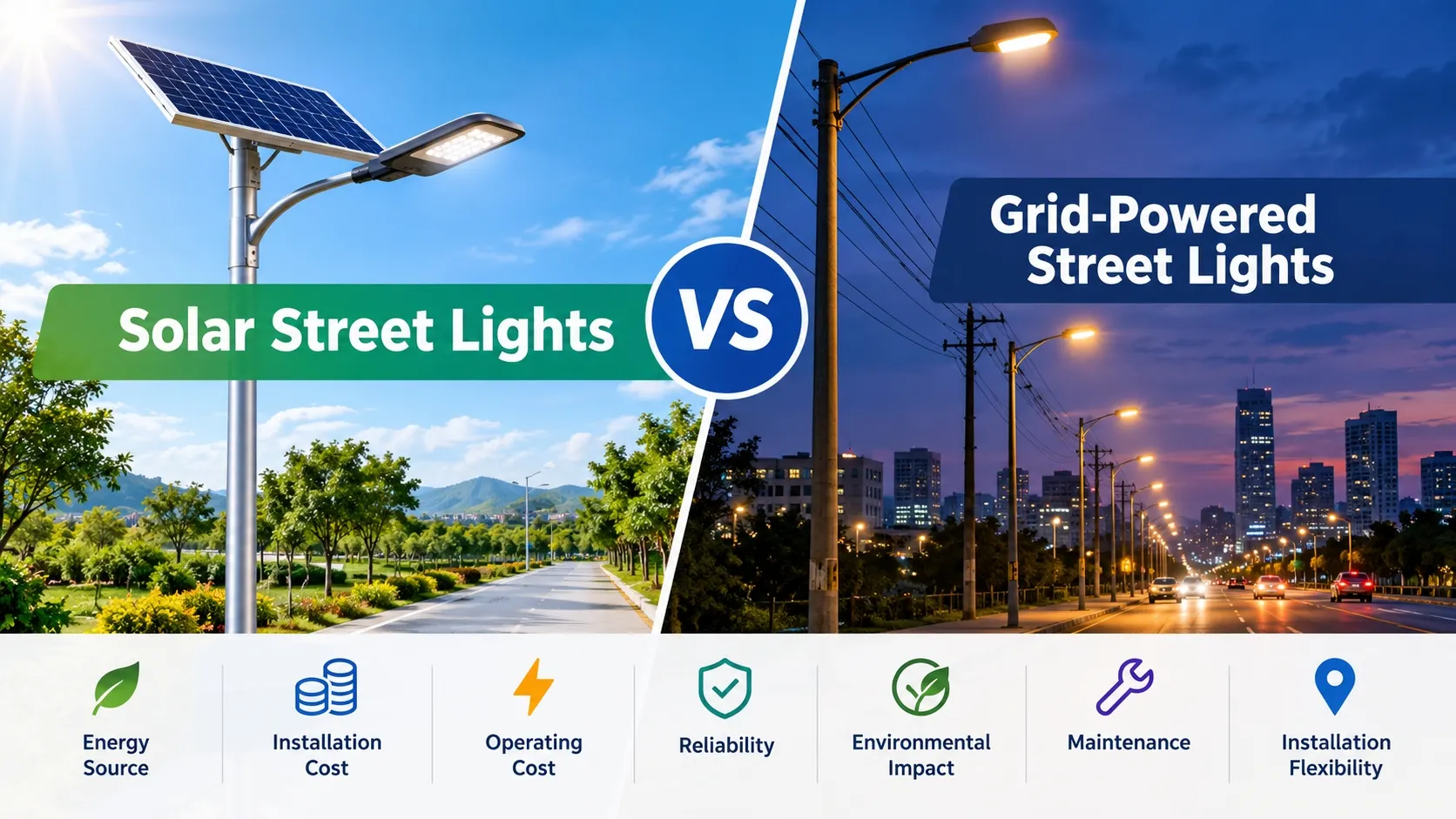
Street lights have been around for a long time and are still prevalent in many cities around the world. But, solar street lighting technology has come a long way and delivers an alternative that can help lower electricity use, make installation easier, and help illuminate hard-to-reach areas.
Hence, which one would be better, solar street lights or grid powered street lights?
This will depend on the location of installation, availability of infrastructure, budget, energy costs, weather and the long-term maintenance needs. This guide provides a comparison of the two systems to aid project owners, contractors, municipalities and businesses in making an informed choice.
What Are Solar Street Lights?
Solar street lights are such outdoor lighting systems, which are operated mainly with energy collected from the sun. Solar panels harness solar energy during the day and transform it into electricity. At night the electricity is stored in the battery and used to light the LED lights.
The typical solar street light system consists of:
- Solar panel
- LED light fixture
- Rechargeable battery
- Solar charge controller
- Lighting pole and mounting structure
- Motion sensor or smart lighting controller in some systems
Currently, many solar street lights are all-in-one systems, whereas split-type solar street lights consist of a separate solar panel, batteries, and LED fixture.
Solar street lights are not connected to the electrical grid and are installed in remote areas, rural roads, parks, parking lots, construction sites, residential communities, and other areas where electrical infrastructure would be costly to lay underground.
What Are Grid-Powered Street Lights?
Street lights that are powered by a grid have their electricity supplied via the local electricity service. A lighting system is controlled by timers, photocells or smart control system, each of which is electrically connected to the street lights by electrical cables.
Typical street lighting systems with a traditional approach to powering the lights with electricity use the following components:
- LED or conventional street light fixture
- Electrical cables
- Utility grid connection
- Control system
- Street light pole
- Electrical protection equipment
Grid-powered systems are particularly common in large cities and established urban areas where electrical infrastructure is already available.
Although grid electricity can provide stable and consistent power, installation may require trenching, wiring, electrical permits, and ongoing electricity payments.
Solar Street Lights vs Grid-Powered Street Lights: Key Differences
1. Energy Source
The biggest difference between solar street lights and grid-powered street lights is their energy source.
Solar street lights use renewable energy from sunlight. Solar panels collect energy during the day, and batteries store the electricity for nighttime operation.
Grid-powered street lights depend on electricity supplied through the public utility network.
Winner: Solar Street Lights
Solar lighting offers greater energy independence and reduces reliance on conventional electricity sources. For projects focused on renewable energy and sustainability, solar street lighting is an attractive option.
2. Installation Cost
The initial purchase price of a solar street light can sometimes be higher than the cost of a basic grid-powered LED fixture. However, the total installation cost can be significantly different.
Grid-powered street lights often require:
- Underground cable installation
- Trenching
- Electrical connections
- Distribution equipment
- Professional electrical labor
- Permits and inspections
These infrastructure requirements can make installation expensive, especially in undeveloped or remote locations.
Solar street lights usually require fewer electrical construction activities because they operate independently. In many cases, installation mainly involves preparing the foundation and installing the lighting pole.
Winner: Solar Street Lights for Remote Projects
For locations without existing electrical infrastructure, solar street lights can significantly reduce construction complexity and installation costs.
3. Operating Costs
Operating costs are one of the most important considerations when comparing the two systems.
Solar street lights generate electricity from sunlight, meaning there are generally no monthly electricity bills for normal operation.
Grid-powered street lights consume electricity from the utility network. Even energy-efficient LED fixtures create ongoing electricity expenses.
Over time, these electricity costs can become significant for large projects involving hundreds or thousands of street lights.
Winner: Solar Street Lights
Solar street lighting can provide substantial long-term savings by reducing or eliminating electricity costs.
4. Reliability and Power Availability
Grid-powered street lights generally provide stable power as long as the electrical grid is functioning properly.
However, grid systems can be affected by:
- Power outages
- Electrical failures
- Storm damage
- Infrastructure problems
Solar street lights operate independently and are not directly affected by grid outages. A properly designed battery system can continue powering the lights using stored energy.
However, solar performance depends on local sunlight conditions. Extended periods of cloudy weather may reduce the amount of energy collected.
High-quality solar street lighting systems address this issue through properly sized solar panels, efficient batteries, intelligent controllers, and energy-saving lighting modes.
Winner: Depends on the Location
Grid power may provide consistent energy in areas with reliable electrical infrastructure, while solar street lights offer greater independence during grid outages.
5. Environmental Impact
Solar street lights use renewable solar energy and can reduce dependence on electricity generated from fossil fuels.
They can help support:
- Lower carbon emissions
- Renewable energy adoption
- Sustainable infrastructure development
- Reduced electricity consumption
Grid-powered street lights can also become more environmentally friendly as power grids increasingly use renewable energy. However, their environmental impact still depends on how the local electricity is generated.
Winner: Solar Street Lights
For projects with sustainability and environmental goals, solar-powered lighting offers a clear advantage.
6. Maintenance Requirements
Both solar and grid-powered LED street lights require maintenance over time.
Solar street light maintenance may include:
- Cleaning solar panels
- Checking battery performance
- Inspecting controllers
- Replacing batteries when necessary
Grid-powered street lights may require:
- Electrical cable maintenance
- Fixture replacement
- Electrical troubleshooting
- Infrastructure repairs
Modern LED technology has reduced maintenance requirements for both systems compared with older lighting technologies.
The quality of components plays a major role. A well-designed solar street light using reliable batteries and efficient LED chips can provide years of dependable operation.
Winner: Depends on Product Quality
Both systems can offer low maintenance requirements when designed with high-quality components.
7. Installation Flexibility
Solar street lights can be installed in locations where connecting to the electrical grid would be difficult or expensive.
Common applications include:
- Rural roads
- Highways
- Parks
- Farms
- Construction sites
- Industrial areas
- Parking lots
- Residential communities
- Remote villages
Grid-powered lights are generally easier to install where electrical infrastructure already exists.
Winner: Solar Street Lights
Solar lighting provides greater flexibility for remote and off-grid locations.
Cost Comparison: Which Option Saves More Money?
When comparing solar street light cost vs grid-powered street light cost, it is important to consider the total lifecycle cost rather than only the initial product price.
A grid-powered street light may have a lower initial fixture cost, but the project may also require expensive electrical infrastructure and ongoing electricity payments.
A solar street light may have a higher upfront equipment cost, but installation can be simpler and electricity costs can be dramatically reduced.
The total cost depends on:
- Local electricity prices
- Labor costs
- Distance from the electrical grid
- Number of street lights
- Battery technology
- Solar resources
- Installation requirements
- Maintenance costs
For remote projects, solar street lights are often the more economical solution because extending electrical cables over long distances can be extremely expensive.
When Should You Choose Solar Street Lights?
Solar street lights are an excellent choice when:
- The installation location is far from the electrical grid
- Electricity costs are high
- Renewable energy is a project priority
- Fast installation is required
- Underground wiring is expensive
- Grid independence is important
- The location receives sufficient sunlight
They are particularly suitable for rural infrastructure, developing communities, outdoor facilities, and projects with limited electrical access.
When Should You Choose Grid-Powered Street Lights?
Grid-powered street lights may be a better option when:
- Reliable electrical infrastructure already exists
- The installation area has limited sunlight
- Very high and continuous power demand is required
- The project is located in a dense urban environment
- Existing electrical systems can easily support additional lighting
In established cities, grid-powered LED street lighting may remain a practical solution, particularly when the infrastructure is already in place.
The Future of Street Lighting
The future of outdoor lighting is increasingly focused on energy efficiency, smart controls, renewable energy, and intelligent infrastructure.
Modern solar street lights can include technologies such as:
- Motion sensors
- Automatic dimming
- Remote monitoring
- IoT connectivity
- Smart energy management
- High-efficiency lithium batteries
The technologies contribute to enhanced battery performance and minimisation of unnecessary energy use.
Hybrid-fixing solutions are becoming more popular too. A hybrid street lighting system may utilize both solar power sources and grid power sources, thus allowing for increased flexibility in locations with varying weather conditions or lighting needs.
LED technology, batteries, and intelligent control systems will further enhance the capabilities of solar panels as a light source, making solar street lighting more significant in future constructions.
Conclusion: Solar Street Lights vs Grid-Powered Street Lights
There is no one-size-fits-all solution when it comes to solar street light vs grid-powered street light.
The solar street lights have several important benefits, such as energy independence, renewable energy, and installation flexibility, as well as electricity savings. They are especially useful in the regions where electrical power is difficult or costly to obtain.
Grid-powered street lights are reliable, provide consistent power, and could be very useful in cities where there is already an electrical grid in place.
For a lot of contemporary projects, the optimal selection will rely on the assessment of the overall LCC, local environmental factors, energy supply, and long-term infrastructure needs.
In the face of Sustainable City investments, solar street lights are increasingly competing with the grid power and systems. The use of solar-powered street lighting can offer sustainable, economic, and environmentally friendly illumination for various applications, thanks to its energy-efficient LED technology, long-lasting lithium batteries, and intelligent energy management systems.
Project owners should thoroughly consider the amount of sunlight available, the cost of installation, energy needs, and maintenance needs before choosing a lighting system. The right solution can save long life cycle costs, enhance safety, sustainability and lighting performance.
Share on Social:


In This Article
- 1 What Are Solar Street Lights?
- 2 What Are Grid-Powered Street Lights?
- 3 Solar Street Lights vs Grid-Powered Street Lights: Key Differences
- 4 Cost Comparison: Which Option Saves More Money?
- 5 When Should You Choose Solar Street Lights?
- 6 When Should You Choose Grid-Powered Street Lights?
- 7 The Future of Street Lighting
- 8 Conclusion: Solar Street Lights vs Grid-Powered Street Lights
