


Residential Solar vs Utility-Scale Solar: Key Differences
The world's electricity industry is changing with solar power. PV technology is contributing to fossil-fuel alternatives and the provision of renewable energy from rooftop PV panels on individual homes to huge solar facilities spanning hundreds, even thousands, of acres.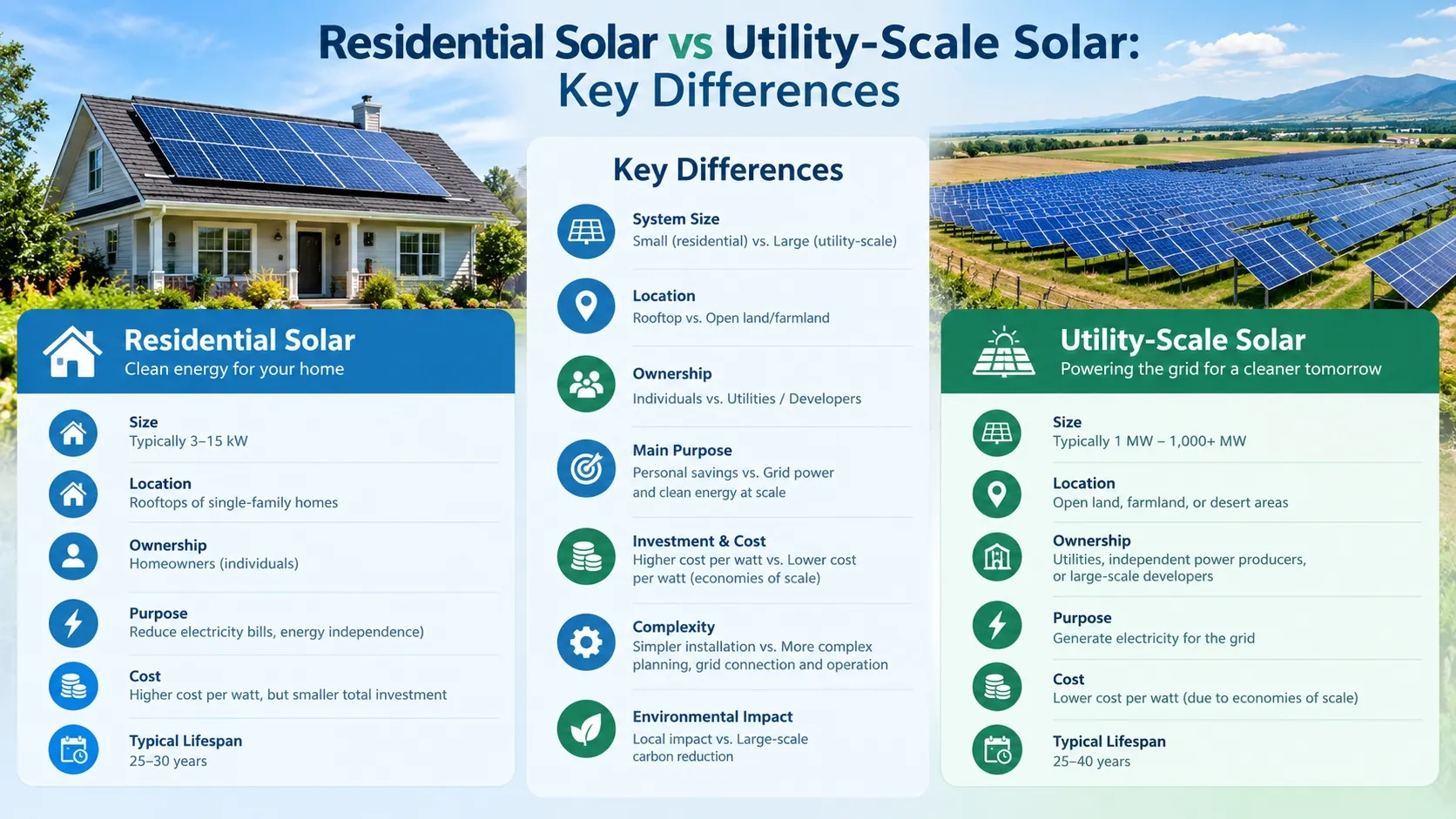
But there are not all solar projects created equal. Residential solar and utility-scale solar are among the two most significant types. The main difference between the two is that they differ significantly in size, setup, ownership, cost, energy generated, electrical connection and use.
Comparing residential solar vs utility-scale solar can inform homeowners, businesses, investors and energy professionals in making their more informed choices for solar power.
What Is Residential Solar?
Residential solar is solar energy systems used in residential buildings. These systems generally are set up on roofs, but when sufficient land is available ground-mounted solar systems can be set up.
A residential solar system consists of:
- Solar panels
- A solar inverter
- Mounting equipment
- Electrical wiring and protection devices
- Monitoring equipment
- Optional battery energy storage
Electricity produced by the solar panels is mostly used in the house. If this extra electricity can be exported to the electricity grid, depending on the local energy system.
The most common approaches to designing solar systems for residences involve assessing the amount of electricity that the house consumes, the available roof area, the local climate and the energy objectives of the homeowner.
A homeowner, for instance, can install solar panels to lower their monthly electricity bills, boost energy independence, and/or pair that energy with a battery stored for backup energy.
What Is Utility-Scale Solar?
Utility-scale solar refers to large solar power plants designed to generate electricity for utilities, power grids, or large-scale energy markets.
These projects are significantly larger than residential installations. A utility-scale solar farm may contain thousands or even millions of solar panels and generate electricity for thousands of homes.
Utility-scale solar projects typically include:
- Large photovoltaic arrays
- Central or string inverters
- Transformers and substations
- High-voltage transmission equipment
- Advanced monitoring and control systems
- Battery energy storage systems in some projects
Instead of powering a single property, utility-scale solar sends electricity into the broader electrical grid.
These projects are usually developed by energy companies, utilities, independent power producers, or infrastructure investors.
Residential Solar vs Utility-Scale Solar: Main Differences
1. System Size
The most obvious difference between residential and utility-scale solar is system size.
Residential solar systems are relatively small. A typical home installation may range from several kilowatts to a few dozen kilowatts, depending on the property's electricity needs and available installation space.
Utility-scale solar systems operate at a completely different level. These projects can range from several megawatts to hundreds of megawatts or even gigawatts.
In simple terms:
Residential solar is designed for individual households.
Utility-scale solar is designed for large-scale electricity generation.
The difference in system size affects nearly every other aspect of the project, including equipment selection, installation methods, financing, maintenance, and grid connection.
2. Installation Location
Residential solar is most commonly installed on rooftops.
Homeowners can use existing roof space to generate electricity without requiring additional land. Ground-mounted systems are another option for properties with sufficient open space.
Utility-scale solar requires much larger areas.
Solar farms are typically developed on open land where developers can install large numbers of solar panels. Site selection is extremely important because developers must consider:
- Solar resource availability
- Land availability
- Grid connection
- Environmental requirements
- Transmission infrastructure
- Construction access
A utility-scale solar project may occupy dozens or hundreds of acres, while a residential solar system may only require part of a home's roof.
3. Electricity Generation and Usage
Residential solar systems primarily generate electricity for on-site consumption.
During daylight hours, solar panels produce electricity that can power appliances, lighting, air conditioning, electronics, and other household equipment.
If the solar system produces more electricity than the home needs, the excess power may be exported to the grid, depending on local regulations and utility programs.
Utility-scale solar works differently.
The electricity generated by a utility-scale solar farm is delivered into the electrical grid. The power is then distributed to homes, businesses, industries, and other electricity users.
Therefore, residential solar focuses on local energy consumption, while utility-scale solar focuses on large-scale electricity supply.
4. Ownership and Investment
Residential solar systems are commonly owned by homeowners or financed through solar loans, leases, or power purchase agreements.
The financial benefits are often directly connected to the homeowner's electricity savings.
Homeowners may evaluate factors such as:
- Installation cost
- Electricity bill savings
- Available incentives
- Payback period
- Property value
- Battery storage benefits
Utility-scale solar projects involve much larger investments.
These projects are usually financed by utilities, renewable energy developers, institutional investors, or infrastructure companies.
Developing a large solar farm requires significant investment in land, equipment, engineering, construction, grid infrastructure, and long-term operations.
Because of the scale involved, utility-scale solar projects often require more complex financial and regulatory planning.
5. Cost Per Unit of Electricity
Utility-scale solar generally benefits from economies of scale.
Because developers purchase equipment in large quantities and operate massive installations, the cost per unit of electricity can often be lower than that of smaller residential systems.
Large projects can also optimize:
- Equipment purchasing
- Construction processes
- Labor efficiency
- Operations and maintenance
- Grid infrastructure
Residential solar systems are smaller and more customized.
Every home has different roof conditions, electricity consumption patterns, and installation requirements. Labor and permitting costs can also represent a larger percentage of the total project cost.
However, residential solar provides a different type of value.
Instead of simply producing electricity at scale, it can help homeowners reduce electricity purchases directly at the point of consumption.
6. Grid Connection
Grid connection is another major difference between residential solar vs utility-scale solar.
Residential systems typically connect to a local distribution network.
The process is usually designed to support smaller electricity generators and may involve relatively simple interconnection equipment.
Utility-scale solar projects often require connections to high-voltage transmission or large distribution infrastructure.
Developers may need to build:
- Substations
- Transmission lines
- Transformers
- Grid protection systems
- Advanced control equipment
Grid connection can be one of the most complex parts of a utility-scale solar project.
In some regions, large solar developments may face long interconnection processes because the existing grid infrastructure needs upgrades to accommodate additional renewable energy capacity.
7. Energy Storage Opportunities
Both residential and utility-scale solar can be combined with battery storage.
For residential systems, solar batteries can store excess electricity for use during the evening or during power outages.
Popular applications include:
- Home backup power
- Self-consumption optimization
- Time-of-use energy management
- Increased energy independence
Utility-scale battery storage serves a broader purpose.
Large battery systems can help stabilize the electrical grid, manage solar generation fluctuations, and store energy for delivery during periods of high demand.
As renewable energy capacity continues to grow, battery storage is becoming increasingly important for both residential and utility-scale solar projects.
Which Type of Solar Is Better?
No one right or wrong answer because residential solar and utility scale solar are different.
Residential solar can be a good choice for homeowners who wish to save on their electricity bills and have more control over their energy usage.
It's also a great choice for homes looking into solar battery storage and back-up power.
For generating large, renewable electric power at scale, utility-scale solar is better.
Solar energy from large-scale solar farms can provide clean energy to thousands of households and significantly contribute to the national and regional energy transition.
These two types of solar energy models can complement.
Residential solar generates electricity at the consumer end of the spectrum, while utility-scale solar generates large amounts of renewable energy for the grid.
The Future of Residential and Utility-Scale Solar
Continuous growth in residential and utility scale solar installations is likely to be part of the future of solar energy.
Solar systems for homes are becoming more efficient, and battery storage and smart energy management systems allow homeowners to better manage electricity generation and usage.
Meanwhile, large-scale solar is booming, with governments, utilities and business investing in big renewable initiatives.
Continuing advancements in technology including advanced battery storage, smart grids, artificial intelligence, and enhanced solar panel efficiency will enhance solar power system performance.
Solar and hybrid energy systems (including solar + batteries + others) also could be more prevalent.
Conclusion
The main differences between residential solar and utility scale solar are size, ownership, installation site, electricity consumption, investment, and grid connection.
Residential solar, which is intended to serve individual homes, is the most common type of solar energy. Provides homeowners with a chance to produce their own power, lower energy bills, and gain a measure of energy autonomy.
Utility scale solar is aimed at large scale electricity generation for supply to the grid. Such large-scale solar installations have the potential to produce renewable energy for thousands of households and companies.
Both of these are vital to the future of clean energy.
Residential solar decants electricity generation and enables consumers to take control, whilst utility scale solar provides medium scale renewable electricity generation to meet rising electricity consumption.
In this rapidly evolving solar technology and energy storage landscape, residential and utility scale solar will increasingly be a part of a cleaner, more flexible and more sustainable global energy system.
Share on Social:


- NEXT: Solar Street Lights vs Grid-Powered Street Lights
- NEXT: Null
