


Commercial Solar vs Residential Solar: Which Is More Cost-Effective?

With the cost of electricity still rising and both businesses and homeowners seeking ways to lower their future energy bills, investing in solar power is becoming more and more appealing. But commercial and residential solar systems have different goals, budgets and energy needs.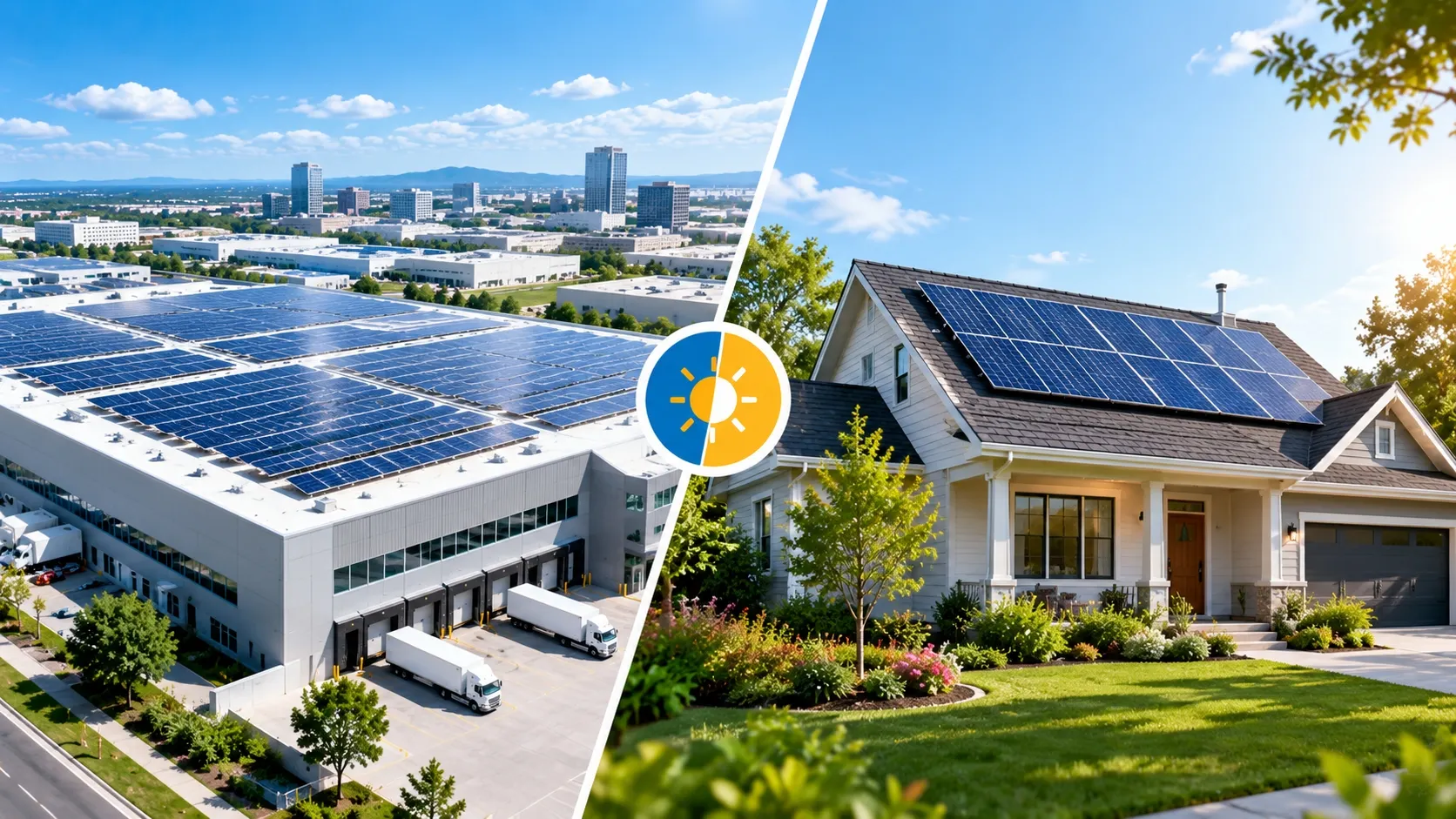
Which of the two is the more economical choice?
It will depend on system size, electricity usage, installation conditions, incentives, financing and the amount of electricity that can be displaced by solar. Sometimes, commercial solar will deliver a lower cost per watt and a more robust long-term savings capability, whereas residential solar will provide a more streamlined route to lowering residents' electric bills.
This guide provides an overview of commercial solar versus residential solar, installation costs, energy savings, ROI, maintenance, incentives, and the long-term value.
What Is the Difference Between Commercial and Residential Solar?
The primary difference is the scale and purpose of the solar installation.
Residential solar systems are typically installed on single-family homes or small residential properties. They commonly range from around 3 kW to 15 kW, depending on household electricity consumption and available roof space.
Commercial solar systems are designed for businesses, warehouses, factories, offices, retail buildings, farms, and other commercial properties. These systems can range from tens of kilowatts to several megawatts.
Commercial solar generally requires larger solar panels arrays, commercial-grade inverters, more complex electrical infrastructure, and professional engineering.
Commercial Solar vs Residential Solar: Cost Comparison
The price of the solar panel installation is one of the most crucial considerations when deciding between solar choices.
Typically, residential systems are larger, so permitting, design, labor and customer acquisition per watt are more expensive; and the system is smaller, therefore higher price per watt.
Economies of scale can be realized with commercial solar projects. Buying hundreds or thousands of panels simultaneously can lower equipment costs and large installations may better utilize installation labor and engineering.
For instance, for a commercial project the total cost may be higher but the cost per watt (c/w) may be lower than a residential project.
Total project cost, however, will depend on a variety of factors:
- Solar system size
- Roof or ground-mount conditions
- Solar panel technology
- Inverter type
- Electrical upgrades
- Battery storage
- Labor costs
- Permitting requirements
- Financing structure
- Local incentives
Therefore, comparing total installation prices alone does not accurately determine which system is more cost-effective.
Which Has Better Energy Savings?
Commercial solar can yield more savings than residential solar, although both options can substantially decrease electricity costs.
Generally, businesses use a lot more electricity than homes. HVAC systems, lights, machines, refrigeration systems, computers and more can run for many hours per day in a factory, warehouse, office or retail building.
This electricity demand can be significantly reduced by a commercial solar system of the right size.
Generally, residential properties use less energy. But there are still substantial savings homeowners can make, particularly if solar generation coincides with peak electricity use times.
The primary figure to consider isn't just the size of the system but the amount of grid power the solar system displaces.
Commercial Solar ROI vs Residential Solar ROI
Return on investment is another major consideration.
A solar system's ROI depends on:
ROI = Energy Savings + Incentives + Other Benefits − System Costs
Commercial properties often have an advantage because of their high electricity consumption and larger systems.
For example, a business operating during daylight hours may use solar electricity directly as it is generated. This can increase the value of solar energy by reducing the amount of electricity purchased from the utility.
Residential customers may generate solar electricity during the day when they are away from home. Depending on the local electricity rate structure and net-metering or export policies, some of that energy may be exported to the grid rather than consumed onsite.
Therefore, self-consumption is an important factor in solar ROI.
Are Commercial Solar Systems More Expensive to Maintain?
Solar PV systems are generally low-maintenance because they have relatively few moving components.
Both residential and commercial solar systems typically require:
- Periodic system inspections
- Solar panel cleaning when necessary
- Inverter monitoring
- Electrical inspections
- Performance monitoring
- Occasional component replacement
Commercial systems may require more extensive maintenance simply because they contain more equipment.
However, maintenance costs per watt can still be competitive for commercial installations because service costs are distributed across a larger system.
Modern solar monitoring platforms can also identify performance problems remotely, allowing maintenance teams to respond quickly when production drops unexpectedly.
Solar Incentives and Tax Benefits
Government incentives can significantly affect the cost-effectiveness of both residential and commercial solar.
Depending on the country, state, or local jurisdiction, solar projects may qualify for programs such as:
- Tax credits
- Rebates
- Accelerated depreciation
- Renewable energy certificates
- Net-metering programs
- Feed-in tariffs
- Local clean-energy incentives
Commercial projects may have access to additional financial mechanisms that are not available to homeowners.
In the United States, businesses should evaluate applicable federal, state, and local incentives with qualified tax and energy professionals because eligibility and program rules can change over time.
Homeowners should also investigate available residential solar incentives before calculating their expected payback period.
Commercial Solar Is Often Better for Large Energy Users
If a property consumes significant electricity every month, commercial solar can provide particularly strong financial benefits.
Consider businesses such as:
- Manufacturing facilities
- Warehouses
- Distribution centers
- Hotels
- Shopping centers
- Agricultural facilities
- Office buildings
- Schools and institutions
These properties often have large roof areas or unused land that can accommodate substantial solar capacity.
A large commercial rooftop can turn previously unused space into an energy-producing asset.
For companies with high daytime electricity demand, solar can reduce operating expenses while also improving energy predictability.
Residential Solar Is Better for Smaller Energy Needs
Residential solar may be more cost-effective when electricity consumption is relatively low and the home has favorable solar conditions.
Homeowners should consider:
- Annual electricity consumption
- Roof orientation
- Roof condition
- Available roof area
- Local electricity rates
- Utility compensation for exported energy
- Financing costs
- Expected time in the property
A home with a south-facing or otherwise productive roof and limited shading may be an excellent candidate for solar.
If the homeowner plans to remain in the property for many years, long-term electricity savings can make solar particularly attractive.
Commercial Solar vs Residential Solar: Which Has a Faster Payback?
There is no universal payback period for either system.
A solar investment may pay for itself faster when:
- Electricity prices are high
- Solar production is strong
- The system has a competitive installed cost
- The property consumes a large amount of solar energy directly
- Incentives reduce upfront costs
- Financing costs are low
- The system operates efficiently for many years
For businesses, the payback profile of solar can be strong due to the fact that electricity costs are often higher and there's a bigger opportunity to reduce grid electricity use.
Residential solar can also be a good ROI especially in markets with high electricity costs and solar incentives.
What About Battery Storage?
Battery storage plays a significant role in the solar strategies both for the commercial and residential applications.
Excess solar electricity is stored in a battery to be used later. This can enable households to consume more solar energy when the sun is not up.
Beyond these benefits, depending on the utility tariff and project design, batteries offer further benefits for commercial customers, such as peak demand management and energy resilience.
But the cost of adding batteries adds up. Thus, it is important that battery storage is assessed based on real energy prices, demand charges, backup needs, and incentives, rather than the assumption that more storage equals more benefit.
Which Solar System Is More Cost-Effective?
Each property is unique, and hence there is no single answer.
For companies that have high electricity use, have large spaces to install, and high energy needs during the day, Commercial solar can be more cost-effective. The cost per watt may also be lowered due to economies of scale.
Solar energy solutions are generally better suited for homeowners who want to lower their energy bills by using a smaller, simpler system.
It is not the sole commercial or residential buildings that can be used, but it depends on the energy profile of the property.
Final Thoughts
The cost and size of the solar system are not the most important factors to consider when comparing commercial solar to residential solar. When performing an analysis, installation cost, electricity usage, solar generation, incentives, financing, maintenance, battery storage, utility costs, and system life should be taken into account.
Commercial solar can help businesses make their large rooftops and blankets of land into sustainable energy resources and save on operating costs over the long term. Homeowners may find residential solar power can offer a practical solution to reduce their electricity costs and boost their energy independence.
Finally, the optimal solar system is the one that will make the most long term sense for its particular energy requirements.
Property owners are advised to schedule a professional solar evaluation of their property prior to investing, to ensure that they receive information on system size, annual production, estimated solar savings, payback period, financing costs, and available incentives. This allows for a much more straightforward comparison of commercial and residential solar systems, not just on the initial purchase price, but on financial facts as well.
Share on Social:


In This Article
- 1 What Is the Difference Between Commercial and Residential Solar?
- 2 Commercial Solar vs Residential Solar: Cost Comparison
- 3 Which Has Better Energy Savings?
- 4 Commercial Solar ROI vs Residential Solar ROI
- 5 Are Commercial Solar Systems More Expensive to Maintain?
- 6 Solar Incentives and Tax Benefits
- 7 Commercial Solar Is Often Better for Large Energy Users
- 8 Residential Solar Is Better for Smaller Energy Needs
- 9 Commercial Solar vs Residential Solar: Which Has a Faster Payback?
- 10 What About Battery Storage?
- 11 Which Solar System Is More Cost-Effective?
- 12 Final Thoughts
