


All-in-One vs Split Solar Street Light
Solar street lighting is an emerging solution for roads, residential communities, parking areas, campus, parks, rural areas, and commercial projects. Solar Street Light designs are available in different types as solar technology is evolving. All-in-one solar street lights and split solar street lights are among the two most popular types available.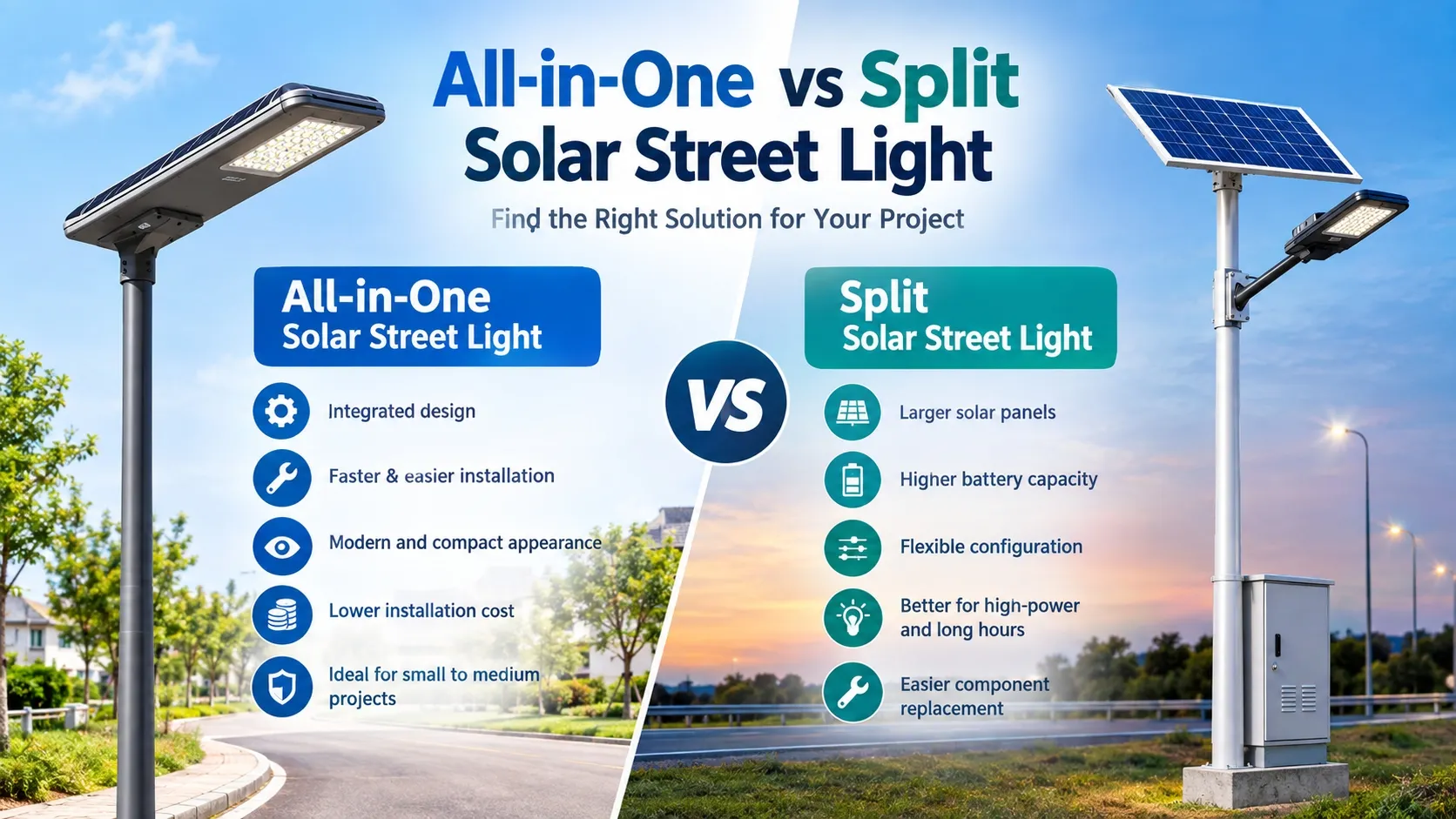
Although they both utilize solar energy to ensure stable outdoor lighting, the systems can be very different with respect to design, installation, maintenance and performance. It is essential for distributors, contractors, government projects, developers, and businesses to understand these differences and determine the best solar street lighting solution.
This article will take an in-depth look into All-in-One Solar Street Light vs Split Solar Street Light to give you a detailed overview of how they're useful, their drawbacks, and when to use each type.
What Is an All-in-One Solar Street Light?
Integrated Solar Street Light (all in one solar street light) refers to a light comprising several critical elements in a small package.
Usually the following components are combined in one housing:
- Solar panel
- LED light source
- Lithium battery
- Solar charge controller
- Motion sensor or lighting control system
The whole lighting system is typically installed directly on a pole or bracket. The solar panel charges the battery when the Sun is shining during the day. The LED lamp is lit by the stored energy at night.
The selling point of an all-in-one solar street light is its reduced and easy design.
Key Benefits of All-in-One Solar Street Lights
Easy installation:
Because the major components are integrated into one unit, installation is generally faster and requires fewer external connections.
Modern appearance:
Integrated solar street lights usually have a clean, compact, and modern design, making them suitable for residential communities, parks, walkways, and urban environments.
Lower installation complexity:
There is no need to install separate battery boxes or connect multiple components through complicated wiring.
Reduced labor costs:
Faster installation can help reduce labor requirements, especially for large lighting projects.
Smart control options:
Many modern all-in-one solar street lights include motion sensors, automatic dimming, timers, remote monitoring, or intelligent lighting controls.
However, the compact design also means that component size can be more limited compared with a split system.
What Is a Split Solar Street Light?
A split solar street light uses separate components installed in different locations on the lighting system.
The system normally includes:
- A separate solar panel
- An LED street light
- A battery
- A solar charge controller
For example, the solar panel may be installed at the top of the pole, while the LED lamp is mounted on a separate arm. The battery may be installed inside a battery box or in another protected location.
Because the components are separated, the system offers greater flexibility in design and configuration.
Key Benefits of Split Solar Street Lights
Larger solar panels:
Split systems can use larger solar panels to generate more electricity.
Higher battery capacity:
A separate battery compartment can support larger energy storage capacity.
More flexible configuration:
Manufacturers can customize the solar panel size, battery capacity, LED power, and system design according to project requirements.
Better performance for demanding applications:
Split solar street lights are often suitable for projects requiring higher brightness, longer operating hours, or greater backup power.
Easier component replacement:
Individual components can often be replaced separately if maintenance is required.
Split systems may require more installation work, but they can provide greater flexibility for large or customized projects.
All-in-One vs Split Solar Street Light: Main Differences
1. System Design
The most obvious difference is the system structure.
An all-in-one solar street light integrates the major components into one compact unit. This creates a simple and streamlined design.
A split solar street light separates the solar panel, battery, LED lamp, and controller into different components.
For projects that prioritize simplicity and appearance, an all-in-one design can be attractive. For projects requiring customized system capacity, a split design may offer more options.
2. Installation
Installation is one of the biggest differences between the two systems.
All-in-one solar street lights are generally easier and faster to install. The installer mainly needs to mount the integrated unit onto the pole and ensure the solar panel receives sufficient sunlight.
Split solar street lights require more installation steps. The solar panel, LED lamp, battery system, and controller may need to be installed separately.
Therefore:
- All-in-One: Faster and simpler installation
- Split System: More installation flexibility but greater complexity
For projects with limited installation time or labor resources, integrated solar street lights can offer important advantages.
3. Solar Energy Collection
Solar energy collection directly affects lighting performance.
Because all-in-one solar street lights have limited space, the size of the integrated solar panel may be restricted.
Split solar street lights can use larger and separately positioned solar panels. This can improve solar energy generation, especially in projects with higher energy requirements.
The ability to optimize the solar panel angle and orientation can also be beneficial in certain geographical locations.
For areas with limited sunlight or demanding lighting requirements, a split solar street light may provide more design flexibility.
4. Battery Capacity and Energy Storage
Battery capacity determines how much energy can be stored for nighttime operation and cloudy weather.
All-in-one solar street lights typically use compact lithium battery systems integrated into the lamp housing.
Split solar street lights can support larger battery systems because the battery does not need to fit inside the lighting fixture.
This makes split systems potentially more suitable for:
- Long nighttime operating hours
- High-power LED street lighting
- Areas with frequent cloudy weather
- Projects requiring multiple days of backup power
However, advances in lithium battery technology continue to improve the energy efficiency of modern all-in-one solar street lights.
5. Maintenance
Maintenance requirements depend on product quality and system design.
With an all-in-one solar street light, the integrated design reduces the number of external cables and exposed components. This can simplify the overall system.
However, because components are integrated, repairing or replacing certain internal parts may require servicing the complete lighting unit.
With a split solar street light, individual components are separate. This can make it easier to replace a solar panel, battery, controller, or LED lamp independently.
For large infrastructure projects, the ability to replace individual components can be an important consideration.
Which Solar Street Light Is Better for Different Applications?
Best Applications for All-in-One Solar Street Lights
All-in-one solar street lights are often suitable for:
- Residential streets
- Parks
- Garden pathways
- Community roads
- Parking areas
- Campuses
- Pedestrian walkways
- Small and medium-sized projects
Their compact design, simple installation, and modern appearance make them an attractive solution for many commercial and residential applications.
Best Applications for Split Solar Street Lights
Split solar street lights are often better suited for:
- Highways
- Large roads
- Industrial areas
- Rural infrastructure projects
- Large commercial developments
- High-power lighting applications
- Locations with challenging weather conditions
These projects may require larger solar panels, higher battery capacity, and customized system configurations.
Cost Comparison: All-in-One vs Split Solar Street Light
The total cost of a solar street lighting project should include more than the product price.
Buyers should consider:
- Product cost
- Installation labor
- Transportation
- Maintenance
- Battery replacement
- Energy performance
- Project lifetime
An all-in-one solar street light may help reduce installation costs because of its simplified design.
A split solar street light may have higher installation complexity, but its flexible component configuration can make it more suitable for demanding projects.
The best choice depends on the total project requirements rather than simply selecting the lowest-priced product.
How to Choose Between All-in-One and Split Solar Street Lights
Before selecting a solar street lighting system, consider the following questions:
What is the required lighting area?
Larger roads and wide spaces may require higher-power lighting systems.
How many hours should the light operate each night?
Long operating hours require sufficient solar energy collection and battery storage.
What are the local weather conditions?
Areas with frequent cloudy or rainy weather may need larger solar panels and batteries.
Is easy installation a priority?
If fast installation is important, an all-in-one solar street light may be the better choice.
Is customization required?
If the project requires specific solar panel sizes, battery capacities, or LED power levels, a split system may offer greater flexibility.
What is the long-term maintenance strategy?
Consider whether integrated simplicity or individually replaceable components better fit the project.
Conclusion
The decision between All-in-One vs Split Solar Street Light will be determined by the application, energy needs, installation environment and budget.
The all in one solar street lights have low installation complexity, easy to install, modern appearance and compact design. They are a great choice for projects requiring an extensive, as well as communities, pathways, parking areas, and small to medium-sized projects.
Split solar street lights offer more flexibility, solar panel sizes, battery capacity, and configurations. They are generally more appropriate for large-scale construction projects, high-performance applications, and environments that have stringent requirements.
There is no one right way that is best for every project. The choice of the optimal solar street light depends on the characteristics of the sun, desired illumination, hours of operation, installation conditions and maintenance requirements.
Partnering with an experienced solar street light manufacturer or supplier can help solar lighting manufacturers, distributors, contractors, and project developers ensure that the system is designed to meet the needs of the particular application. When considering the overall performance of the system and not just the price, buyers can select the best solar street lighting solution which provides reliable lighting, energy efficiency and long-term value.
Share on Social:


- NEXT: Portable Power Station vs Gas Generator
- NEXT: Null
In This Article
- 1 What Is an All-in-One Solar Street Light?
- 2 What Is a Split Solar Street Light?
- 3 All-in-One vs Split Solar Street Light: Main Differences
- 4 Which Solar Street Light Is Better for Different Applications?
- 5 Cost Comparison: All-in-One vs Split Solar Street Light
- 6 How to Choose Between All-in-One and Split Solar Street Lights
- 7 Conclusion
