


How Many Solar Batteries Do You Need for a Home?
Solar battery systems are becoming increasingly commonplace in homes, providing an increasing degree of energy independence, lowering electric bills, and ensuring that residents are able to keep using electricity even when the grid is down. But one of the most frequent queries homeowners pose before energy storage is: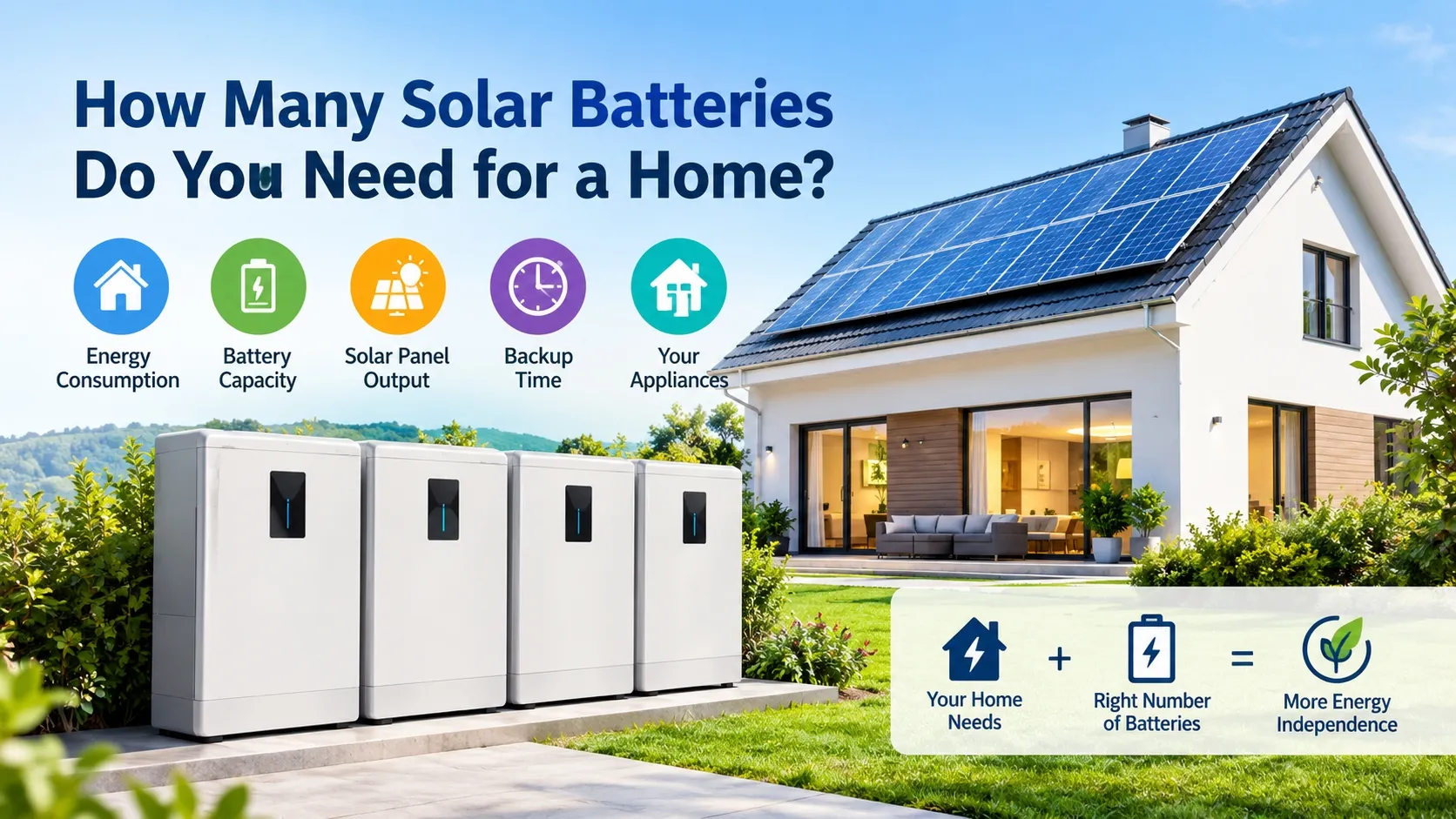
How many solar batteries do you actually need for your home?
The answer will depend on a variety of factors such as the amount of electricity your household uses, the battery capacity, the size of your solar panel system, the duration of backup power needed and which appliances you wish to power.
This guide will discuss and illustrate the correct number of solar batteries needed to power a house and explain why the homeowner must find an energy storage solution that is appropriate to their actual requirements.
What Determines How Many Solar Batteries You Need?
The answer to the question “how many batteries does every home need?” is not cut and dry. Small energy usage household may only need one or two batteries, large household may need multiple battery units.
The following are the most critical factors:
- Daily electricity consumption
- Battery storage capacity
- Usable battery capacity
- Desired backup time
- Number of appliances
- Solar panel production
- Peak electricity demand
- Grid connection or off-grid operation
Understanding these factors makes it easier to design an efficient residential solar battery system.
Step 1: Calculate Your Home's Daily Electricity Usage
The first step is determining how much electricity your household uses every day.
Electricity consumption is usually measured in kilowatt-hours (kWh). You can normally find this information on your monthly electricity bill.
For example, imagine your household uses:
900 kWh per month
To calculate daily consumption:
900 kWh ÷ 30 days = 30 kWh per day
This means your home uses approximately 30 kWh of electricity every day.
However, you may not need enough battery storage to power the entire home for 24 hours. Many homeowners only want batteries to support essential appliances during the evening or during a power outage.
Step 2: Understand Solar Battery Capacity
Solar batteries are usually rated according to their energy storage capacity in kilowatt-hours.
For example:
- Small battery: 5 kWh
- Medium battery: 10 kWh
- Large residential battery: 15 kWh
- Multiple battery system: 20–40 kWh or more
A battery with a capacity of 10 kWh can theoretically store 10 kWh of electricity. However, the full capacity may not always be available for daily use.
This is because batteries have a concept called usable capacity.
For example, a battery rated at 10 kWh may provide approximately 9 kWh of usable energy depending on its depth of discharge and system settings.
When comparing solar batteries, homeowners should focus on usable energy capacity rather than only the total rated capacity.
Step 3: Decide What You Want the Battery to Power
One of the biggest factors affecting the number of solar batteries you need is deciding whether you want to power:
- The entire home
- Only essential appliances
- Selected high-energy appliances
- The home overnight
- The home during multi-day outages
For example, essential loads may include:
- Refrigerator
- Lights
- Internet router
- Television
- Phone charging
- Laptop
- Security system
A whole-home backup system may also support:
- Air conditioners
- Electric water heaters
- Washing machines
- Dryers
- Electric ovens
- Heat pumps
- Electric vehicle chargers
The more appliances you want to operate, the larger your battery storage system needs to be.
How Many Solar Batteries Do You Need for Essential Backup?
If your goal is simply to keep essential appliances running during a power outage, you may not need a large battery bank.
For example, imagine your essential appliances consume approximately:
10 kWh per day
If you use a 10 kWh battery with approximately 9 kWh of usable capacity, you may need:
1–2 batteries
depending on how long you want the backup power to last.
A two-battery system could provide approximately 18–20 kWh of usable energy, allowing essential household loads to operate for a longer period.
This type of system is often suitable for homeowners who want emergency backup rather than complete energy independence.
How Many Batteries Do You Need for Overnight Power?
Many homeowners install solar batteries to store excess solar energy produced during the day and use it at night.
Suppose your home consumes approximately:
15 kWh of electricity between sunset and sunrise
If your battery provides 10 kWh of usable energy, you may need:
2 batteries
This gives your system enough storage capacity to cover most nighttime electricity consumption while leaving some additional energy available for unexpected demand.
Your solar panels can then recharge the batteries during the next day.
This strategy can help homeowners reduce their dependence on grid electricity, especially in areas with high evening electricity rates.
How Many Batteries Are Needed for Whole-Home Backup?
Whole-home backup requires significantly more battery storage.
Consider a household that uses:
30 kWh per day
If the homeowner wants one full day of battery backup, the system should ideally provide approximately 30 kWh of usable storage.
Depending on battery size, this could mean:
- Three 10 kWh batteries
- Two 15 kWh batteries
- One large modular battery system
However, battery sizing should also consider reserve capacity. Installing exactly the same amount of storage as daily electricity consumption may not provide enough flexibility during periods of high demand.
For this reason, many homeowners choose additional battery capacity.
A household consuming 30 kWh per day may consider approximately:
30–40 kWh of usable battery storage
for more reliable whole-home backup.
Consider Your Solar Panel System Size
Solar batteries do not generate electricity themselves. They store electricity generated by solar panels or supplied by the electrical grid.
Therefore, your solar panel system must be large enough to recharge the batteries.
For example, imagine you install a 30 kWh battery system but your solar panels only generate 15 kWh of excess electricity per day.
The batteries may not fully recharge regularly.
A properly designed solar energy system should balance:
Solar generation + Battery capacity + Household consumption
Homeowners should consider how much excess solar electricity is available after daytime appliances have been powered.
If your solar system frequently produces excess electricity, adding battery storage can help capture and use that energy later.
How Long Do You Want Backup Power to Last?
Backup duration is another important consideration.
You may want battery power for:
- A few hours
- Overnight
- One day
- Two days
- Several days
The longer the desired backup period, the more batteries you need.
For example, if your essential loads consume 10 kWh per day:
One-Day Backup
Approximately 10–15 kWh of usable storage may be suitable.
Two-Day Backup
Approximately 20–30 kWh of usable storage may be needed.
Three-Day Backup
Approximately 30–45 kWh of usable storage may be required.
These estimates can change significantly depending on weather conditions, appliance usage, and whether solar panels continue generating electricity during the outage.
Battery Power Rating Also Matters
Battery capacity is not the only important specification.
You should also consider battery power output, usually measured in kilowatts (kW).
For example, a battery may store 10 kWh of energy but only provide 5 kW of continuous power.
This means it may not be able to operate multiple high-power appliances simultaneously.
High-power appliances may include:
- Air conditioners
- Electric ovens
- Water heaters
- Pumps
- Electric dryers
When designing a residential solar battery system, homeowners should consider both:
Energy capacity (kWh) – How long the battery can provide electricity.
Power capacity (kW) – How many appliances the battery can operate at the same time.
A properly sized system requires the right balance between both.
A Simple Formula for Calculating Battery Needs
You can use this simple formula as a starting point:
Daily electricity needed from batteries ÷ usable battery capacity = number of batteries required
For example:
Your nighttime electricity consumption: 18 kWh
Usable capacity per battery: 9 kWh
18 ÷ 9 = 2 batteries
If you want additional backup capacity, you may consider adding another battery.
Remember that this is only a basic calculation. A professional system design should also consider peak loads, inverter capacity, solar production, battery efficiency, and future electricity needs.
Should You Install Extra Battery Capacity?
Installing additional battery capacity can provide several advantages.
Extra batteries can help you:
- Extend backup time
- Handle higher electricity consumption
- Improve energy independence
- Store more excess solar energy
- Prepare for future appliance additions
- Support electric vehicle charging
- Reduce dependence on expensive peak electricity
Future energy needs are especially important.
For example, a household may currently have moderate electricity consumption but later add:
- An electric vehicle
- A heat pump
- Additional air conditioning
- Electric cooking appliances
Choosing a scalable battery system can make future expansion easier.
How Many Solar Batteries Does the Average Home Need?
For many residential applications, the answer typically falls somewhere between:
1 and 4 solar batteries
A small backup system may use:
1 battery
A standard home energy storage system may use:
2 batteries
A larger whole-home backup system may use:
3–4 batteries or more
The exact number depends on battery capacity and household electricity requirements.
Instead of asking only, “How many solar batteries do I need?”, homeowners should also ask:
- How much electricity does my home use?
- What appliances do I want to power?
- How long do I need backup electricity?
- How much solar energy does my system generate?
- Do I want whole-home or essential-load backup?
- Will my electricity needs increase in the future?
Final Thoughts
The number of solar batteries required for a domestic application will largely depend on the size of the solar system, the desired battery capacity, the desired backup period, and the electricity usage.
If you need a simple backup, 1-2 batteries could be sufficient. The combination of two or more batteries might offer more coverage for overnight energy storage. Households could need 20-40 kWh of usable battery capacity or more for whole home backup.
To choose a battery system, the best way is to obtain a calculation of your household energy usage and understand the most critical electrical loads.
A correctly sized rooftop solar battery storage system can enable homeowners to store more solar power for later use, cut electricity bills, be less reliant on the grid, and have electricity when the grid goes down.
With the advancement of solar technology and energy storage solutions, determining the optimal number of solar batteries has become a crucial consideration for creating a smarter, more efficient, and resilient home energy system.
Share on Social:


In This Article
- 1 What Determines How Many Solar Batteries You Need?
- 2 Step 1: Calculate Your Home's Daily Electricity Usage
- 3 Step 2: Understand Solar Battery Capacity
- 4 Step 3: Decide What You Want the Battery to Power
- 5 How Many Solar Batteries Do You Need for Essential Backup?
- 6 How Many Batteries Do You Need for Overnight Power?
- 7 How Many Batteries Are Needed for Whole-Home Backup?
- 8 Consider Your Solar Panel System Size
- 9 How Long Do You Want Backup Power to Last?
- 10 Battery Power Rating Also Matters
- 11 A Simple Formula for Calculating Battery Needs
- 12 Should You Install Extra Battery Capacity?
- 13 How Many Solar Batteries Does the Average Home Need?
- 14 Final Thoughts
