


Solar Generator vs Portable Power Station
When people talk about what they need for a backup power source, two technologies that frequently come up in the same search results are solar generators and portable power stations. Although these terms are sometimes used interchangeably, they are not exactly the same.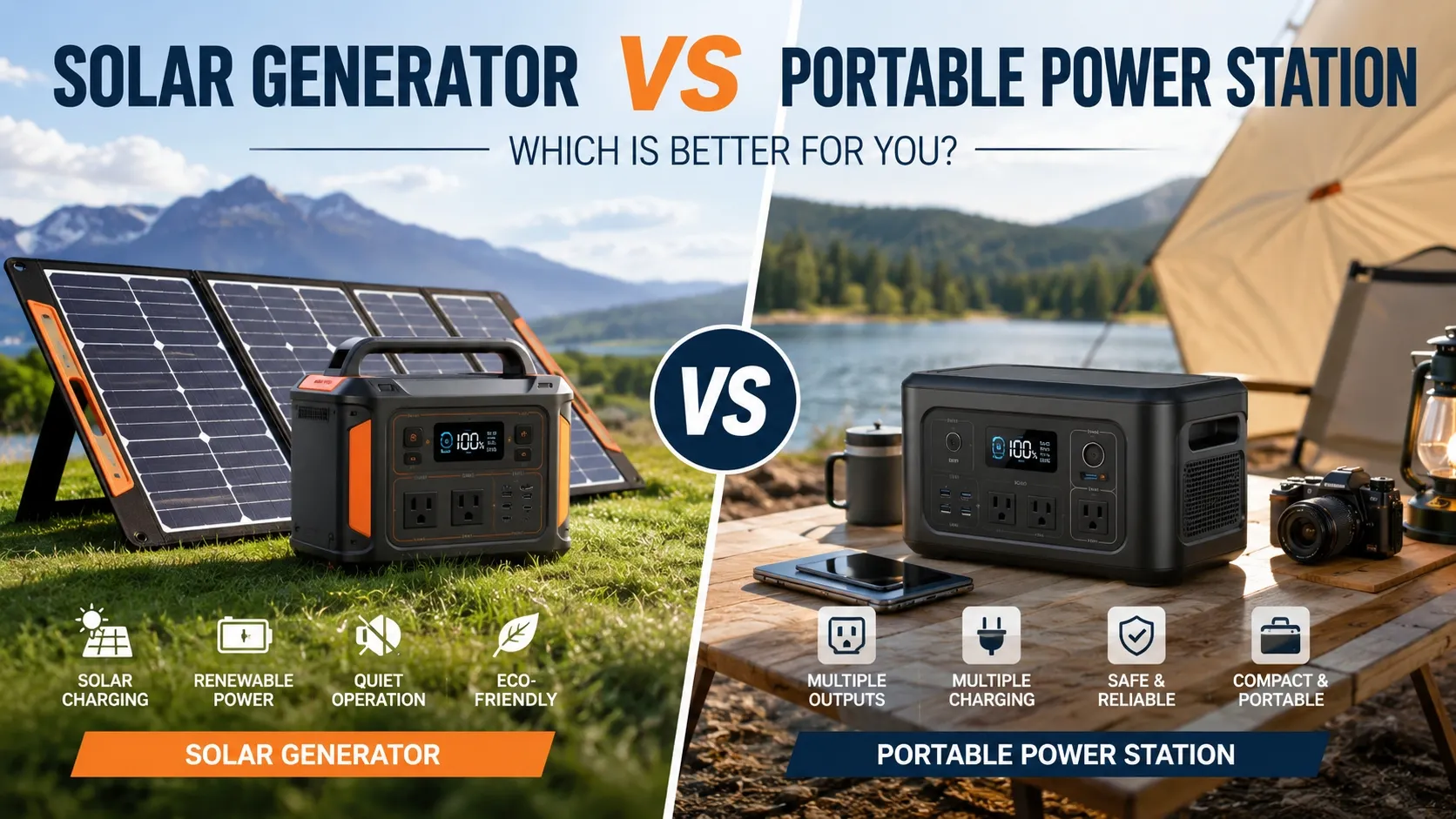
The general distinction is easy: a portable power station is one that has a built-in battery, and a solar generator is usually a portable battery power station that's related to solar panels for recharging. Both owners and non-owners of outdoor homes, outdoor enthusiasts, RV owners and emergency-preparedness users can benefit from understanding this distinction to select the most appropriate system.
What Is a Portable Power Station?
Portable power station is a battery-powered unit that can be charged to provide power away from a power outlet. The majority of the models have an integrated battery, inverter, AC outlets, USB ports, and DC outputs.
Portable power stations can be charged from a number of sources including:
- AC wall outlets
- Car charging ports
- Solar panels
- Sometimes other compatible DC sources
There are various types of portable power stations with various power capacities. The smaller units can power phones, cameras and laptops, the larger ones can power appliances like refrigerators, lights, fans and some power tools.
Portable power stations are typically designed to run on battery power, eliminating the need for gasoline or diesel fuel, which means they make no direct exhaust emissions while they're in operation.
What Is a Solar Generator?
Typically, a solar generator consists of a battery-powered power station equipped with solar panels. It stores electricity in a battery instead of generating it using fuel during combustion, and uses solar energy to charge the battery.
The average solar generator system consists of:
- Solar panels
- A rechargeable battery
- A charge controller
- An inverter
- AC and DC output ports
In the daytime solar panels harness sunlight to generate electricity. The charge controller controls the electricity that enters and the battery bank stores the electricity. If electricity is required, the inverter converts the stored electricity from DC to AC electricity for working the compatible appliances.
This makes a solar generator especially beneficial for applications or use outside of the electrical grid, camping, traveling in a recreational vehicle, emergency backup and areas with limited electrical grid access.
Solar Generator vs Portable Power Station: Key Differences
The biggest difference is how the system is defined and used.
| Feature | Solar Generator | Portable Power Station |
|---|---|---|
| Battery storage | Yes | Yes |
| Solar charging | Usually included or supported | Often supported, but panels may be separate |
| AC output | Yes, depending on model | Yes, depending on model |
| Fuel required | No | No |
| Quiet operation | Yes | Yes |
| Portability | High | High |
| Off-grid use | Excellent | Good to excellent |
| Solar independence | Higher | Depends on charging setup |
| Typical use | Backup, camping, emergency power | Portable electronics and backup power |
In practice, many modern portable power stations can become part of a solar generator system simply by connecting compatible solar panels.
Which One Is Better for Emergency Backup?
Both can be helpful for emergency preparedness.
A portable power station is useful for times when you need electric power for a short period and won't be able to use the power grid. Keep it charged and use it right away for critical applications like phones, WiFi, LED lights, laptops, small appliances, etc.
Another benefit of a solar generator is that solar panels can help charge the battery in longer power outages as an alternative to the power grid.
For instance, following an extreme storm or natural disaster, grid electricity could be down for some time. As long as the sun is providing the power and the solar generator is the right size, it will continue to generate a usable electrical current.
A portable power station could be sufficient for short-term backup power. A solar generator offers more charging options for longer off-grid times.
Which Is Better for Camping and Outdoor Activities?
Portable power stations are common to campers due to their ease of carrying and use. They can be used to power up a mobile phone, camera, laptop, light, portable refrigerator, fan and other camping equipment.
When you are going on a trip that lasts more than one day, a solar generator will be a great asset for you. Users can simply position solar panels in the sun and recharge the system over time rather than stopping for a campsite and spending time charging a depleted battery or using a vehicle to charge it.
Solar charging, however, is dependent on a number of factors such as:
- Solar panel wattage
- Battery capacity
- Sunlight intensity
- Weather conditions
- Panel orientation
- Charging efficiency
For weekend camping, a portable power station may be the simplest solution. For extended outdoor stays, a solar generator can provide more energy independence.
Solar Generator vs Gas Generator
It is also important not to confuse a solar generator with a conventional fuel-powered generator.
A gasoline generator creates electricity by running an internal combustion engine. A solar generator normally stores electricity in a battery and uses solar panels to recharge it.
Gas generators can provide substantial continuous power and can be refueled quickly. However, they produce noise, exhaust gases, and require fuel storage.
Solar generators have different advantages:
- Quiet operation
- No direct exhaust during operation
- Low routine maintenance
- Renewable solar charging
- Useful for indoor emergency applications when operated according to manufacturer safety instructions
The right choice depends on your required power level, runtime, charging conditions, and budget.
How to Choose the Right Capacity
Battery capacity is one of the most important specifications to consider. It is commonly expressed in watt-hours (Wh).
For example, a 1,000Wh battery theoretically stores 1,000 watt-hours of energy. If a device consumes 100W continuously, the theoretical runtime would be about 10 hours.
In real-world applications, actual runtime is lower because of inverter losses, battery-management systems, temperature, and other efficiency factors.
A simple estimation is:
Runtime ≈ Battery Capacity × Efficiency ÷ Device Power
Suppose a portable power station has a 1,000Wh battery and an estimated usable efficiency of 85%. A 100W appliance could theoretically operate for approximately:
1,000 × 0.85 ÷ 100 = 8.5 hours
When selecting a system, consider both battery capacity and output power. A large battery does not necessarily mean the system can operate every appliance. You also need to check the inverter's continuous and peak output ratings.
What About Solar Charging Speed?
For a solar generator, solar input is another critical specification.
A larger solar input rating generally allows the battery to recharge faster under suitable sunlight conditions. For example, a system capable of accepting 400W of solar input can potentially recharge more quickly than one limited to 100W, assuming the battery, solar conditions, and charging architecture support those figures.
However, advertised solar charging times should not be treated as guaranteed real-world results. Weather, shade, temperature, panel orientation, and seasonal sunlight can significantly affect performance.
Pros and Cons of Each Option
Portable Power Station Advantages
- Easy to use
- Convenient for short trips
- Multiple charging methods
- Quiet operation
- Suitable for electronics and small appliances
- No fuel storage required
Portable Power Station Disadvantages
- Battery capacity is limited
- Requires recharging
- Long-term off-grid operation may require solar panels
- High-capacity models can be expensive
Solar Generator Advantages
- Supports renewable solar charging
- Suitable for extended off-grid applications
- Quiet and convenient
- Useful for emergency preparedness
- Can reduce dependence on grid electricity
Solar Generator Disadvantages
- Solar charging depends on sunlight
- Panels require additional space
- Complete systems can cost more
- Recharge times may increase during cloudy weather
Which Should You Choose?
The best choice depends on your application.
Choose a portable power station if you mainly need convenient electricity for camping, travel, work, electronics, or short power outages.
Choose a solar generator if you want a more complete off-grid energy solution that combines battery storage with solar charging.
For many users, the decision does not have to be either-or. A modern portable power station can serve as the battery and inverter component of a solar generator system, with solar panels added when renewable charging is needed.
Final Verdict
The first and most significant distinction between solar generators vs portable power stations is that they can be used interchangeably for a good portion of the time. A portable power station is just the battery-based power station, whereas a solar generator may include solar panels and solar charging functionality.
A portable power station is convenient and flexible for simple portable back-up power. Solar panels could make the system much more versatile in use scenarios like camping, emergency preparedness, and extended off-grid use.
When buying one, consider battery size, steady power, peak power, solar power, charging time, battery type, mobility and the type of devices you must charge. Selecting a product by its actual energy needs (not the name) will help you to ensure that you are getting an actual backup energy source.
Share on Social:


In This Article
- 1 What Is a Portable Power Station?
- 2 What Is a Solar Generator?
- 3 Solar Generator vs Portable Power Station: Key Differences
- 4 Which One Is Better for Emergency Backup?
- 5 Which Is Better for Camping and Outdoor Activities?
- 6 Solar Generator vs Gas Generator
- 7 How to Choose the Right Capacity
- 8 What About Solar Charging Speed?
- 9 Pros and Cons of Each Option
- 10 Which Should You Choose?
- 11 Final Verdict
