


Lithium Battery vs Gel Battery for Solar Applications



One of the most critical decisions in the design of a solar energy system is selecting the proper battery. The battery can hold any solar electricity that is created in the daytime and can release it later when the sun is not around. Popular types include lithium and gel batteries.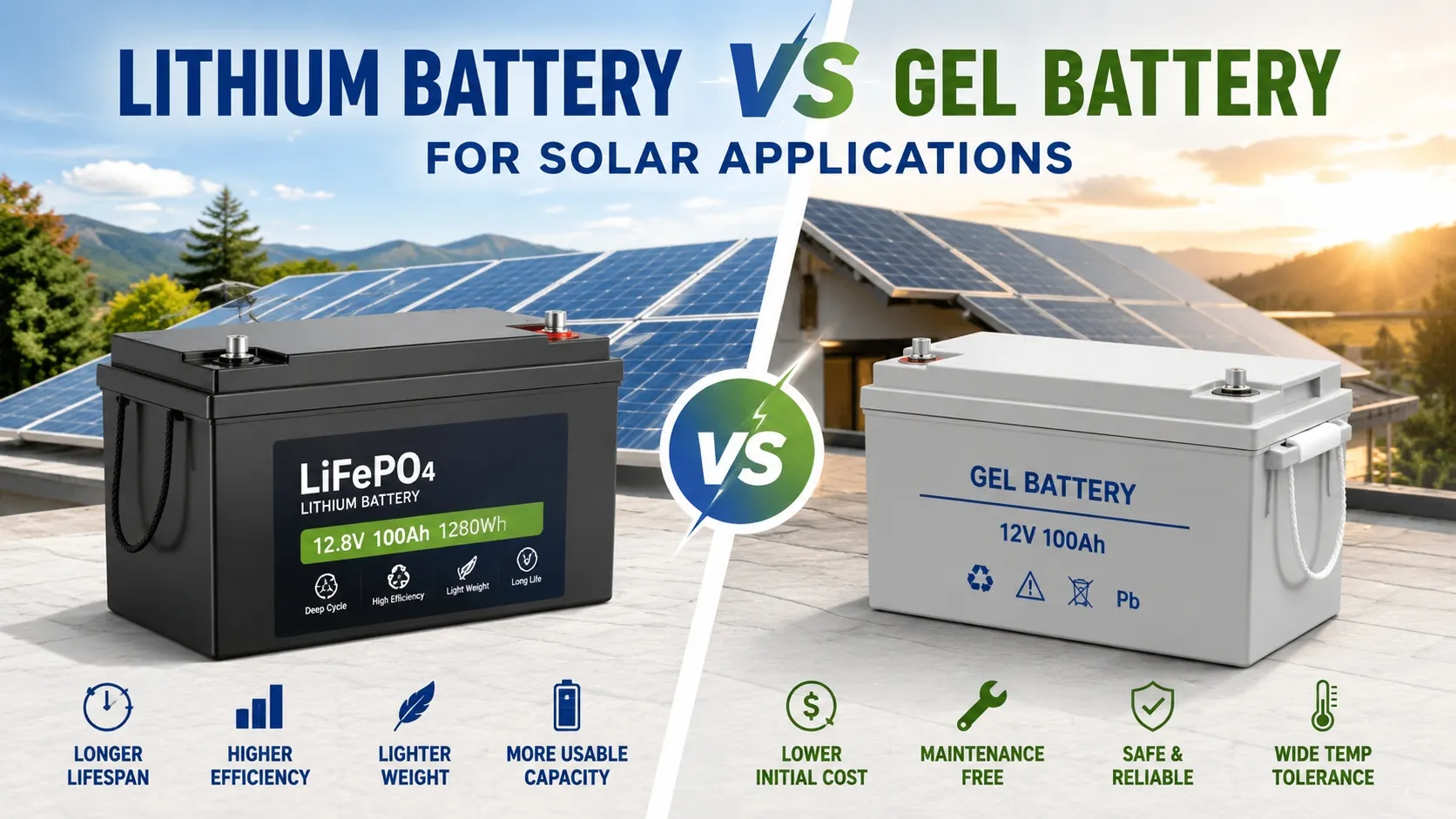
But which of these is more suitable for solar applications?
The performance, service life, and usable capacity in most modern solar energy systems is improved by lithium batteries, particularly lithium iron phosphate (LiFePO4) batteries. For some applications, the cost savings and ease of installation and/or operating environment are more significant and may result in the selection of Gel batteries.
This guide will compare lithium batteries vs. gel batteries for solar purposes, in regards to capacity, lifespan, charging efficiency, maintenance, safety, cost, and ideal applications for use.
What Is a Lithium Solar Battery?
Lithium Solar Battery is a Solar Lithium-ion battery. For solar applications, LiFePO4 batteries are particularly popular because they offer good thermal stability, long cycle life, and reliable performance.
The electricity produced by solar power can be stored in lithium batteries and efficiently supplied to the household appliances, commercial equipment or to an off-grid system.
Most contemporary lithium solar batteries will also consist of a Battery Management System (BMS). The BMS keeps track of the voltage, temperature, current and other operating parameters to help reduce battery damage and enhance the reliability of the system.
What Is a Gel Solar Battery?
A gel battery is a type of sealed lead-acid battery, sometimes referred to as a Valve-Regulated Lead-Acid (VRLA) battery. The free flowing liquid electrolyte is replaced with silica to make the electrolyte more of a gel.
The electrolyte is minimized to prevent leakage, and Gel batteries are maintenance-free in normal operation. They have been typically employed in solar standby systems, telecommunication systems, emergency power systems and other off-site power applications.
Gel batteries, on the other hand, typically have a much lower energy density and shorter cycle life than contemporary lithium batteries.
Lithium Battery vs. Gel Battery: Key Differences
The best battery depends on the application, but several major differences make lithium batteries increasingly popular for solar energy storage.
1. Battery Lifespan
One of the biggest advantages of lithium batteries is their long cycle life.
A quality LiFePO4 battery can often provide several thousand charge-discharge cycles when operated under suitable conditions. Gel batteries generally provide fewer cycles, especially when they are regularly discharged deeply.
For solar systems that operate every day, this difference can have a significant impact on the total cost of ownership.
Winner: Lithium battery
2. Usable Battery Capacity
Battery capacity is normally measured in kilowatt-hours (kWh) or amp-hours (Ah). However, the full rated capacity is not always recommended for daily use.
Lithium batteries typically support a higher usable depth of discharge (DoD). This means a greater percentage of the stored energy can be used without significantly reducing battery life.
Gel batteries generally require a shallower discharge to achieve their expected service life.
For example, a solar system requiring substantial daily energy storage may need a larger gel battery bank to provide the same usable energy as a lithium battery bank.
Winner: Lithium battery
3. Charging Efficiency
Charging efficiency is especially important in solar applications because available solar energy can vary throughout the day.
Lithium batteries generally have high charge and discharge efficiency. They can accept energy efficiently from solar panels and return a large percentage of stored energy to the load.
Gel batteries are less efficient, and some energy is lost during the charging and discharging process.
Higher efficiency can help a solar system make better use of limited solar generation.
Winner: Lithium battery
4. Charging Speed
Lithium batteries can generally accept higher charging currents than gel batteries when the battery and charging equipment are properly designed for this purpose.
This can be useful in solar systems where sunlight is available for only a limited number of hours.
Gel batteries usually require more controlled charging profiles and may take longer to recharge after a deep discharge.
Winner: Lithium battery
5. Weight and Energy Density
Lithium batteries have a much higher energy density than traditional lead-acid battery technologies.
For the same usable energy capacity, a lithium battery system can be significantly lighter and more compact than a gel battery bank.
This is particularly valuable for:
- RV solar systems
- Mobile power systems
- Marine applications
- Portable solar equipment
- Space-limited installations
Gel batteries are heavier and typically require more physical space for the same usable energy storage.
Winner: Lithium battery
6. Maintenance Requirements
Both lithium and gel batteries can be used in low-maintenance solar systems.
Gel batteries are sealed and do not normally require adding water like traditional flooded lead-acid batteries. However, they still need appropriate charging and operating conditions.
Lithium batteries with an integrated BMS require little routine maintenance. Proper system monitoring and temperature management are still important.
Winner: Lithium battery
7. Temperature Performance
Temperature is an important consideration for any battery installation.
Lithium battery performance can be affected by extreme temperatures. In particular, charging certain lithium chemistries at temperatures below freezing can cause permanent damage unless the battery incorporates appropriate protection or heating.
Gel batteries also experience reduced performance in cold conditions and can be affected by high temperatures, which may accelerate battery aging.
Therefore, neither technology should be selected based on temperature alone. The battery's operating temperature range, installation environment, and protection system should be considered.
Winner: Depends on the application
Lithium Battery vs. Gel Battery: Cost Comparison
Gel batteries generally have a lower initial purchase price than lithium batteries. This makes them attractive for budget-sensitive solar projects.
However, the purchase price is only one part of the total cost.
A solar battery should also be evaluated based on:
- Usable capacity
- Cycle life
- Charging efficiency
- Replacement frequency
- Maintenance
- Installation space
- Long-term operating cost
Although lithium batteries usually have a higher upfront cost, their longer service life and higher usable capacity can make them more economical over the entire system lifetime.
For a solar installation expected to operate for many years, total cost of ownership is often more useful than comparing the initial battery price alone.
Which Battery Is Better for Off-Grid Solar?
For off-grid solar systems, battery performance is particularly important because the battery may be cycled every day.
Lithium batteries are usually the better choice for modern off-grid systems because they offer high usable capacity, efficient charging, long cycle life, and compact installation.
Gel batteries can still work well for smaller or less frequently cycled off-grid systems where the initial budget is a major consideration.
Which Battery Is Better for Home Solar Backup?
For residential solar energy storage, lithium batteries are generally preferred.
They can store solar energy during the day and provide power during the evening, overnight, or during a grid outage. Their compact size and high usable capacity are also useful where installation space is limited.
For homeowners planning long-term energy storage, a LiFePO4 battery is often a strong option because of its combination of safety, cycle life, and performance.
Which Battery Should You Choose?
The right choice depends on your solar system and priorities.
Choose a lithium battery if you need:
- Long service life
- High usable capacity
- High charging efficiency
- Fast charging
- Compact size
- Lower long-term replacement costs
- Frequent daily cycling
Consider a gel battery if you prioritize:
- Lower initial purchase cost
- Proven lead-acid technology
- Stationary applications
- Moderate energy storage requirements
- Less frequent battery cycling
Final Verdict
Lithium battery technology will give overall better performance than gel battery technology when used for solar applications.
Lithium batteries provide increased cycle life, increased usable capacity, increased efficiency, quicker charge times and higher energy density. This gives them special appeal for off-grid power storage, residential power storage, RVs, commercial energy storage and any other application that requires frequent battery cycles.
If initial cost is the major issue or if a traditional sealed lead-acid battery system requirements are met, Gel batteries are still a viable option.
Select a battery after analyzing the entire solar package (solar panel capacity, inverter type and size, daily energy requirement, solar charging conditions, solar installation environment, backup time required, and battery life).
To sum up: Lithium battery packs are the most cost-effective option for most modern solar powered applications while gel batteries can be a cost-effective solution for low cost applications.
Share on Social:


In This Article
- 1 What Is a Lithium Solar Battery?
- 2 What Is a Gel Solar Battery?
- 3 Lithium Battery vs. Gel Battery: Key Differences
- 4 Lithium Battery vs. Gel Battery: Cost Comparison
- 5 Which Battery Is Better for Off-Grid Solar?
- 6 Which Battery Is Better for Home Solar Backup?
- 7 Which Battery Should You Choose?
- 8 Final Verdict
