


Solar Battery vs Generator: Which Backup Power Is Better?
A backup power system can help keep your home, business or critical equipment up and running during a power outage. The two types that are most common include solar batteries and solar generators. Which is the superior one, though?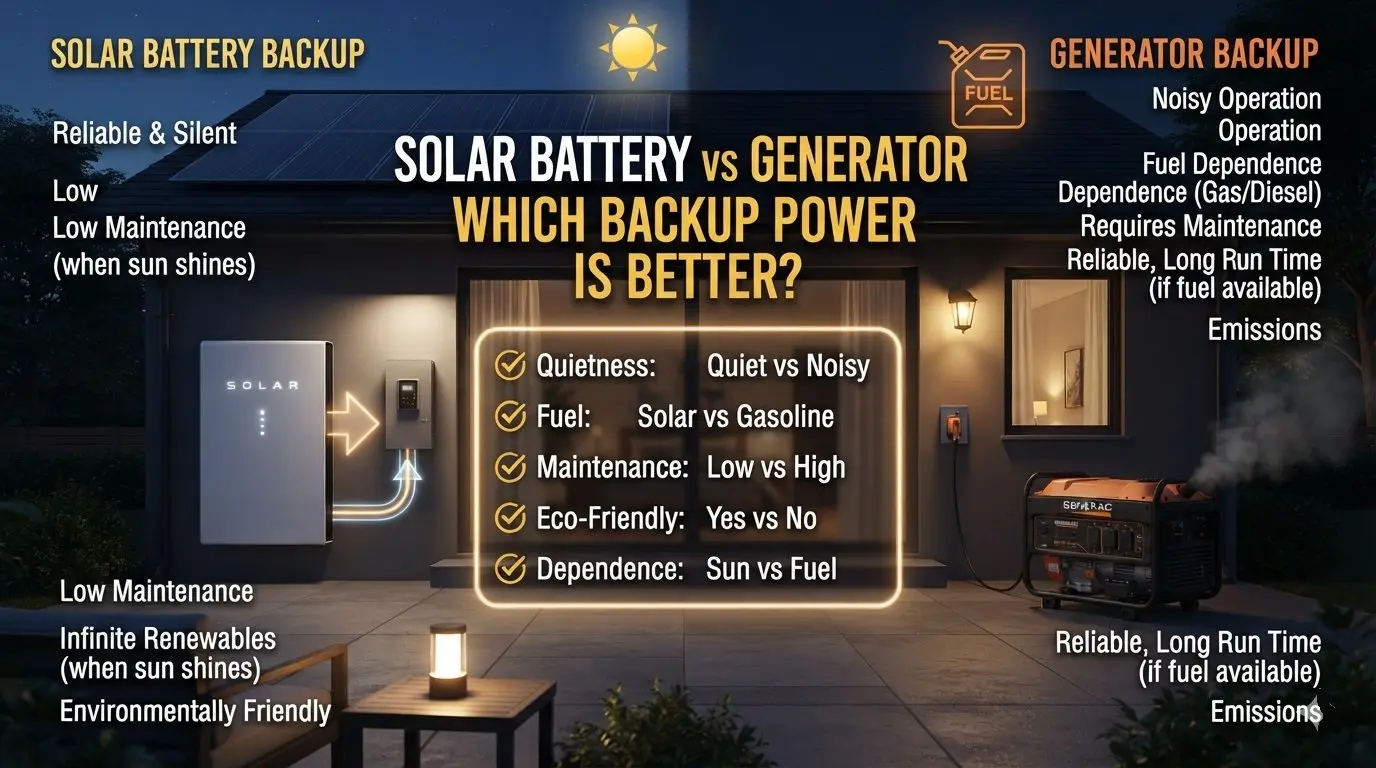
It will depend on your energy requirements, cost, length of time without power, fuel supply and if you already have a solar power system.
Solar batteries can supply low noise, low maintenance power, and are clean, whereas generators can supply power for a longer period of time if sized correctly to provide the required load and fueled by the correct fuel. A hybrid of solar panels, batteries, and a generator may even be the most appropriate choice for many homes and businesses.
What Is a Solar Battery Backup System?
Solar Battery storage system saves electrical energy for future use. The battery is capable of storing extra solar energy during the day, and drawing power from its source when demand is high or solar production is insufficient.
The typical solar battery system consists of:
- Solar panels
- Battery storage
- Hybrid or battery inverter
- Battery management system
- Backup load panel or transfer equipment
The benefits include that solar batteries can be recharged with sunlight. This means that, with a well-designed solar-plus-storage system, during a longer power outage, this combination can generate and store power without dependence on gas or diesel.
Solar batteries are particularly great for homeowners that are seeking to save grid power and have backup power too.
What Is a Generator?
A generator is a piece of equipment that generates electricity from fuel. Most residential generators run off gas or diesel fuel, propane or natural gas.
There are two principle types:
Portable generators are relatively affordable and can power selected appliances or circuits. They usually require manual setup and fuel storage.
Standby generators are permanently installed and can automatically start when the grid fails. Depending on their capacity and fuel supply, they can power many or all household circuits.
Generators are widely used for homes, commercial buildings, construction sites, emergency services, and other applications where reliable power is essential.
Solar Battery vs Generator: Key Differences
The biggest differences between solar batteries and generators involve fuel, operating costs, noise, maintenance, runtime, and environmental impact.
| Feature | Solar Battery | Generator |
|---|---|---|
| Energy source | Stored electricity/solar | Fuel |
| Noise | Nearly silent | Typically noisy |
| Emissions during use | None at point of use | Produces exhaust emissions |
| Maintenance | Low | Regular maintenance required |
| Fuel required | No | Yes |
| Long outage capability | Depends on battery + solar size | Depends on fuel supply |
| Automatic backup | Yes, with proper system | Yes with standby models |
| Solar charging | Yes | No |
| Installation | Professional installation often required | Varies by type |
| Best for | Clean, quiet backup | Long-duration/high-load backup |
Which Is More Reliable During a Power Outage?
System design is a crucial factor in reliability.
When a generator is properly maintained and fueled and is designed to run continuously, it can do so. Generators are especially beneficial for extended power outages, during severe storms or in an emergency.
A solar battery, however, can offer very reliable short time backup without having to be fueled. The battery may charge in the daylight hours, if solar panels are installed.
For instance, a battery from the solar energy could power important loads during the night and charge again during the next day. But clouds, low solar generation and higher electricity use, coupled with limited battery capacity can diminish the amount of backup electricity available.
When making a comparison between solar battery vs generator reliability, you should take into account battery capacity, generator size, solar array size, weather, and the length of time you anticipate being out of power.
Which Has Lower Operating Costs?
Solar batteries generally require less continuous operating needs.
After installation, a solar battery will not need gasoline or diesel to generate electricity. It is also a generator with less mechanical parts than a typical combustion generator.
Ongoing fuel and maintenance expenses on generators. Depending on the type of generator, periodic oil changes, inspections, battery checks, filter changes and engine maintenance may be needed.
But the cost of the solar battery system is generally higher than the upfront cost of installation. Batteries also need to be replaced at some point and have a limited service life.
A solar battery may be appealing for those who want the savings potential of solar power and also reserve stored energy for later use, making it a good option for homeowners who value long-term energy savings.
Which Is Better for Long Power Outages?
Generally, generators are better equipped during extended outages.
If fuel is available, the generator can continue to provide power if it is the correct size. A large stand-by generator can be used for heavy loads like air conditioners, refrigerators, pumps, and other heavy loads.
There's a limit to how much energy solar batteries can store. With battery depletion, power availability is dependent on recharging via solar panels or other power source.
But, a solar-plus-battery system can be very effective during longer power outages due to the fact that solar panels can charge the battery during the day. Energy management becomes relevant: Users might need to prioritize critical loads and minimise unnecessary power use.
Which Is Quieter?
If noise matters, solar batteries come out on top.
Battery storage systems eliminate the need for combustion with no engine noise. This makes them ideal for noise-sensitive locations, such as residential areas, bedrooms, offices, etc.
Generators make mechanical and engine sounds. Today's standby generators are also much louder than battery systems.
When quietness is a critical consideration, solar battery backup is the more typically preferred alternative.
Which Is Better for the Environment?
Solar batteries tend to be less harmful to the environment during operation since they don't burn fuel to produce electricity.
Generators use combustion and as such emit emissions during operation. Environmental impact depends upon the type of fuel used, the efficiency of generator, operating conditions and frequency of use.
Battery systems, however, are not impact free as batteries need raw materials, production, transport and recycling or disposal. However, battery storage combined with renewable solar generation can greatly decrease reliance on fossil-fuel backup generation.
Solar Battery or Generator: Which Should You Choose?
Choose a solar battery if you want:
- Quiet backup power
- Low ongoing maintenance
- No fuel storage
- Clean energy operation
- Integration with solar panels
- Backup power for essential household loads
- Reduced dependence on the electrical grid
Choose a generator if you need:
- Long-duration backup power
- High continuous power output
- A backup solution independent of sunlight
- Reliable operation during extended outages
- Support for large electrical loads
For some users, the ideal solution is a solar battery and generator combination. The battery can handle short outages and daily energy management, while the generator can provide additional power during prolonged emergencies.
Frequently Asked Questions
Is a solar battery better than a generator?
A solar battery is better for quiet, clean, low-maintenance backup power, while a generator is often better for long outages and high electrical loads. The right choice depends on your specific energy requirements.
How long can a solar battery power a house?
Runtime depends on battery capacity, usable energy, household electricity consumption, and which appliances are running. Reducing nonessential loads can significantly extend backup time.
Can a solar battery work without solar panels?
Yes. A battery can store electricity from the grid and provide backup power during an outage. However, without solar panels or another charging source, its backup runtime is limited by its stored energy.
Can solar batteries replace generators?
For many homes, solar batteries can replace generators for short- and medium-duration backup needs. However, generators may remain preferable for extremely long outages or applications requiring large continuous power loads.
Can you use a solar battery and generator together?
Yes. Properly designed systems can combine battery storage, solar panels, and a generator. The generator can serve as an additional backup charging or power source when solar production and battery capacity are insufficient.
Final Verdict
When comparing solar batteries to generators, there is no one that's a clear winner.
Solar battery provides silent, clean, less maintenance backup power and it works well with solar panels. A generator can be a more suitable option for long outages, high power demands and where fuel is easily available.
When considering a backup power solution, consider your critical loads, backup time, space, cost, fuel type, solar energy capacity, and installation needs.
Today, the most versatile approach is not to use one technology over the other, but to use a combination of solar, battery storage, and generator power as needed for the home or business.
Share on Social:


In This Article
- 1 What Is a Solar Battery Backup System?
- 2 What Is a Generator?
- 3 Solar Battery vs Generator: Key Differences
- 4 Which Is More Reliable During a Power Outage?
- 5 Which Has Lower Operating Costs?
- 6 Which Is Better for Long Power Outages?
- 7 Which Is Quieter?
- 8 Which Is Better for the Environment?
- 9 Solar Battery or Generator: Which Should You Choose?
- 10 Frequently Asked Questions
- 11 Final Verdict
