


Hybrid Inverter vs Off-Grid Inverter

One of the most crucial decisions for designing a residential, commercial or industrial solar power system is the selection of the solar inverter. The most common types are hybrid inverters and off-grid inverters. Both can be used with solar panels and batteries; however, they are optimized for different energy strategies and operating conditions.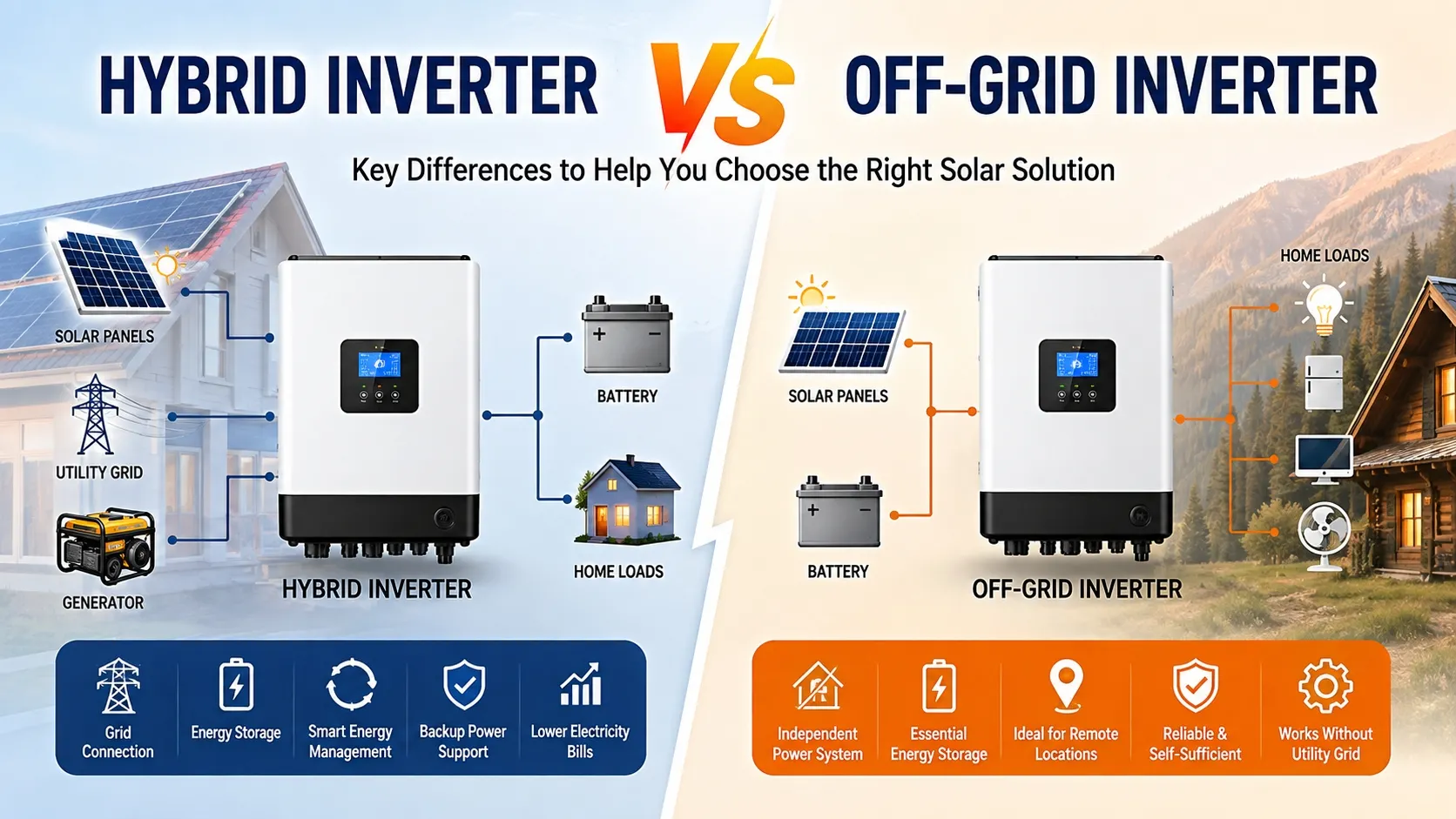
Therefore, what's the difference between a hybrid inverter and an off-grid inverter? A hybrid inverter can control a variety of energy sources (usually solar, batteries, and a utility connection) while an off-grid inverter is mainly used in systems that are not connected to the electrical grid.
By knowing how they work, their benefits, its drawbacks and best uses, you can choose the right inverter for your solar power system.
What Is a Hybrid Inverter?
A hybrid inverter is a multi-functional solar inverter that can control solar panel, battery power and grid power. Supports integrated functionality such as solar energy conversion, battery charging, energy management and grid interaction.
Solar panels produce direct current (DC) electricity during the day. This electricity is then passed to a hybrid inverter which transforms it into AC for use by homes or businesses. If there is an excess of solar energy, it can be stored in a battery to be used at a later time.
If solar energy is not being generated, stored battery energy or energy from the grid can be automatically used as appropriate based on the system design and energy goals.
Key Features of Hybrid Inverters
Common features include:
- Solar PV input
- Battery charging and discharging
- Grid connection
- Automatic energy management
- Backup power capability
- Load prioritization
- Peak shaving and energy arbitrage
- Monitoring and remote management
- Optional generator integration
Because of these capabilities, hybrid inverters are particularly suitable for users who want flexibility and energy independence without completely disconnecting from the utility grid.
What Is an Off-Grid Inverter?
An off-grid inverter is designed for solar systems that operate independently of the utility grid. It converts DC electricity from solar panels and batteries into AC electricity that can power household appliances, equipment, lighting, and other loads.
Unlike a typical grid-connected hybrid system, an off-grid solar system does not depend on the utility grid for normal operation.
A complete off-grid system generally includes:
- Solar panels
- Off-grid inverter
- Battery bank
- Charge controller or integrated MPPT controller
- Electrical loads
- Optional backup generator
The battery is especially important because solar generation changes throughout the day. Energy produced during sunny periods can be stored and used at night or during periods of low solar generation.
Hybrid Inverter vs Off-Grid Inverter: Key Differences
Although both inverter types can support battery storage, their system architecture and intended applications are different.
| Feature | Hybrid Inverter | Off-Grid Inverter |
|---|---|---|
| Grid connection | Usually supported | Usually not required |
| Battery storage | Supported | Essential |
| Solar input | Supported | Supported |
| Backup power | Common | Standard system function |
| Grid export | Often supported | Not applicable |
| Energy management | Advanced | Focused on standalone operation |
| Grid dependence | Flexible | Independent |
| Ideal application | Grid-connected + backup | Remote/off-grid locations |
| System flexibility | High | High for standalone systems |
| Typical complexity | Moderate to high | Moderate |
The most important distinction is grid compatibility. Hybrid inverters can manage energy between solar panels, batteries, loads, and the grid. Off-grid inverters are primarily designed to create and maintain an independent electrical system.
How Does a Hybrid Inverter Work?
A hybrid inverter typically follows a programmed energy-management strategy.
For example, during the daytime:
Solar panels → Hybrid inverter → Home loads
If solar generation exceeds current consumption:
Solar panels → Hybrid inverter → Battery
When solar generation decreases:
Battery → Hybrid inverter → Home loads
If the battery reaches a predefined minimum state of charge, the system may switch to:
Grid → Hybrid inverter → Home loads
Depending on local regulations, inverter configuration, and utility policies, excess solar electricity may also be exported to the grid.
This flexibility allows homeowners and businesses to optimize self-consumption, reduce grid electricity usage, and maintain backup power during outages.
How Does an Off-Grid Inverter Work?
An off-grid inverter operates without relying on the utility grid.
During sunny conditions, solar panels supply electricity to the loads and charge the battery. When solar generation is unavailable or insufficient, the battery supplies energy.
A simplified energy flow is:
Solar panels → Off-grid inverter → Loads
and:
Solar panels → Battery → Off-grid inverter → Loads
When the battery becomes depleted and solar energy is unavailable, an optional generator may provide backup power.
Because there is no utility grid available to stabilize voltage and frequency, the off-grid inverter must manage the standalone electrical network itself. This makes inverter sizing and battery capacity particularly important.
Advantages of Hybrid Inverters
1. Greater Energy Flexibility
Hybrid inverters can combine solar, battery, and grid electricity. Users can choose how energy should be prioritized according to their needs.
2. Backup Power
Many hybrid systems can provide backup electricity when the utility grid fails. This is valuable for homes, offices, stores, and other facilities that require continuous power.
3. Higher Solar Self-Consumption
Instead of sending excess solar energy immediately to the grid, a hybrid system can store it in batteries and use it later.
4. Advanced Energy Management
Modern hybrid inverters can support functions such as time-of-use optimization, peak shaving, battery scheduling, and load management.
5. Easier System Expansion
For users who want to start with solar and add batteries later, a compatible hybrid inverter can provide a practical foundation for future energy storage.
Advantages of Off-Grid Inverters
1. Complete Energy Independence
Off-grid systems can provide electricity in locations where utility power is unavailable or unreliable.
2. Ideal for Remote Locations
Cabins, farms, telecommunications facilities, remote work sites, and rural properties can benefit from standalone solar systems.
3. No Utility Grid Required
An off-grid inverter does not need the electrical grid to operate. This makes it suitable for locations where grid connection is too expensive or impossible.
4. Designed for Standalone Operation
Off-grid inverters are specifically engineered to create an independent AC power supply and coordinate with batteries and solar generation.
Which Is Better: Hybrid or Off-Grid Inverter?
There is no universal winner. The best choice depends on your energy goals and location.
Choose a hybrid inverter if:
- Your property has access to the utility grid.
- You want solar + battery storage.
- You need backup power during outages.
- You want to reduce electricity bills.
- You want to maximize solar self-consumption.
- You may want grid interaction in the future.
Choose an off-grid inverter if:
- Your property has no utility connection.
- Grid electricity is unavailable or impractical.
- You want a completely standalone solar system.
- You are powering a remote home, farm, cabin, or worksite.
- You are prepared to size the battery system for extended periods of low solar production.
What Should You Consider Before Buying?
Inverter Capacity
Calculate the total continuous and peak power requirements of your appliances. Motors, pumps, refrigerators, and air conditioners can require significantly more starting power than their normal operating consumption.
Battery Capacity
For off-grid systems, battery sizing is especially critical. Consider daily energy consumption, desired backup duration, battery depth of discharge, and expected solar production.
Solar PV Capacity
Check the inverter's maximum PV input voltage, current, and allowable solar array capacity. Oversizing or incorrectly configuring the PV array can reduce performance or damage equipment.
Backup Requirements
If backup power is important, check whether the inverter supports automatic transfer, backup outputs, and the required load capacity.
System Compatibility
Ensure that the inverter is compatible with your battery chemistry, battery management system, solar panels, monitoring platform, and other equipment.
Local Regulations
Grid-connected hybrid systems may be subject to local electrical codes, utility requirements, and interconnection rules. Always verify applicable requirements before installation.
Hybrid Inverter vs Off-Grid Inverter: Final Verdict
The primary difference between hybrid inverter and off-grid inverter is that off-grid inverter operates in an environment completely isolated from the electrical grid while hybrid inverter works with the electrical grid.
The hybrid inverter is more flexible as it controls both solar energy, batteries, home loads and the power grid. This is usually the preferred option for properties that have a power grid connection and need the flexibility and control to use the energy.
The off-grid inverter is, however, designed for off-grid solar power systems. When there's no grid electricity or full energy independence is the goal, it's the better option.
In simple terms:
Hybrid Inverter = Solar inverter + Battery Inverter + Grid + Backup
Off grid inverter = Solar + Battery + Stand alone Power
The first step to choosing an inverter is to assess the usage of electricity, solar potential, what kind of battery you would need, how long you want to be able to power the house when the grid goes out and what electrical services are available. Selecting the proper inverter architecture can optimize system reliability, energy efficiency and maximize solar investment.
Share on Social:


In This Article
- 1 What Is a Hybrid Inverter?
- 2 What Is an Off-Grid Inverter?
- 3 Hybrid Inverter vs Off-Grid Inverter: Key Differences
- 4 How Does a Hybrid Inverter Work?
- 5 How Does an Off-Grid Inverter Work?
- 6 Advantages of Hybrid Inverters
- 7 Advantages of Off-Grid Inverters
- 8 Which Is Better: Hybrid or Off-Grid Inverter?
- 9 What Should You Consider Before Buying?
- 10 Hybrid Inverter vs Off-Grid Inverter: Final Verdict
