


Whole House Solar System
A whole house solar system enables residents to create solar power from the sun and use it to run their daily domestic appliances. The use of solar energy can lower electric bills, enhance energy independence, and serve as a back-up power source in the event of an electric outage, depending on the system design.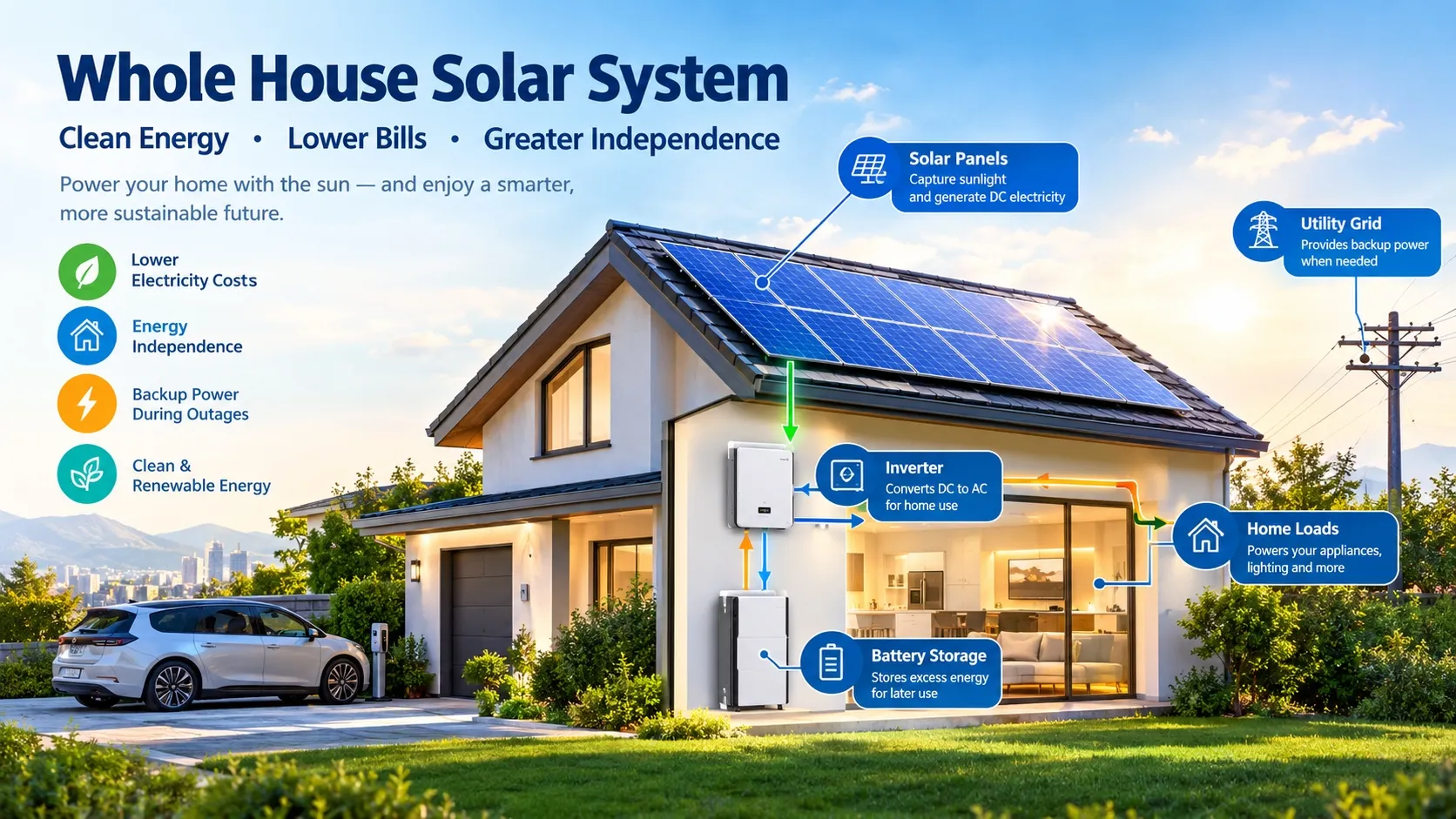
In the modern era, all solar array components, its inverter, battery storage, monitoring and electrical protection components can be integrated into a single solar electrical energy solution for the home. But when selecting the appropriate system, it isn't just about the number of solar panels. Everything from the amount of energy used in the home to the condition of the roof up to the local sun's angle, battery capacity, inverter size and what the home expects from the energy will be taken into consideration.
The purpose of this guide is to explain how a whole house solar system works, the components required and how to size the system, and things homeowners should consider prior to installation.
What Is a Whole House Solar System?
Whole House Solar System: A solar power system used in a residence that generates electricity for a significant part and/or a large number of electrical appliances.
A whole home system is usually sized based on the total energy used in the home, rather than a small solar system for a few appliances. Can run on standard loads like:
- Refrigerators and freezers
- Air conditioning and heating systems
- Lighting
- Washing machines and dryers
- Kitchen appliances
- TVs and computers
- Water heaters
- Electric vehicle chargers
- Home security systems
It can be a grid-tied, off-grid or hybrid system. In a grid-tied system, the energy is fed into the electricity grid, and in an off-grid system, it is generated independently. A hybrid solar system is a combination of grid connection and battery storage, providing flexibility and backup power.
How Does a Whole House Solar System Work?
The basic process is straightforward.
Sunlight is first converted to direct-current (DC) electricity by solar panels. An inverter then converts the DC electric power to alternating (AC) electric power that is usable by household appliances.
For the daytime period, solar energy is typically provided to meet the home's electrical loads first. Excess energy may be stored in batteries or exported to the electrical grid, as allowed by local electric utility regulations and configuration.
When the solar panels are not generating electricity during the night, the home can consume power from the battery storage or utility grid.
A well-designed lighting system, using battery storage and suitable back-up power devices, can keep power to selected circuits or to the entire home during a power out. An ordinary grid-tied solar system that is not equipped with the proper back-up power system will not run properly during a power outage.
Main Components of a Whole Home Solar System
1. Solar Panels
Solar panels are the primary energy-generation component. Their total capacity is measured in kilowatts (kW).
The number of panels required depends on factors such as:
- Annual household electricity consumption
- Local solar irradiance
- Roof orientation and tilt
- Shading
- Panel efficiency
- Available roof area
High-efficiency monocrystalline panels can be useful when roof space is limited because they can generate more electricity from a given installation area.
2. Solar Inverter
The inverter is another critical component. It converts the DC electricity generated by solar panels into AC electricity for household use.
Depending on the design, homeowners may choose a string inverter, microinverters, or a hybrid inverter.
For systems that include batteries, a compatible hybrid inverter or battery inverter can manage electricity flowing between the solar array, battery, home, and grid.
3. Solar Battery Storage
Battery storage allows excess solar electricity to be saved for later use.
This can be especially useful for homeowners who want to:
- Use solar energy at night
- Reduce dependence on grid electricity
- Maintain essential appliances during outages
- Increase self-consumption of solar energy
- Create a more resilient home energy system
Battery capacity is usually measured in kilowatt-hours (kWh). The appropriate capacity depends on household consumption, backup requirements, and which appliances need to remain operational during an outage.
4. Mounting and Electrical Equipment
A complete installation also requires mounting structures, wiring, disconnects, protection equipment, meters, and other balance-of-system components.
Proper electrical design is important because a whole-house solar installation must safely handle significant amounts of DC and AC power.
How Large Should a Whole House Solar System Be?
There is no single solar system size that works for every home.
The best starting point is your actual electricity consumption. Review at least 12 months of utility bills and determine your annual kWh usage.
A simplified sizing concept is:
Solar System Size = Annual Electricity Consumption ÷ Expected Annual Solar Production per kW
For example, if a home consumes approximately 12,000 kWh per year and each installed kW is expected to generate around 1,300 kWh annually, the estimated system size would be approximately:
12,000 ÷ 1,300 ≈ 9.2 kW
This is only a preliminary estimate. Roof orientation, shading, weather, panel efficiency, inverter losses, and local solar conditions can significantly affect actual production.
A professional solar assessment should therefore be used before finalizing system capacity. ItekEnergy also emphasizes customized system design based on individual property and energy requirements.
Do You Need Batteries for a Whole House Solar System?
Not necessarily.
A grid-connected solar system can operate without batteries. In this configuration, solar electricity powers the home during the day, while the grid supplies electricity when solar production is insufficient.
However, batteries become important when backup power and energy independence are priorities.
For example, a homeowner may install a battery system to keep refrigerators, lights, internet equipment, medical devices, security systems, or heating and cooling equipment operating during an outage.
The amount of battery storage required depends on whether the goal is:
- Critical-load backup
- Several hours of backup
- Overnight energy storage
- Full-home backup
- Extended off-grid operation
A system designed for whole-home backup generally requires more battery capacity and inverter power than a system designed only for essential circuits.
Whole House Solar System: Grid-Tied vs. Hybrid vs. Off-Grid
Choosing the right architecture is an important part of solar planning.
Grid-tied solar:
The system remains connected to the utility grid. It can reduce grid electricity consumption, but a conventional grid-tied system may shut down during a utility outage.
Hybrid solar:
Solar panels, batteries, and the utility grid work together. This configuration provides greater flexibility and can provide backup power when properly designed.
Off-grid solar:
The property operates independently from the utility grid. Because there is no grid available as a backup source, sufficient solar generation and battery storage are especially important.
For most homeowners who want both solar savings and outage protection, a properly designed hybrid configuration can provide a practical combination of grid connectivity, solar generation, and battery backup.
Benefits of a Whole House Solar System
A properly sized residential solar system can provide several potential benefits.
Lower Electricity Costs
Generating electricity from sunlight can reduce the amount of electricity purchased from the utility.
Greater Energy Independence
Solar generation allows homeowners to produce part of their own electricity instead of relying entirely on the grid.
Backup Power
When combined with appropriately sized batteries and backup equipment, solar can help keep important household loads operating during outages.
Renewable Energy
Solar power generates electricity without directly burning fossil fuels during operation, making it an important renewable energy technology.
Long-Term Energy Planning
A well-designed system can be expanded with additional battery storage or solar capacity when household energy requirements change, provided the original system architecture supports expansion.
What to Consider Before Installing Solar
Before purchasing a whole house solar system, homeowners should evaluate several factors.
Energy consumption: Review historical electricity bills instead of estimating usage based only on home size.
Roof condition: Solar panels can remain installed for decades, so the roof should be evaluated before installation.
Sun exposure: Trees, neighboring buildings, roof orientation, and shading can affect solar production.
Battery requirements: Determine whether you need simple solar savings, critical-load backup, or whole-home backup.
Inverter capacity: The inverter must be capable of handling the expected continuous and peak electrical loads.
Local regulations: Permits, utility interconnection requirements, electrical codes, and available incentives vary by location.
Installation quality: A qualified solar installer should perform a site assessment, electrical design, permitting, installation, and system commissioning.
Is a Whole House Solar System Worth Considering?
A whole house solar system is not just a set of solar panels, it is an investment in energy. The appropriate answer is determined by the level of electricity use, property attributes, budget, back-up needs and utility conditions in the area.
If homeowners want to save mainly on their use of electricity from the grid, they might be satisfied with a grid-connected system. If you have additional energy needs, like backup power, a battery storage system or hybrid architecture might serve your needs more effectively. Those homes that do not have a solid connection to the grid may need to be sited with a bigger solar and battery setup.
The essential is to make each of them a part of one system. Solar panels, batteries, inverters, electrical equipment and electrical loads should be considered together.
Using a whole-house energy assessment, you can design a solar solution around your home's solar potential and energy needs, including backup options.
Share on Social:


In This Article
- 1 What Is a Whole House Solar System?
- 2 Main Components of a Whole Home Solar System
- 3 How Large Should a Whole House Solar System Be?
- 4 Do You Need Batteries for a Whole House Solar System?
- 5 Whole House Solar System: Grid-Tied vs. Hybrid vs. Off-Grid
- 6 Benefits of a Whole House Solar System
- 7 What to Consider Before Installing Solar
- 8 Is a Whole House Solar System Worth Considering?
