


Types of Solar Inverters: String, Micro & Hybrid Guide
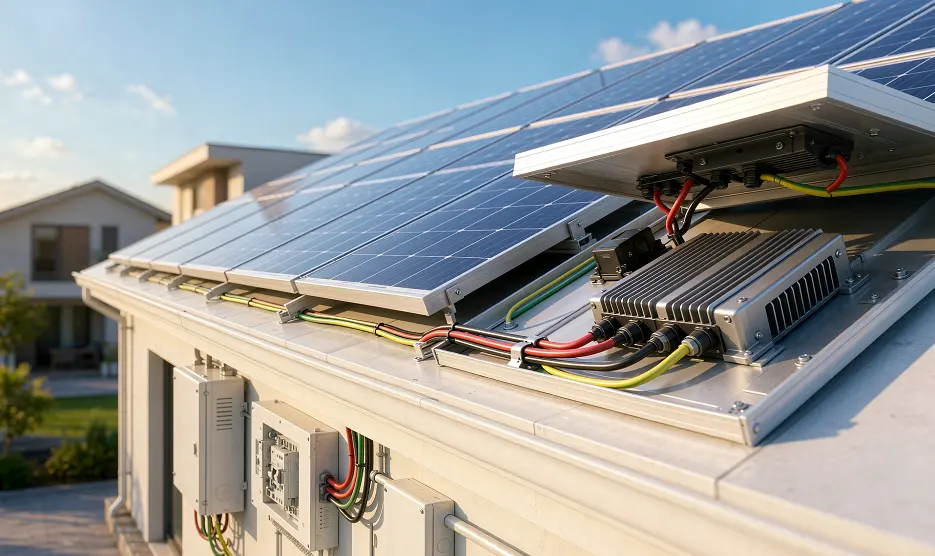
This is because solar panels produce electricity from sunlight and the majority of household appliances are powered by electricity. PV panels generate direct current (DC) electricity and homes and businesses use alternating current (AC). That's where a solar inverter plays a role.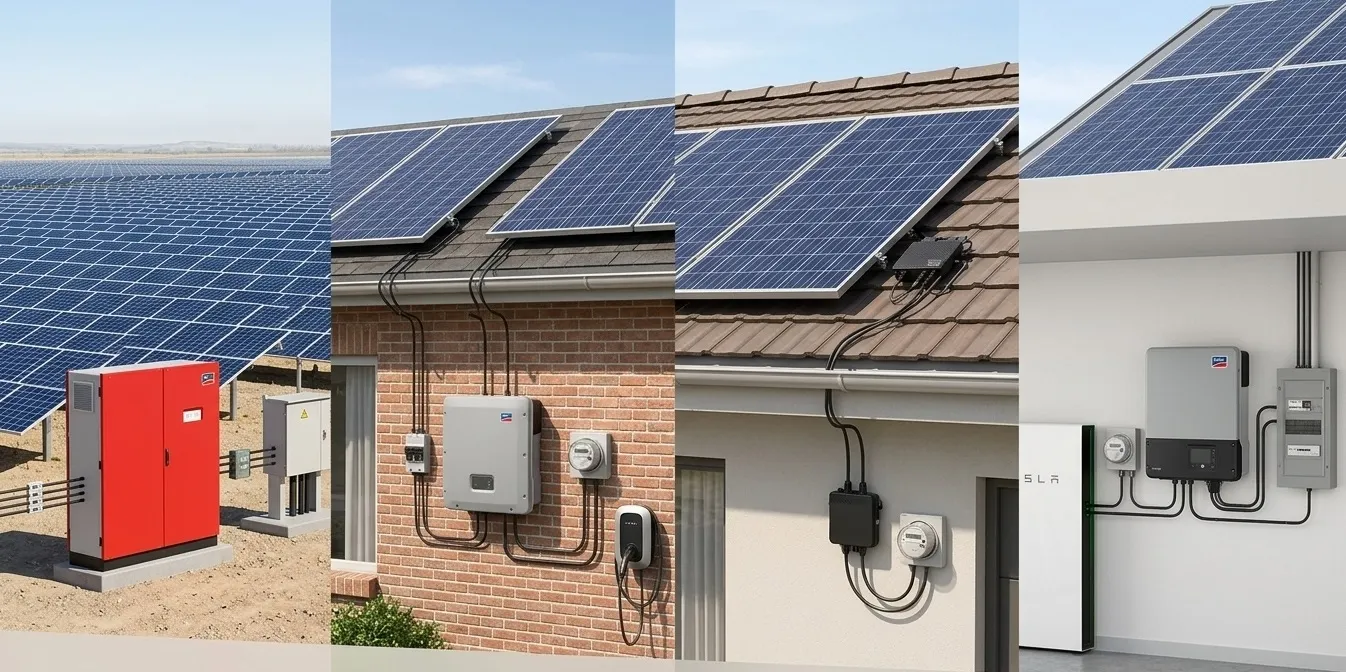
A solar inverter transforms the direct current (DC) energy generated by the solar panels into alternating current (AC) energy, and assists in monitoring the flow of solar energy from the PV system to electrical loads and battery storage.
But not all solar inverter function the same. The main types of solar inverters include string inverters, microinverters, and hybrid inverters. There are pros and cons, limitations and costs for each technology and some applications are more suited than others.
The selection of the appropriate solar inverter will rely on the roof's layout, the shading conditions, the solar system size, the energy usage, battery storage needs, and potential future expansion plans.
What Is a Solar Inverter?
One of the most crucial parts of a photovoltaic system is the solar inverter. It is mainly used to convert the direct current (DC) power produced by the solar panels to alternating current (AC) power which can then be applied to electric motors or sent to the electrical grid for use.
Today's solar inverters may offer other features such as:
- Maximum power point tracking (MPPT)
- Grid synchronization
- Solar system monitoring
- Energy management
- Battery charging and discharging
- Backup power control
- Fault detection and protection
The inverter type determines how solar panels are connected and how efficiently the system responds to shading, different roof orientations, battery storage, and changing energy demands.
The 3 Main Types of Solar Inverters
For residential and many commercial solar applications, three inverter technologies are particularly important:
- String inverters
- Microinverters
- Hybrid inverters
Although all three convert solar DC power into AC electricity, their system architecture is different.
1. String Inverters
A string inverter connects multiple solar panels together in a series, creating a PV string. The DC electricity generated by the panels is sent to a centralized inverter, which converts it into AC electricity.
String inverters are one of the most widely used solar inverter technologies because they offer a relatively simple system design and can be cost-effective for suitable installations.
How Do String Inverters Work?
Several solar panels are connected in a string. The electricity produced by the panels travels through the string to the inverter.
For example, a residential solar system may contain several strings connected to one or more string inverters. The inverter then converts the combined DC power into AC electricity for household consumption or grid export.
Advantages of String Inverters
- Generally lower equipment cost
- Simple system architecture
- Easier centralized maintenance
- Suitable for large and straightforward PV installations
- Proven and widely adopted technology
- High conversion efficiency in appropriate conditions
Limitations of String Inverters
The main consideration is that panels in the same string are electrically connected. If one or more panels experience significant shading, dirt, or different operating conditions, the performance of the affected string can be reduced.
Therefore, string inverters are particularly suitable for roofs with consistent sunlight and similar panel orientations.
Best Applications
String inverters are often suitable for:
- Unshaded residential roofs
- Commercial rooftops
- Large solar installations
- Ground-mounted solar systems
- Projects where cost efficiency is a major consideration
2. Microinverters
A microinverter is a small inverter installed at the individual solar-panel level. Instead of sending DC electricity from multiple panels to one central inverter, each panel can convert its own electricity from DC to AC.
This distributed architecture allows each solar panel to operate more independently.
How Do Microinverters Work?
With a microinverter system, each solar panel is connected to its own microinverter or a multi-panel microinverter.
The DC electricity generated by the panel is converted into AC electricity locally. The AC electricity is then combined and supplied to the building's electrical system.
This design is especially useful when panels receive different amounts of sunlight.
Advantages of Microinverters
Panel-level optimization: Each panel can operate independently, reducing the impact of performance differences between panels.
Better performance under partial shading: If one panel is shaded, other panels can continue operating without being directly limited by that panel.
Panel-level monitoring: Many microinverter systems allow users and installers to monitor individual panel performance.
Flexible roof design: Microinverters can work well with roofs containing multiple orientations, roof sections, or complex layouts.
Lower rooftop DC voltage: Because DC-to-AC conversion occurs close to the panels, microinverter systems can reduce the amount of high-voltage DC wiring within the building.
Limitations of Microinverters
The main disadvantage is typically a higher upfront equipment cost compared with a conventional centralized string inverter system.
Because microinverters are installed on or near the roof, maintenance may also require rooftop access if an individual unit needs replacement.
Best Applications
Microinverters can be particularly useful for:
- Roofs with partial shading
- Multiple roof orientations
- Complex residential rooftops
- Installations with different panel angles
- Systems where detailed panel-level monitoring is important
3. Hybrid Inverters
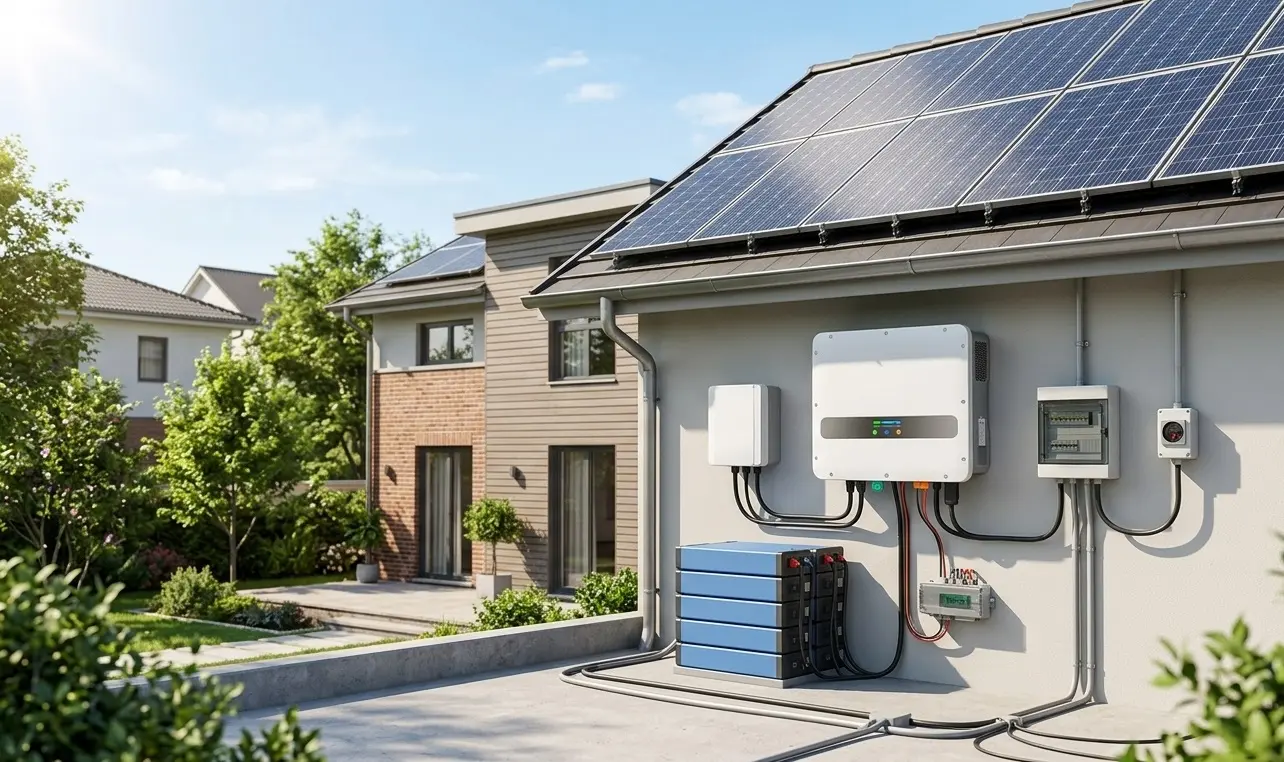
A hybrid inverter combines solar power conversion with battery energy management. It can coordinate electricity from solar panels, batteries, the grid, and household loads within one energy management system.
Hybrid inverters are increasingly important as more homeowners and businesses combine solar PV with battery storage.
A hybrid inverter can convert solar DC power into AC electricity while also managing battery charging and discharging.
How Does a Hybrid Inverter Work?
During sunny periods, solar panels generate electricity. The hybrid inverter can distribute that electricity according to the system's energy requirements.
Depending on the system configuration, solar energy may be:
- Used directly by household or commercial loads
- Stored in a battery
- Exported to the grid
- Used in a combination of these ways
When solar production decreases, stored battery energy can be used to supply loads.
This makes hybrid inverters particularly attractive for users who want to increase self-consumption, add energy storage, or prepare for backup power.
Advantages of Hybrid Inverters
- Integrates solar and battery storage
- Supports intelligent energy management
- Can increase solar self-consumption
- Suitable for backup power applications
- Simplifies future battery integration
- Can coordinate grid, solar, battery, and loads
Limitations of Hybrid Inverters
Hybrid systems can have a higher initial cost than solar-only systems because they are designed to support additional energy-storage functions.
System compatibility is also important. The inverter, battery, electrical loads, and backup configuration must be properly matched.
Best Applications
Hybrid inverters are suitable for:
- Homes with solar batteries
- Businesses requiring energy storage
- Areas with frequent power interruptions
- Users seeking greater energy independence
- Solar systems designed for future battery expansion
String Inverter vs Microinverter vs Hybrid Inverter
Choosing between different types of solar inverters becomes easier when the main differences are understood.
| Feature | String Inverter | Microinverter | Hybrid Inverter |
|---|---|---|---|
| Installation | Centralized | Panel-level | Centralized energy hub |
| Panel optimization | String-level | Panel-level | System-level |
| Shading tolerance | Moderate to low | High | Depends on PV architecture |
| Battery integration | Depends on model | Usually requires additional equipment | Designed for battery integration |
| Monitoring | System/string level | Panel level | System and energy level |
| Initial cost | Generally lower | Generally higher | Varies |
| Best suited for | Simple roofs | Complex or shaded roofs | Solar + storage systems |
There is no single inverter type that is ideal for every solar project. The right choice depends on the physical characteristics of the installation and the user's energy objectives.
How to Choose the Right Solar Inverter
When selecting a solar inverter, consider these key factors.
1. Roof Design
A simple roof with the same orientation and little shading may work well with a string inverter.
A roof with multiple orientations, roof sections, or changing sunlight conditions may benefit from panel-level power electronics.
2. Shading
Shading from trees, buildings, chimneys, or other structures can affect solar production.
If significant partial shading is present, microinverters or other module-level optimization technologies may be worth considering.
3. Battery Storage
If you plan to install a battery now or in the future, a hybrid inverter can simplify system integration.
Before purchasing, check battery compatibility, voltage ranges, power ratings, and backup functionality.
4. System Size
Residential, commercial, and utility-scale systems have different inverter requirements.
For larger installations, centralized or string inverter architectures may provide practical advantages in terms of system design and maintenance.
5. Monitoring Requirements
If you want to identify the performance of individual solar panels, microinverters can provide more granular monitoring.
For simpler systems, string-level monitoring may provide sufficient information.
6. Budget
The cheapest inverter is not necessarily the lowest-cost solution over the entire system lifetime.
Consider installation costs, maintenance, energy production, warranty coverage, battery compatibility, and potential future upgrades.
What Is the Most Efficient Type of Solar Inverter?
Solar inverter efficiency should not be evaluated using the efficiency rating alone.
String inverters can achieve very high conversion efficiencies under suitable operating conditions, while microinverters can provide advantages when individual panels receive different levels of sunlight. Hybrid inverters add battery-management capabilities while maintaining high conversion efficiency.
In real-world applications, system design and environmental conditions can be just as important as the inverter's rated efficiency.
For example, a highly efficient string inverter may not deliver the expected system-level production if multiple panels are heavily shaded. Conversely, panel-level optimization can help maintain production when panels experience different operating conditions.
Solar Inverter Lifespan and Maintenance
Solar inverter lifespan varies by technology, manufacturer, operating environment, and installation quality.
A typical string or hybrid inverter may need replacement before the solar panels reach the end of their useful life. Microinverters can have different warranty and lifespan characteristics depending on the manufacturer and model.
Regular monitoring is important because it can help identify:
- Unexpected drops in energy production
- Communication problems
- Temperature-related issues
- Grid faults
- Individual panel performance problems
- Battery or charging issues
Selecting an inverter with appropriate protection, monitoring, warranty coverage, and technical support can improve the long-term reliability of a solar PV system.
Frequently Asked Questions
What are the main types of solar inverters?
For most home installations there are three types of inverters; string inverters, micro-inverters, and hybrid inverters. There are three types of string Inverters, microinverters and hybrid inverters, with the former two being built at the panel level and the latter hybrid combining solar conversion and battery energy management.
Are microinverters better than string inverters?
They have been created for different system conditions. For a shaded or complex roof, microinverters may be beneficial due to their ability to allow higher independence of individual panels. An inverter for strings may be a viable option for a flat roof with uniform sunlight.
What is a hybrid solar inverter?
A hybrid solar inverter combines solar power conversion and battery energy management. It can coordinate solar generation, battery storage, household loads, and grid electricity.
Can a solar inverter work without batteries?
Yes. There are numerous solar PV systems that are not battery based. A solar-only string inverter or microinverter will provide power to the loads and, when allowed by the regulations, the excess power will be fed into the grid.
Which solar inverter should I choose?
This depends on the nature of your roof layout, shading, system size, energy usage, budget, battery plans, and backup needs. These should be considered by a qualified solar installer when deciding on the inverter to install.
Conclusion
When planning a dependable and efficient solar power system, it is crucial to understand the various kinds of solar inverters.
Simple PV systems with uniform illumination are good candidates for string inverters. Microinverter for panel-level power conversion and for shaded or complex rooftops can be beneficial. Hybrid inverters are designed for solar + battery + advanced energy management systems.
Consider the entire solar system instead of just the inverter – roof conditions, energy needs, battery plans, monitoring, installation cost and long term expansion.
The correct inverter design can maximize the use of available sunlight, and create a solid basis for future energy storage and energy-management technologies.
Share on Social:


- NEXT: Micro Inverter Solar System
- NEXT: Null
In This Article
- 1 What Is a Solar Inverter?
- 2 The 3 Main Types of Solar Inverters
- 3 2. Microinverters
- 4 3. Hybrid Inverters
- 5 String Inverter vs Microinverter vs Hybrid Inverter
- 6 How to Choose the Right Solar Inverter
- 7 What Is the Most Efficient Type of Solar Inverter?
- 8 Solar Inverter Lifespan and Maintenance
- 9 Frequently Asked Questions
- 10 Conclusion
